
Categories
Home Buying TipsPublished October 26, 2026
Five Reasons Buyers Think They Won't Qualify for a Mortgage


Executive Summary
You may be closer to qualifying for a mortgage than you think. I've spent 12 years working with buyers across the Philadelphia area, and many first-time buyers rule themselves out before they ever talk to a lender. Credit scores in the 500s can qualify in some circumstances, several loan programs require far less than 20% down, and student loans or self-employment don't automatically disqualify you. The real question isn't whether you think you qualify. It's what your actual numbers say.
If you're putting off buying a home because you're pretty sure you won't qualify, you're in good company. That same fear comes up for many first-time buyers we talk to.
Maybe you think your credit isn't good enough. You don't have 20% saved. Your student loan balance looks enormous. Or someone in your family had a difficult experience buying a home, and you've assumed the same rules apply to you.
I've spent 12 years in mortgage lending, and I've had this conversation with first-time buyers over and over again. Often, when we actually look at credit, income, debt, and available funds, buyers are in a much better position than they thought. And when they're not ready yet, we can usually identify what needs to change and build a plan for the next three, six, nine, or 12 months.
That's why we don't recommend you trying to decide for yourself whether you qualify. Finding that out is the point of talking to a lender.
Here are the five misconceptions we hear most often, and what lenders actually look at instead.
Myth vs. Reality at a Glance
| What Buyers Assume | What's Actually True |
|---|---|
| My credit score isn't high enough | Scores in the high 500s and 600s get approved, depending on the rest of your financial picture. |
| I need 20% down to buy a home | Some loan programs require as little as 3% to 3.5% down; VA and USDA loans may require no down payment. |
| My student loans will disqualify me | Lenders look at the monthly payment used for qualification, not how much you owe. |
| I have too much debt to qualify | Lenders look at your monthly obligations compared with your gross income, not just your total debt. |
| Self-employed or gig workers can't get approved | Bank statement, P&L loans, and asset-based programs provide other ways to document qualifying income. |
Can You Qualify for a Mortgage With a Low Credit Score?
We recently worked with a buyer who was approved with a 560 credit score because they had strong reserves and manageable debt. Scores around 640 are typically enough for grant funds or first-time buyer programs, with at least one program going as low as 600.
For a deeper look at the numbers and what to do if you're below them, read What Credit Score Do You Need to Buy a House in Pennsylvania? For this article, the short version is simple: a lower score is a starting point for a conversation, not a closed door.
Do You Need 20% Down to Buy a Home?
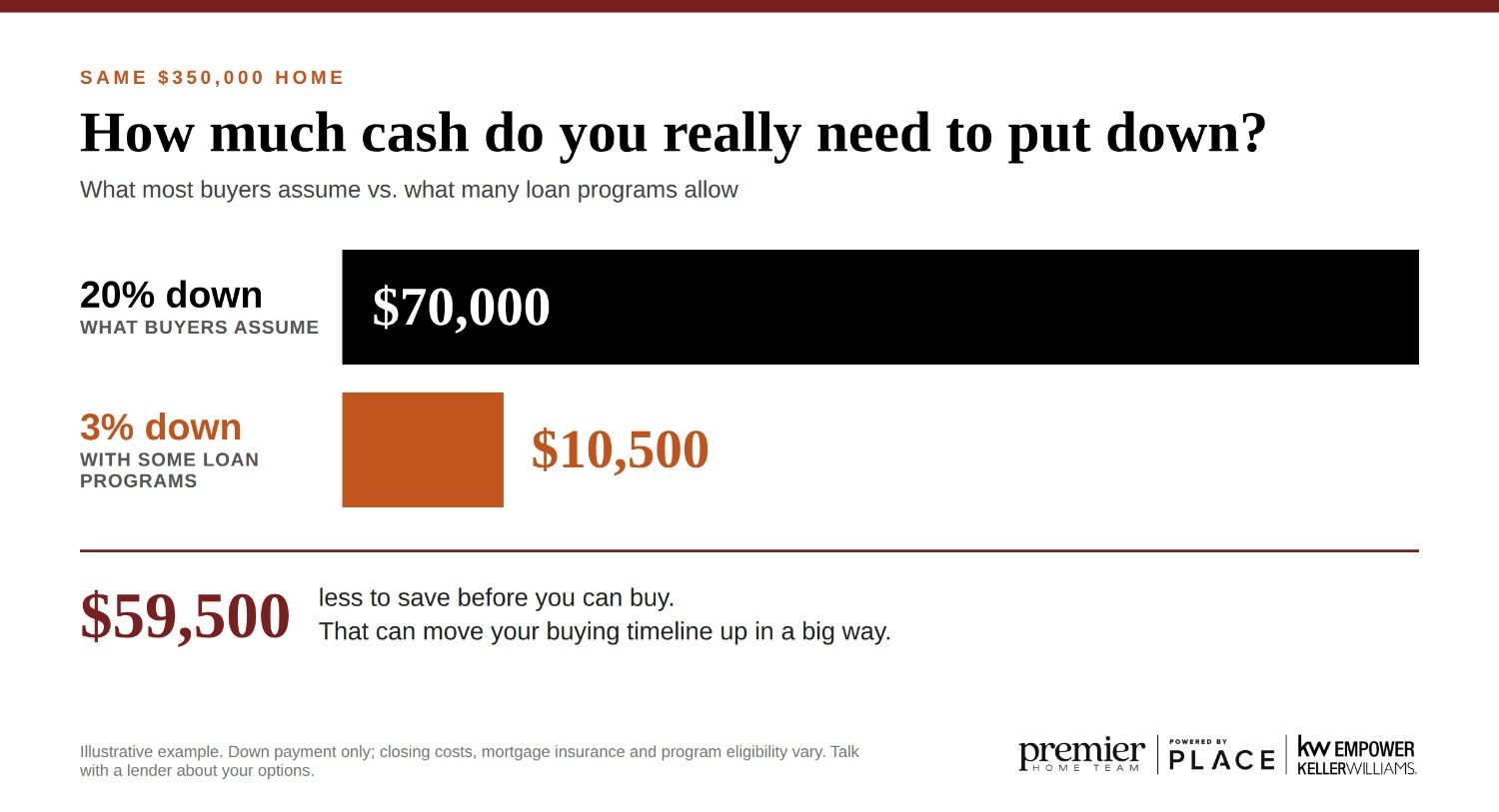
The belief that you need 20 percent down comes up often with first-time buyers, and it can cause people to put off buying while they save far more than they may actually need. Most of the buyers we work with today put down far less.
| Loan Type | Typical Minimum Down Payment |
|---|---|
| Conventional (first-time buyer, or household income under 80% of area median) | 3% |
| Conventional (standard) | 5% |
| FHA | 3.5% |
| VA / USDA | No down payment required |
On a $350,000 home, a 3 percent down payment works out to roughly $10,500, a very different number than the $70,000 most buyers assume they need to save first.
Buyers who don't have enough saved for the down payment may also have assistance options available. Learn how down payment assistance programs work in Pennsylvania.
Will Student Loans Keep You From Qualifying for a Mortgage?
Honestly, pretty much everyone we work with qualifies with student loan debt. It rarely even registers as an issue when we’re reviewing a file.
The reason is that lenders don't count your full loan balance against you. Depending on the loan program and how your student loans are reporting, we may use your documented monthly payment or a calculation based on your outstanding balance. If you owe $50,000 in student loans, for example, we might only be counting around $250 a month against you in the math, not the full balance.
If student loans are the reason you think you won't qualify, read How Student Loans Affect Your Ability to Qualify for a Mortgage for a closer look at how lenders calculate that debt and how it affects what you can qualify for.
Deferred loans and income-driven repayment plans still count, but neither one is an automatic disqualifier.
Do You Have Too Much Debt to Qualify for a Mortgage?
This myth usually comes from a misunderstanding of what we’re actually measuring. It's not your total debt. It's your debt-to-income ratio, or DTI, which compares your monthly obligations (things like auto payments, credit card minimums, student loan payments, and your new mortgage payment) against your gross monthly income before taxes.
| Loan Type | Typical Maximum DTI |
|---|---|
| Conventional | Around 50% |
| FHA | Up to 56.99% (with a separate, lower cap on the housing portion alone) |
| USDA | 43% |
| VA | No fixed cap; uses a residual income calculation instead |
These figures reflect general lending guidelines at the time of publication. DTI limits and approval requirements can vary by loan program, borrower, and lender.
A DTI in the 30 percent range is generally considered strong. One detail that surprises a lot of buyers: buy now, pay later apps count too. If a recurring payment for something like Klarna shows up on your bank statements, we have to factor it into your DTI just like a credit card payment.
If your DTI is too high, the solution usually comes down to increasing qualifying income, adding a co-signer when appropriate, or paying down existing debt before applying.
Can You Qualify Without Traditional W-2 Income?
There are more programs for self-employed borrowers than many buyers realize. Bank statement loans calculate income from your actual deposits rather than your tax return. Profit and loss statement loans use your P&L, backed up by a few months of bank statements. For retirees or high-net-worth buyers without a regular paycheck, asset depletion programs can turn savings into qualifying income on paper.
We worked with a client who had about $2 million in an investment portfolio and qualified for meaningful income under this calculation without pulling a dollar out of the account. For buyers just starting retirement distributions, a letter from a CPA or financial advisor confirming the plan can often be used the same way, as long as the funds are projected to last three years.
Find Out Where You Stand Before You Rule Yourself Out
Credit, savings, student loans, debt, and nontraditional income can all affect whether you qualify for a mortgage. But none of them, on their own, tell you the answer.
We recently worked with an active-duty service member who assumed their income wouldn't be enough to qualify. What they didn't realize was that their housing allowance could count as qualifying income. Once that was factored in, they were comfortably within the price range they wanted.
That's why the smartest next step isn't waiting until you think you're ready. It's finding out where you actually stand.
You may be ready to buy now. If you're not, a lender can help you identify what needs to change and whether you're looking at a three-, six-, nine-, or 12-month plan instead.
The best way to find out is to talk to a lender before you start looking at homes. Premier Home Team’s home financing resources can connect you with a lender who can look at your actual numbers and help you understand where you stand.
Frequently Asked Questions
What's the lowest credit score that can still get approved?
There's no single cutoff. We've seen approvals in the high 500s when the buyer had solid reserves and a manageable debt load, and scores around 640 typically open up grant and first-time buyer programs.
Do buy now, pay later payments really affect my mortgage approval?
Yes. If a recurring payment for something like Klarna shows up on your bank statements, it can count as part of your monthly debt, just like a credit card or auto payment.
Do deferred or income-driven student loan payments still count against me?
Yes, but how they're calculated depends on the loan program and how the payment is documented. Neither deferment nor an income-driven plan is an automatic disqualifier.
Should I fix my finances first or talk to a lender now?
Talk to a lender first. Buyers sometimes pay down debts or make other financial changes assuming they'll help them qualify when they may not actually improve the numbers that matter. A lender can look at your situation first and help you identify what, if anything, needs to change.

Robin Martin
Realtor® | Premier Home Team | Keller Williams Empower | PLACE
or another way