
Categories
Careers, Working in Real EstatePublished September 11, 2026
A Real Day in the Life of a Successful Real Estate Agent


Executive Summary: A successful real estate agent's day involves much more than showings and closings. For Premier Home Team top producer Joe Stacy, a typical weekday includes prospecting, dozens of calls, client meetings, property research, negotiations, and evening follow-up. Real estate offers flexibility, but building a successful career can require long hours, consistency, and significant sacrifices, especially in your first year.
If you're considering a career in real estate, it's easy to picture the parts of the job everyone sees: touring homes, negotiating offers, handing buyers the keys, and celebrating another closing.
What you don't see are the 60 or 70 calls that helped create those opportunities. The lunch that gets pushed to 3 p.m. The client texting after 10 pm. The new agent working another weekend because they're still building a business from scratch.
At Premier Home Team, our agents range from brand-new to established top producers. So rather than give you the highlight-reel version of the job, we asked top producer Joe Stacy to walk us through a real day, including the work and sacrifices that got him where he is today.
By the end, you'll have a better idea of what success in real estate actually demands and whether it's the kind of career you want for yourself.
What Does a Real Estate Agent Actually Do All Day?
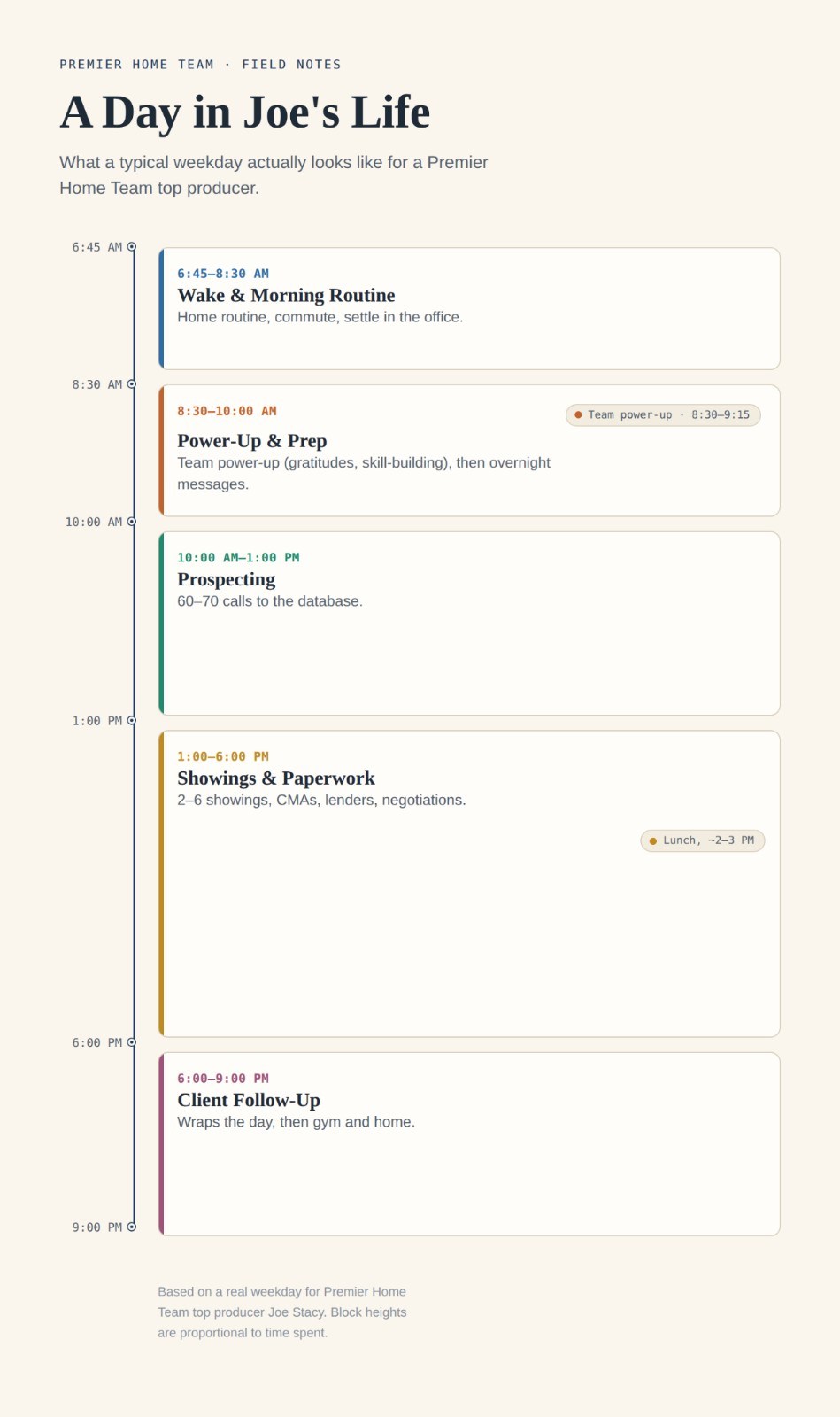
Joe's typical weekday runs in three blocks: morning follow-up and prospecting, afternoon showings and paperwork, evening client follow-up, often stretching from before 7 am to 8 or 9 pm.
For Joe, the day starts at 6:45 am. He leaves home around 7:35 am and arrives at the office between 8:20-8:30 am.
His priority is clearing anything left over from the previous night. Clients don't always treat real estate like a nine-to-five, and messages can come in after 10 pm. Joe wants a clean slate before turning to new business.
From roughly 10 am to 1 pm, he works his database. On a typical day, that means making 60 to 70 calls, following up with prospects, reconnecting with past contacts, and figuring out who is ready to make a move.
Then the day shifts.
A normal afternoon can include two to six showings with two to four clients. Between appointments, Joe researches properties, prepares comparative market analyses, talks with lenders, checks for competing offers, and negotiates contracts.
When the showings end, the work often doesn't. From 6 pm until 8 or 9 pm, Joe follows up with clients and finishes whatever the day requires. Then he goes to the gym and heads home.
Lunch? Usually around 2 or 3 pm.
That's a normal weekday, and a useful reminder that the part of real estate most people see, the showings and closings, is only a fraction of the work.
Why Is Prospecting So Important for Successful Real Estate Agents?
Prospecting is what creates everything else on an agent's calendar; without consistent calls and follow-up, there's no pipeline of showings, offers, or closings to manage.
If there's one part of his schedule Joe tries hardest to protect, it's the three-hour prospecting block between roughly 10 am and 1 pm. Those hours create the rest of his day.
Without the calls and follow-up, Joe says, there eventually wouldn't be an afternoon full of showings. He wouldn't have contacted the people who needed help, discovered who was ready to move, or created the relationships that turn into future business.
That's one of the realities new agents can underestimate. Showing a house feels like real estate; calling dozens of people who might not be ready to buy or sell yet can feel less productive. But the calls create the showings, and Joe doesn't stop when he hits the bottom of the day's list. If he runs out of people to contact, he starts looking for the next opportunity. As he puts it:
"You eat what you kill in this industry, and if you're not on the hunt, you're not gonna catch anything."
Unlike a salaried job, simply putting in your hours doesn't guarantee future income. That's echoed industry-wide — NAR's own member research shows agent income tracks production, which is part of why the work you do today determines how much business you have tomorrow.
Is a Real Estate Agent's Schedule Really Flexible?
Yes, but flexibility doesn't necessarily mean fewer hours.
A buyer may only be able to tour a home in the evening. A property can hit the market at any time. An offer may need attention after dinner. Clients can text after 10 pm. Joe says real estate has a way of creeping into parts of your life that wouldn't normally be part of a nine-to-five job. If a client needs information about a property they toured, he tries to get it to them that day, whether that means he's finished at 6 pm or 9 pm.
Ironically, one of Joe's favorite parts of the day is when the sun goes down. By then, the calls and texts finally begin to slow down, and instead of new tasks being added to his list, he can focus on finishing what's already there, going home knowing his clients have what they need and tomorrow can start with a clean slate.
But even on a day that runs until 9 pm, Joe doesn't let the chaos set his direction. Every week, he measures himself against one number, and it's not the one the team tracks by default.
"On our team, the simplest thing we track is phone calls made," Joe says. "But the number that actually helps me plan and build my pipeline is real estate conversations, the actual conversations I'm having every week."
It's a small distinction with a real difference. Phone calls made are easy to log and easy to inflate. A conversation - a homeowner talking through their timeline, a buyer working through financing, a past client checking in on the market - is harder to fake and a much better read on whether Joe is actually building a pipeline or just staying busy.
His target: roughly 85 conversations a week, based on the goals in his annual business plan.
That's the tradeoff behind a "flexible" real estate schedule: you may have more control over your time, but you're also responsible for what you accomplish with it.
What Is the First Year as a Real Estate Agent Really Like?
The first year can be the hardest; without an existing client base, we see new agents spending most of their time prospecting and building a database from scratch, often for less income and more hours than they'll put in later.
Joe's days are consistently busy now. That wasn't the case when he started.
Today, his database is large enough that there's almost always someone to call, follow up with, or help. In year one, much more of his time went toward finding people to put into that database in the first place, holding more open houses, working leads from the team database, and chasing every opportunity to meet prospective clients.
The numbers make the shift concrete. In his first full year, Joe closed 27 transactions, most of them earned by holding open houses, working team leads, and chasing every opportunity to meet a prospective client, because he didn't have a database yet to draw from. Last year, he closed 48. Today, that database is large enough that there's almost always someone to call, follow up with, or help; the work of finding people to put into it doesn't dominate his week the way it did in year one.
He also made significant sacrifices, tracking how long he could go without a day off. His longest stretch was three and a half months, including weekends, the kind of early commitment that we see among successful agents building a business from the ground up.
That doesn't mean every new agent needs months without a break to succeed. It was the choice Joe made because he wanted to invest as much time as possible into learning the business and building a book of clients, the same climb we documented in Joe's Journey to 48 Deals, which walks through how those early sacrifices compounded over his first three years.
Early on, you may constantly wonder, "Where am I going to find someone to work with?" Eventually, if you build enough relationships and take care of enough people, past clients and contacts can begin generating business for you.
Getting there takes time. For Joe, there was no shortcut around that.
Does Joining a Real Estate Team Make the Job Easier?
For Joe, joining a team was never about making the job easier; it was about not doing it alone. A team can make parts of the job easier. It doesn't eliminate the work.
At Premier Home Team, transaction and operations support handles many of the backend tasks Joe would otherwise manage himself: title work, inspections, tax certificates, use and occupancy certificates, freeing him to spend more time serving clients and growing his business. He also has access to leads, education, systems, and something he considers equally valuable: accountability. Joe describes the team's structure as guardrails; when his own motivation is low, he's surrounded by people dealing with the same challenges and working toward similar goals.
But guardrails don't drive the car. The team provides systems, support, and opportunities. Joe still has to make the calls, follow up, and do the work.
Joe's day didn't always look like this. His climb from 27 deals in year one to 48 by year three shows exactly what that early grind builds toward; read Joining a Real Estate Team: Joe's Journey to 48 Deals to see how the structure of a team helped him get there.
Do You Have What It Takes to Succeed in Real Estate?
Joe believes someone who thrives in real estate needs an interesting combination: an appreciation for structure, paired with a willingness to take initiative on your own.
One reason for entering real estate gives him pause: wanting to "make your own schedule." Technically, you can, but if that means working only when you feel like it while expecting a predictable income, Joe says the reality of the business can be difficult.
If your goal is just extra money on the side, there are easier ways to get it. But if your goal is a real estate business that could change your financial future, Joe believes you have to understand what that costs, and especially in the beginning, the highest cost is time: prospecting before you have clients, evenings spent following up, weekends spent building your database, hours of work today that may not pay off for months.
Joe decided that investment was worth making. You have to decide whether it's worth making for you.
What a Successful Real Estate Career Really Requires
It's difficult to know whether you want a career when you've only seen its highlight reel.
Joe's day includes the exciting parts of real estate: showings, negotiations, offers, helping clients find homes. But those moments sit alongside dozens of calls, late lunches, evening follow-up, and the daily discipline of keeping his pipeline alive.
Premier Home Team has changed how Joe spends his time: systems, leads, education, transaction support, teammates working toward similar goals. What the team can't provide is the willingness to do the work. That part has to come from you.
If you've seen what Joe's day really looks like and you're thinking, "That's demanding, but that's the kind of business I want to build," your next step is seeing what that looks like in practice: Your First 90 Days as a New Real Estate Agent on Premier Home Team walks through exactly what to expect the moment you start.

Robin Martin
Realtor® | Premier Home Team | Keller Williams Empower | PLACE
or another way