
Categories
Home Buying TipsPublished October 19, 2026
What Is Debt-to-Income Ratio (DTI) When Buying a Home?

Executive Summary
Your debt-to-income ratio, or DTI, is your total monthly debt payments, including your future mortgage, divided by your gross monthly income. It is one of the biggest factors in whether you qualify for a home loan and which loan program fits you. There is no single number that works for everyone, since the maximum allowed DTI varies by loan type, and qualifying at a higher DTI doesn’t necessarily mean that payment will be comfortable. In our experience, a ratio in the 30% range is generally considered strong and affordable for most buyers.
If you are not sure what your debt-to-income ratio actually is, you are not alone. Buyers who skip talking to a lender first often end up touring homes above what they can actually finance, only to realize the payment is outside their comfort zone after they have already started looking at homes in that price range. Others assume a maxed-out ratio rules them out completely and stop looking altogether, even when a different loan program or a few months of planning could get them there.
In more than 12 years of mortgage lending, we’ve helped buyers work through this exact calculation, and we’ve found that the fear of not qualifying is often bigger than the math itself.
We will walk through exactly what counts as debt, how the math works, what pushes your DTI up or down, and what your realistic next steps are if your ratio is not where it needs to be yet.
What Debt-to-Income Ratio Actually Means
The number one misconception we hear is that DTI is about how much debt you have in total. It is not. We are looking at your total monthly obligations, not the total amount you owe. DTI compares what you owe every month, plus your new mortgage payment, against your gross monthly income, meaning your income before taxes, 401(k) contributions, and insurance are taken out. That distinction matters because a buyer with a large student loan balance can still have a very manageable monthly payment, and we are generally looking at that monthly number, not the sticker shock of the total owed.
How to Calculate Your Debt-to-Income Ratio
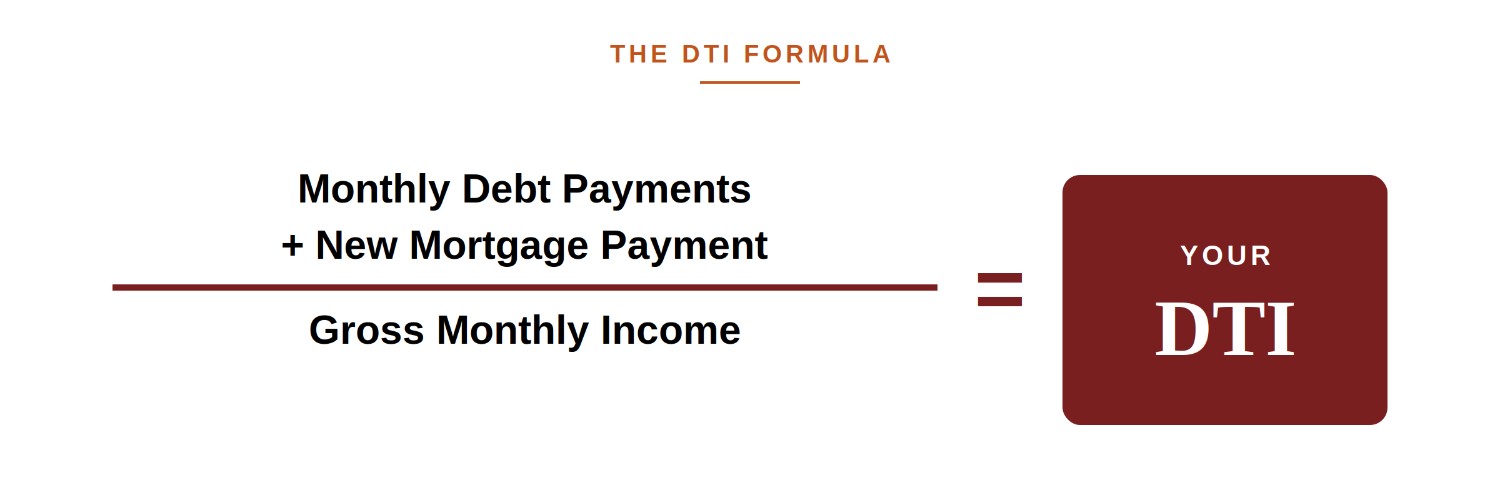
The formula itself is straightforward: add up your monthly debt obligations and your new mortgage payment, then divide that by your gross monthly income. Monthly obligations include things like auto loan payments, credit card minimums, and student loan payments, but there are a few categories buyers often forget: child support or alimony, potential back tax obligations, and increasingly, buy-now-pay-later apps like Klarna.
If a $100 payment like that is showing up on the bank statements you provide during your transaction, we are going to include it in your total debt-to-income ratio, and underwriters are getting sharper at catching these every year.
What Counts as a Good Debt-to-Income Ratio
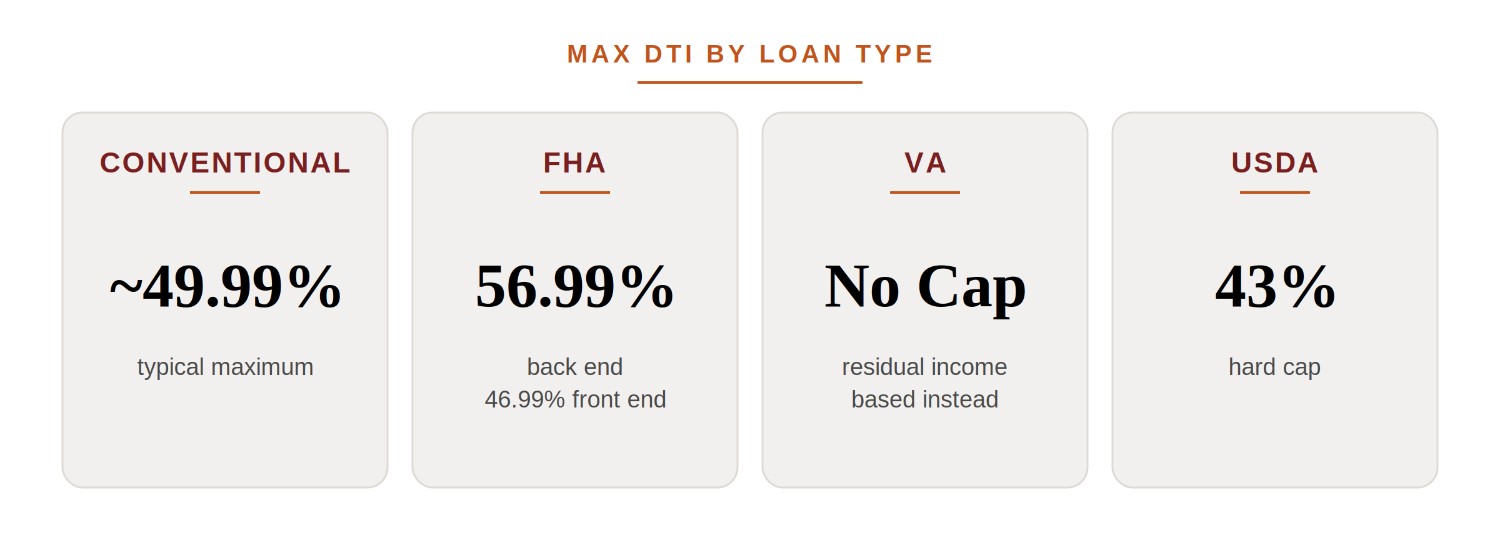
There is no universal cutoff, because the maximum allowed DTI depends on the loan program. As a general rule of thumb, conventional loans rarely approve above 49.99%, though certain Fannie Mae and Freddie Mac programs allow slightly higher in specific cases.
FHA can go up to around 56.99% on the back end, though the front-end ratio (your housing payment alone) also comes into play, with approvals typically staying under about 46.99% there. VA loans technically have no fixed limit and instead rely on a residual income calculation, and USDA loans cap at 43%.
In our experience, a DTI in the 30% range tends to be the sweet spot. That is usually a pretty affordable number for most people.
What Raises Your Debt-to-Income Ratio
Opening a new credit card, financing furniture, or buying a car between contract and closing can all push your DTI higher and potentially affect your approval. Buy-now-pay-later plans fall into this category too, even for smaller purchases. Our advice is to keep using credit normally for everyday things like groceries, but check with your lender before taking on anything new.
What Lowers Your Debt-to-Income Ratio
Paying down existing balances and avoiding new credit accounts can help lower your DTI, but talk with your lender first to understand which changes could have the biggest impact on your ability to qualify.
We have also seen buyers improve their numbers simply by finding a higher-paying job or bringing on a co-signer. It really depends on whether your income or your existing debt is the bigger obstacle to qualifying.
Ready to run your own numbers? Your future mortgage payment is a key part of your DTI. Use our mortgage calculator to get a clearer picture to estimate your monthly mortgage payment, including principal and interest, taxes, insurance, HOA fees, and private mortgage insurance.
Are There Exceptions to the DTI Rule?
Yes, and this is where working with an experienced lender pays off. VA loans do not use a hard DTI ceiling at all; they rely on a residual income calculation, which means buyers may still qualify at higher DTI ratios. Certain conventional programs through Fannie Mae and Freddie Mac allow slightly over 50% in specific circumstances. And even when a loan program allows a higher DTI, qualifying does not necessarily mean the payment will be comfortable long term. That is where a more careful conversation with your lender about affordability matters.
What Should You Do If Your DTI Is Too High?
If your DTI is too high to qualify right now, that does not necessarily mean homeownership is off the table. It may mean you need a plan to increase your qualifying income or reduce your monthly debt obligations. Either way, the fastest way to find out where you actually stand is to have that conversation with a lender before you start touring homes, not after you fall in love with one.
DTI can feel like one more confusing hurdle standing between you and a home, but the truth is it is just math, and math can be worked with. Once you understand that lenders are looking at your monthly obligations against your monthly income rather than some vague sense of how "in debt" you are, the whole process becomes a lot less intimidating.
If you have been putting off that first conversation because you assumed your numbers would not work, that is exactly the assumption worth testing. We would rather help you build a game plan now than have you wait and lose time.
Use our mortgage calculator to estimate your monthly mortgage payment and get a clearer picture of one of the biggest pieces of your DTI.
Frequently Asked Questions
What is considered a good debt-to-income ratio when buying a home?
There is no single number that applies to everyone, since it depends on your loan program. In our experience, a DTI in the 30% range is generally strong and affordable for most buyers, although some loan programs allow significantly higher ratios.
Does DTI include my future mortgage payment or just my current debts?
Both. Your DTI calculation includes your new mortgage payment on top of your existing monthly obligations, compared against your gross monthly income.
Do buy-now-pay-later apps like Klarna count toward my DTI?
Yes. If those payments show up on the bank statements you provide during the transaction, lenders will typically include them in your debt-to-income calculation.
Can I still buy a home if my DTI is too high right now?
Potentially, yes, with a plan. Increasing your income, adding a co-signer, or paying down existing debt may help improve your ratio, and a lender can help you map out which option makes the most sense for your situation.
Is my DTI calculated using my take-home pay or my gross income?
Gross income, meaning your pay before taxes, 401(k) contributions, and insurance are deducted.

Robin Martin
Realtor® | Premier Home Team | Keller Williams Empower | PLACE
or another way