
Categories
Home Owners, Market TrendsPublished October 21, 2026
How Accurate Is a Zestimate When You're Selling Your Home

Executive Summary
Your Zestimate is a rough estimate of your home’s value, not a price to list at or plan around. In the Philadelphia metro, Zillow's own numbers (as of September 2026) put its median error at 7.65% for homes that aren't for sale, the category your home falls into until you list. On a $587,295 home, that's about a $45,000 miss. In the homes we price, we typically see Zestimates land $10,000 to $25,000 away from what the market will pay, and sometimes much further, mostly because the algorithm has never been inside your house. Before you decide whether to sell, what to list at, or what you can afford next, get a comparative market analysis (CMA) from an agent who has walked through your home and the ones it's being compared to.
You've been watching your Zestimate for a while. Maybe it jumped and got you thinking about selling. Maybe it dropped and made you wonder if you should wait. Either way, you're making decisions based on a number you're not sure you can trust.
Our team has closed over 800 transactions on both sides of the table, and this article draws on more than three years of pricing conversations with buyers and sellers. The Zestimate comes up in almost every one of them, and we see where it lands compared to what homes sell for.
Here's how your Zestimate compares to your home's real market value, and when to rely on each one.
What's the Difference Between a Zestimate and What Your Home Is Worth?
A Zestimate is Zillow's algorithm-generated estimate of your home's value. Your home's real market value is what a buyer will pay for it, based on recent comparable sales, the condition of your home, and what the market is doing right now. An agent finds that number through a CMA.
The biggest misconception we hear from sellers is that the Zestimate is how much their home is worth. It's an estimate from software that has never seen your kitchen, your basement, or your boiler.
How Is a Zestimate Calculated, and How Does an Agent Price Your Home?
The two numbers start from different places. One comes from online records. The other starts with those same records and adds someone standing in your house.
How the Zestimate is calculated
Zillow's algorithm looks at the market and your property type. It finds similar homes in your neighborhood, say other four-bedroom, two-bath homes, and estimates your value from what those sold for. According to Zillow, Zestimates are updated daily, though the number itself doesn't necessarily change every day. (Zillow)
What it can't do is look inside. The algorithm doesn't know whether your home was fully renovated or has been sitting empty for five years. It doesn't know your home's history or what it has been through. It's working from online stats, not real life.
How an agent finds your home's market value
A real CMA covers the basics the algorithm uses, like bedrooms, bathrooms, and square footage, and then adds condition. We compare your home against homes that have sold nearby, ideally ones we've been inside. Then we walk through your home to see how it stacks up. We also look at whether it's a buyer's market, a seller's market, or a balanced market, because that affects what buyers are willing to pay.
How Accurate Is a Zestimate Before Your Home Is Listed?
What Do Zillow's Own Numbers Show?
Zillow publishes its own accuracy numbers. As of September 2026, for homes listed for sale in the Philadelphia metro, the median error is 2.11%, and about 82% of those Zestimates land within 5% of the sale price. That still leaves roughly 1 in 5 off by more than 5%, which on a $587,295 home is more than $29,000. For homes that aren't listed, the median error jumps to 7.65%, and only about 60% of those Zestimates land within 10% of the sale price. That means roughly 4 in 10 miss by more than 10%. If you're checking your Zestimate while you're thinking about selling, you're looking at the less accurate of the two. A median error also means half have an error at or above that number.
In our experience, Zestimates often miss by $10,000 to $25,000, and the gap depends on the individual house. Sometimes it's a lot wider, as the Havertown homes below show. When one home is fully renovated and the one next door still has its original major systems, the algorithm treats them as nearly the same. Buyers don't, because they'll have to budget for replacing those systems.
Here's what that looks like on the ground. We pulled Zestimates for five neighboring homes in one small section of Havertown, where homes sold for an average of $587,295 from late June to late September 2026. The Zestimates ranged from $504,100 to $789,600.
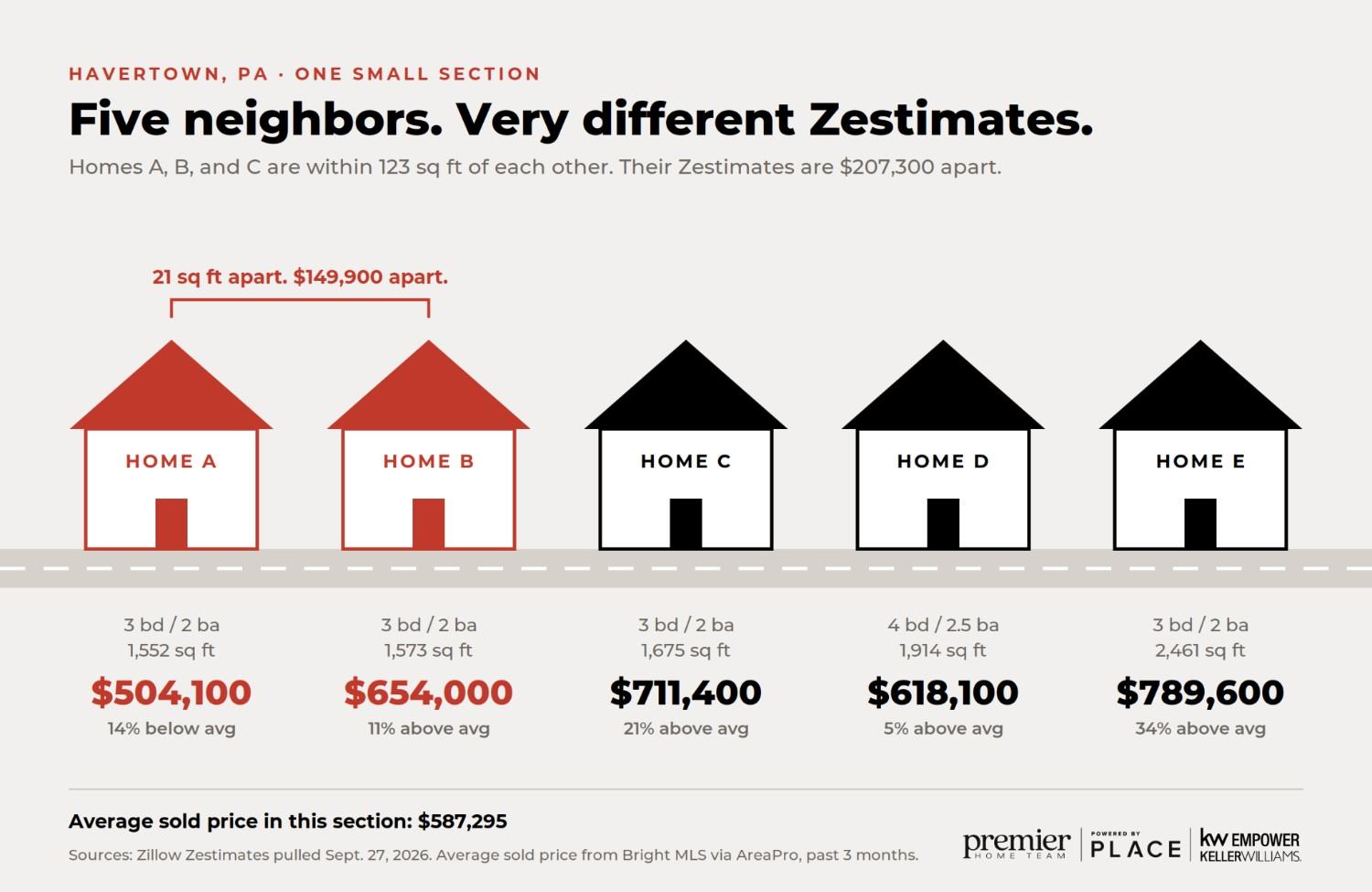
Homes A and B are 21 square feet apart, and their Zestimates are almost $150,000 apart. Maybe one has been fully updated and the other hasn't. From the outside, there's no way to tell which Zestimate is closer to the truth, and that's the problem for a seller.
So we checked three similar Havertown homes that sold this summer against their Zestimates from the month before listing.
| Home | Beds / Baths | Sq Ft | Zestimate Before Listing | Sold Price | Zestimate Missed By |
|---|---|---|---|---|---|
| Home F | 3 / 1.5 | 1,800 | $649,000 (June) | $610,000 (Aug.) | $39,000 too high (6.4%) |
| Home G | 4 / 2.5 | 1,754 | $710,900 (May) | $790,610 (July) | $79,710 too low (10.1%) |
| Home H | 3 / 2.5 | 1,606 | $600,200 (May) | $555,000 (Aug.) | $45,200 too high (8.1%) |
Source: Zillow Zestimate history, pulled September 27, 2026. Sold prices from Delaware County public records [VERIFY BEFORE PUBLISHING: confirm all three prices once deeds are recorded], closed July to August 2026.
Two sellers got less than their Zestimate, and one got almost $80,000 more.
How Does a CMA Compare?
A CMA is built on actual recent sales and an in-person look at your home, so it catches the things that move your price. How old is your boiler? Your heater? Your electrical system and plumbing? Have you made upgrades the comparable homes don't have? All of those play a part, and none of them show up in your Zestimate.
A CMA is still an estimate, not a guarantee, and there's no published accuracy rate for CMAs the way there is for Zestimates. It's only as good as the comps behind it, so ask your agent which homes they used and why. If a number seems designed to win your listing rather than sell your home, that's worth questioning.
When to Check Your Zestimate and When to Get a Real Number
Keeping an eye on your Zestimate is fine to give you a general sense of what's happening in your area and what your home might be worth. Just keep in the back of your mind that it's an estimate.
Once you're seriously asking what your home is worth, or trying to decide whether you can afford to sell and buy your next place, don't rely on it. A Zestimate that's too low can convince you now isn't the time when it actually is. One that's too high can set you up for disappointment and doubt when the offers don't match the number in your head.
Thinking about listing above the market? [Read How Overpricing a Home Backfires and What the Data Shows (link pending)] to see what it costs sellers who aim too high.
What Happens When Your Zestimate Is Higher Than Our Recommended List Price?
It happens often. A seller's Zestimate says one thing, and the comps say something lower. When that happens, we take our opinion out of it and show you what the market is saying. Sold homes are what buyers and their agents use to decide what to offer, so that's the number that will actually hold up once your home is listed.
Know Your Real Number Before You Make Your Move
You came here because you've been watching your Zestimate and weren't sure how much to trust it.
It's a useful starting point and an unreliable final answer. It knows your neighborhood and your property type. It doesn't know what's inside your house. It's better to know your real number now than to find out when you're ready to move and holding onto a number that was never accurate.
That's the work our team does every day. A Zestimate gives you an idea, and it's really just an idea. We walk through your home, compare it to homes we've seen sell in person, and show you what the market is bearing.
Your next step is a no-obligation listing consultation with a Premier Home Team agent who knows your market. We'll come out to your home, go over what comparable homes have sold for, and give you a number you can plan around.
Frequently Asked Questions
How accurate is a Zillow Zestimate? As of September 2026, Zillow reports a median error in the Philadelphia metro of 2.11% for homes listed for sale and 7.65% for homes that aren't, so half of all estimates miss by more than that. We typically see Zestimates off by $10,000 to $25,000, and sometimes much more, depending on condition.
Why is my Zestimate different from what my home would sell for? The algorithm can't see inside your home. It doesn't know about your upgrades, the age of your major systems, or your home's history, and all of those affect what buyers will pay.
Is a Zestimate the same as an appraisal? No. A Zestimate is an automated estimate built from online data. An appraisal is done by a licensed appraiser, usually for the buyer's lender, and is based on the actual home and recent comparable sales.
What is a CMA in real estate? A comparative market analysis is an agent's estimate of your home's value based on recently sold homes nearby, adjusted for bedrooms, bathrooms, square footage, and condition. It's what we use to recommend a list price.
How often does Zillow update Zestimates? Zillow updates Zestimates daily, but the number itself doesn't necessarily change every day.

Robin Martin
Realtor® | Premier Home Team | Keller Williams Empower | PLACE
or another way