
Categories
Home Buying TipsPublished October 14, 2026
How Student Loans Affect Your Ability to Qualify for a Mortgage


Executive Summary:
Having student loan debt doesn't automatically prevent you from qualifying for a mortgage. Instead of looking only at your total student loan balance, lenders determine a monthly payment to include when calculating your debt-to-income ratio. Depending on your loan program and repayment status, that may be the payment reported on your credit report, a documented income-driven payment, or a calculated amount based on your balance.
If you owe $50,000, $90,000, or even more in student loans, it's easy to look at that balance and assume buying a home is still years away. But is that really how a mortgage lender views your debt? And does a large student loan balance automatically mean you won't qualify?
Usually, no. As Premier Home Team's lending partner at Envoy Mortgage, we have this conversation with first-time buyers all the time. What matters isn't simply how much you owe in student loans, but the monthly payment a lender must account for along with your other debts and income.
In this article, we'll break down how lenders calculate student loan payments for mortgage qualification, how deferment and income-driven repayment plans are handled, and what “too much” student loan debt actually looks like when you're trying to buy a home.
How Do Student Loans Factor Into Your Debt-to-Income Ratio?
When lenders calculate your debt-to-income, they look at what you owe every month, and that distinction is where most of the confusion starts. Buyers come in convinced that a six-figure balance means they have "too much debt," but we're calculating total monthly obligations, not the total amount owed.
To calculate a buyer's debt-to-income ratio, we add up:
- Auto loan payments
- Minimum credit card payments
- Student loan payments
- Child support or alimony
- Back taxes, if applicable
- The new mortgage payment being applied for
We then compare those obligations with your gross monthly income: the amount you earn before taxes, retirement contributions, insurance, and other deductions come out.
How Do We Calculate a Student Loan Payment for DTI?
Guidelines shifted after the pandemic-era deferment period, when many borrowers had a $90,000 balance reporting a $0 monthly payment, a number we couldn't realistically build a decision around.
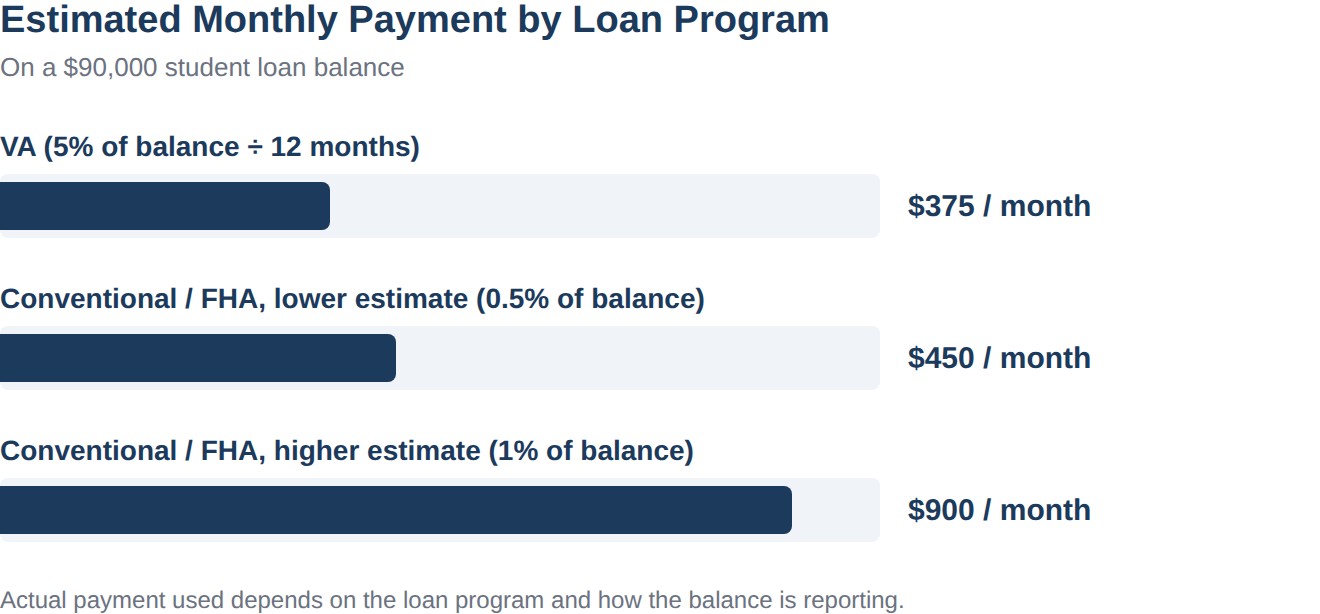
Today, the payment we use depends on the loan program and how the student loan is reporting. If a monthly payment is reporting on the credit report, we generally use that payment. If you're on an income-driven repayment plan and we can document the payment, we may be able to use that amount. If neither gives us a payment we can use, depending on the loan program, we calculate one using either 0.5% or 1% of the outstanding student loan balance.
For example, using a half-percent or one-percent calculation, a $90,000 student loan would result in a $450 or $900 monthly payment for DTI purposes, not $90,000 being counted against you. VA loans use a different calculation: five percent of the outstanding balance divided by 12 months.
Do Deferred or Income-Driven Repayment Plans Still Count?
Yes. If you're on an income-driven repayment plan and the actual monthly payment can be documented, we may be able to use that amount. If your student loan is deferred and reporting a $0 monthly payment, we still have to account for the debt and calculate a payment based on the applicable loan program.
Don't let a large balance in deferment talk you out of applying. The math is rarely as bad as it looks on paper.
What Does Too Much Student Loan Debt Actually Look Like?
There isn't a specific student loan balance that's automatically too much. What matters is whether the monthly payment we have to count pushes your overall debt-to-income ratio too high.
For most buyers, student loans barely move the needle on their own. Almost everyone who went to college carries some student debt now, and it rarely registers as a real obstacle for the buyers we see. A buyer carrying $50,000 in student loans might only see roughly $250 a month counted against their ratio, not the number that keeps them up at night.
The debt itself is rarely the deciding factor. What derails buyers more often is a missed payment somewhere on the credit report, which can hurt a credit score far more than the loan balance ever will.
What’s the Biggest Mistake Buyers With Student Loans Make?
Don't assume you need to wait to apply for a mortgage just because you have student loan debt. Buyers who assume they'll never qualify often put off the conversation with a lender for months or years, and in the meantime, home prices keep climbing. Waiting doesn't fix the number. It just prolongs the inevitable and pushes the timeline further out while prices keep going up.
Another mistake is taking on new monthly payments because they don't seem like traditional debt. Buy-now-pay-later apps are a good example. A $400 balance split into four $100 payments through an app like Klarna will show up on bank statements during underwriting, and we're required to count that recurring payment toward the buyer's debt-to-income ratio. It's a small thing that surprises a lot of buyers who never thought of it as debt in the first place.
What Should Buyers Do Before They Start House Hunting?
Talk to a lender before touring a single home. A short consultation gives buyers a real number to work from instead of a guess, and it prevents the common scenario of getting pre-approved to their absolute maximum, shopping at that ceiling, and then realizing the payment feels heavier than expected.
For buyers wondering exactly where their credit needs to sit before that conversation, What Credit Score Do You Really Need to Buy a Home? is a natural next read.
What This Means for You
For most buyers, the fear of student loan debt is bigger than the impact it ultimately has on their mortgage application.
A large student loan balance doesn't automatically disqualify you from buying a home. What matters is the monthly payment a lender has to account for, your overall debt-to-income ratio, and the loan program you're using. Buyers who assume their student debt will keep them from qualifying are often surprised once someone actually runs the numbers.
This is exactly the kind of conversation we have with buyers every week at Premier Home Team, turning credit reports and repayment plans into a real, honest answer instead of a guess.
If student loan debt has been the reason your home search hasn't started yet, the fastest way to find out where you actually stand is a conversation with a lender, not another year of waiting. Reach out to Premier Home Team to get connected with our lending team, or start by browsing our other buyer resources for a lower-commitment first step.
Ready to find out where you actually stand? Connect with Premier Home Team to get matched with a lender who can run your real numbers, student loans included.
Frequently Asked Questions
Does my full student loan balance count against me when I apply for a mortgage?
No. We calculate a monthly payment figure based on the balance or the reported payment, not the balance itself, and that monthly figure is what factors into a buyer's debt-to-income ratio.
What happens if my student loans are in deferment?
We still have to account for the loan. If it's reporting a $0 monthly payment, we'll calculate a payment based on the applicable loan program rather than simply treating the obligation as zero.
Can an income-driven repayment plan lower the payment lenders use?
In some cases, yes, if the buyer can document the actual income-driven payment amount. Otherwise, we default to the calculation required by the applicable loan program based on the total balance.

Robin Martin
Realtor® | Premier Home Team | Keller Williams Empower | PLACE
or another way