
Categories
Home Buying TipsPublished September 28, 2026
How to Buy a House That Needs Repairs Without Losing the Deal

How to Buy a House That Needs Repairs Without Losing the Deal
Executive Summary
Buying a house that needs repairs doesn't mean you have to lose the house or overpay for it. Start by getting real quotes, not guesses, for anything that worries you, then use those numbers to negotiate a credit, a price reduction, or specific repairs before you close. For most buyers, the decision to move forward or walk away comes down to whether the repair costs still make sense against the home's value and how long you plan to stay, not fear.
You've fallen for this house. You can already picture your furniture inside, while you sip your coffee on that porch. Then the inspection report comes back, and instead of a green light, you're staring at a list that makes your stomach drop, heartbroken and worried the home you love is about to cost more than you're willing to take on.
At Premier Home Team, we’ve helped more than 500 buyers purchase homes, and inspection issues and repair negotiations are a regular part of that process. We know the emotions that come with it are real: fear, anxiety, and sometimes regret, especially for first-time buyers. Investors tend to look at repairs through a completely different lens; buyers looking for a home to actually live in rarely do.
This article breaks down the real problems buyers run into when a house needs repairs, and the specific move that solves each one, so you can decide with facts instead of panic.
Problem #1: You Don't Know How Bad the Repairs Really Are
Get a full professional inspection, then bring in a specialist for anything that worries you. A general home inspection tells you what's wrong, not always what it costs to fix, and that gap is where the panic sets in.
We recently worked with a buyer who nearly walked away after an inspection turned up issues beyond what was visible at the showing, including a radon problem. He panicked at first, understandably. Instead of guessing, we identified the specific items causing him the most anxiety and brought in the right vendor for each one: an electrician, a radon specialist, and a structural engineer for the foundation questions. Once he had real quotes in hand, the decision became financial instead of emotional, and the love for the house won out.
| Inspection concern | Who to call |
|---|---|
| Foundation movement/cracking | Structural engineer |
| Electrical issue | Licensed electrician |
| Radon | Radon mitigation specialist |
| Plumbing/sewer concern | Licensed plumber/sewer specialist |
| Roof issue | Roofer |
| HVAC problem | HVAC contractor |
Problem #2: You're Worried the Seller Won't Budge on Repairs
If a seller won't make repairs, you can still ask for a credit or a lower price. One of the biggest myths buyers believe is that sellers are obligated to fix everything an inspection turns up. They're not. In Pennsylvania, buying a home ‘as-is’ generally means the seller isn't promising to make repairs just because an issue is discovered. It doesn't eliminate the seller's obligation to disclose known material defects, and depending on the terms of your agreement, you may still have inspection and negotiation options.
An inspector may flag everything from major defects to minor issues, which isn't the same as a seller being required to fix it. Wanting a fence where there wasn't one doesn't qualify. When a seller declines repairs outright, you still have two real options: a seller's credit at closing, which many sellers prefer since it skips managing contractors, or a reduction in the offer price.
If the seller agrees to make a repair but can't get it completed before closing, an escrow holdback may also be an option. This can come up when you're working with a short closing timeline, a contractor can't get there in time, or weather prevents the work from being completed. In that situation, money from the seller's proceeds is held back at closing to help ensure the agreed-upon repair gets finished afterward.
When we structure an escrow holdback, we want enough money held back to cover the possibility that the repair costs more than the original estimate, not just the number on paper.
Problem #3: You're Afraid Asking for Too Much Will Cost You the House
Piling every item from the inspection report into one request backfires, so we suggest separating the must-fix items from the nice-to-haves before you submit a repair request.
Sellers will often agree to fix several small, cheap items and decline the one or two expensive issues that actually matter, then consider the negotiation settled. Before the inspection happens, talk to your agent and walk through what you can reasonably ask for versus what you shouldn't. Then revisit that list during the inspection itself so nothing gets mistaken for a bigger problem than it is. A door that doesn't quite latch is not a structural issue. Keeping the request focused on what's truly major protects your ability to actually get those things addressed.
Not sure what to expect during the inspection itself?
Watch our video, What to Expect at Your Home Inspection, to see what happens during the inspection, what your inspector is looking for, and how to prepare for the conversation about repairs afterward.
Problem #4: You Don't Know Which Repairs Could Affect Your Financing
Your home inspector's job is to identify problems with the house so you understand what you're buying. The repairs your home inspector finds and the repairs your lender requires aren't necessarily the same thing. Your inspector may point out peeling paint, a missing handrail, electrical concerns, water issues, or dozens of other items. But just because something appears on your inspection report doesn't automatically mean it has to be repaired for your loan to go through.
The appraisal is different. If you're using an FHA or VA loan, the appraiser is also looking at whether the property meets that loan program's property requirements. Depending on the home and the loan, that can include issues such as peeling or defective paint, missing handrails, water or moisture problems, roof issues, and other health, safety, or property-condition concerns.
If the appraiser calls out a required repair, that repair will typically be sent to the seller to be completed before closing. Once the work is finished, the appraiser comes back to verify that the repair was completed and the property meets the program's requirements.
That's why it's important not to treat your inspection report and appraisal as the same thing. Your inspector may flag something that never becomes a financing issue, while your appraiser may identify a condition that has to be addressed for your loan to move forward.
| Home inspection | Appraisal |
|---|---|
| Helps you understand the home's condition | Determines whether the home meets applicable loan-program property requirements |
| Inspector may flag repairs, maintenance issues, and defects | Appraiser may identify conditions that must be addressed for financing |
| An item being on the report doesn't automatically mean it must be repaired | A required appraisal repair can affect whether the loan moves forward |
| Used to help you decide what to negotiate with the seller | Required items typically need to be completed and reinspected |
So, How Do You Decide Whether to Buy a House That Needs Repairs?
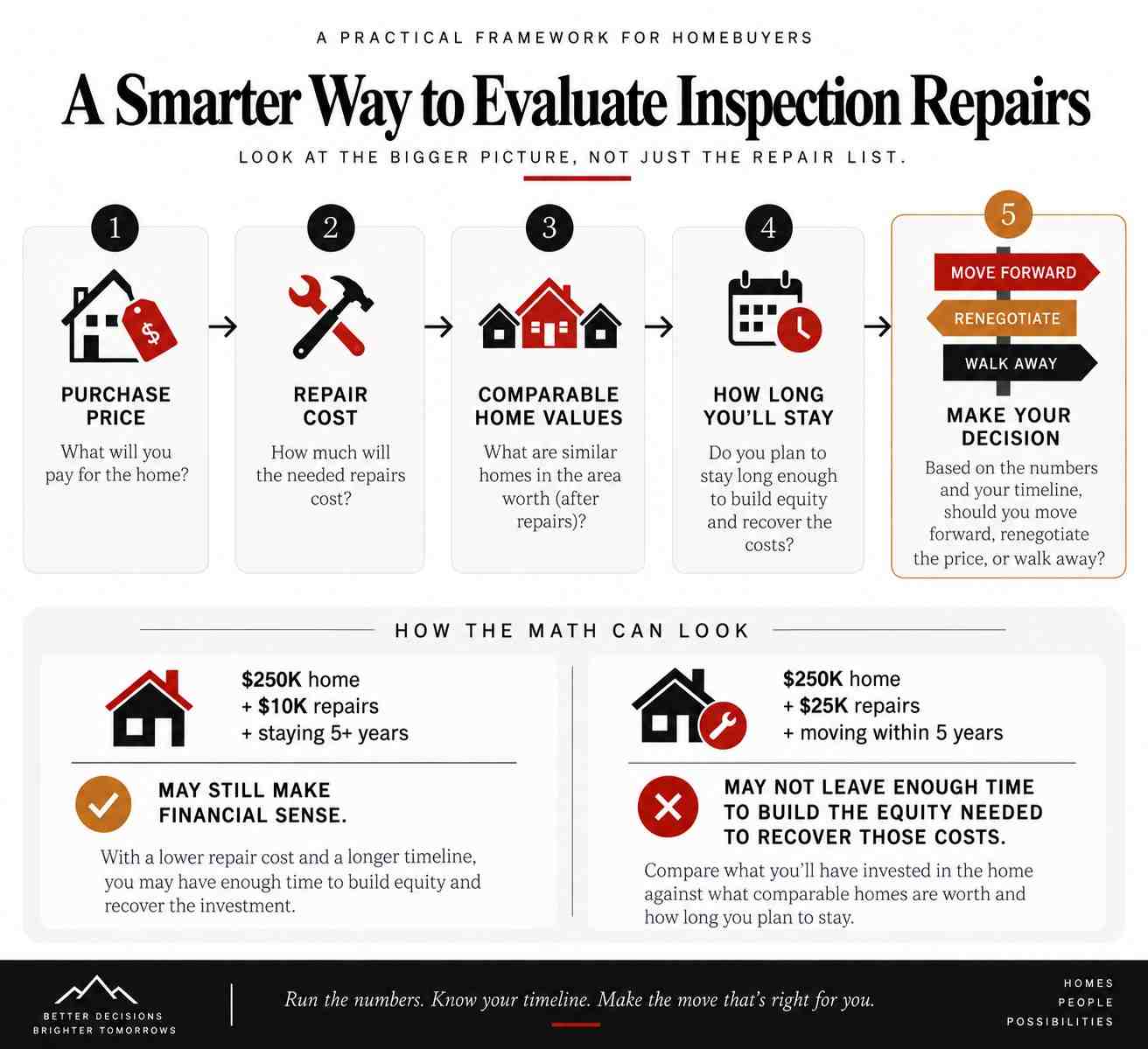
There's no universal number that makes a repair worth it; it depends on the math. Weigh the dollar amount of the repairs against the home's value, the comps, and how long you plan to stay.
On a $250,000 house with $10,000 in needed repairs, the numbers can still make sense if you plan to stay in the home for at least five years. But if that same house needs $25,000 in repairs and you plan to move again within five years, it usually doesn't make as much financial sense because you may not build enough equity to recover those costs when you sell. Major structural issues, or electrical and plumbing problems throughout the house, deserve a second opinion regardless of the number.
Your Next Steps
Loving a house and needing repairs aren't mutually exclusive. They're two separate questions that deserve two separate answers.
Once you know exactly what's wrong, what it actually costs from a real specialist instead of a guess, and how that number compares to the home's value and your own timeline, most repair situations stop feeling scary and start feeling like a straightforward financial decision.
Premier Home Team's agents walk buyers through this exact scenario regularly, from deciding which repairs are worth pushing for to structuring an escrow holdback that actually protects you.
Not sure whether the repairs change the deal? Download our House Repair Decision Tree to work through the repair costs, your negotiation options, the home's value, and how long you plan to stay before deciding whether to move forward, renegotiate, or walk away.
Already have an inspection report? Review it with your real estate agent. They can help you determine which issues are worth investigating further, what to negotiate with the seller, and when it's time to bring in a specialist for a real quote.
Still looking for a home and don't have an agent yet? Schedule a consultation with a Premier Home Team agent.
FAQ
Is the seller required to fix everything found on the home inspection?
No. An issue appearing on the inspection report doesn't automatically mean the seller is required to repair it. Depending on the terms of your agreement, you may be able to negotiate repairs, a seller credit, or a price reduction.
What's the difference between a seller credit and asking for repairs directly?
A credit reduces what you owe at closing so you handle repairs yourself, which many sellers prefer. Asking for repairs directly means the seller completes the work first, adding time.
Can I still get an FHA or VA loan on a house that needs repairs?
Yes. An issue appearing on your home inspection doesn't automatically make it a lender-required repair. With an FHA or VA loan, the appraisal may identify repairs that need to be completed for the property to meet the loan program's requirements. If the appraiser requires a repair, it will typically need to be completed and reinspected before closing.
What is an escrow holdback, and how does it protect me?
If the seller agrees to make an inspection-related repair but can't complete it before closing because of timing, contractor availability, weather, or another delay, an escrow holdback may be an option. A portion of the seller's proceeds is held back at closing, giving the seller a financial incentive to complete the agreed-upon work. The amount held should leave room in case the repair costs more than the original estimate.
Should I trust the inspector's repair estimate, or get my own quotes?
Get your own quotes for anything that concerns you. Inspectors flag issues but aren't pricing specialists, and scary-sounding items are often cheaper than buyers assume once a professional gives a real number.

Robin Martin
Realtor® | Premier Home Team | Keller Williams Empower | PLACE
or another way