
Categories
Careers, Working in Real EstatePublished August 28, 2026
Real Estate Agent Schedule: Productivity Rhythms That Stick


Executive Summary
The best real estate agent schedule protects lead generation every morning, serves clients in the afternoon, and follows a weekly planning rhythm. While every day changes in real estate, top producers keep these core blocks consistent because they create predictable growth instead of reactive work.
You got into real estate for the freedom. But somehow every day still feels reactive, scattered, and exhausting. Your phone runs your schedule, not the other way around.
Some days it feels like there aren't enough hours to do it all. You've got showings to run, offers to write, calls to return, and deals already in motion that need constant attention to stay on track. But if that's all you do, your pipeline quietly dries up, and three months from now you're staring at an empty calendar wondering where your next deal is coming from. Balancing what's already moving with what still needs to be built is the tension almost every agent feels, and most days it feels like there's no good answer.
At Premier Home Team, we've coached and trained dozens of agents across every production level. We've watched what separates agents who build sustainable careers from those who burn out by year two, and schedule is almost always the difference.
In this article, we'll walk you through the daily and weekly rhythms top-producing agents actually use, from time blocking to morning routines to protecting your focus time, so you can build a schedule that sticks.

Why Most Real Estate Agents Struggle With Their Schedule
Most agents struggle with their schedule because they treat every task as equally urgent, when only a handful of activities actually move the needle. Early in a career, it's easy to fall into what feels like constant motion without much production to show for it.
The problem isn't a lack of effort. It's a lack of protected space for the work that matters most. New agents especially fall into "getting ready to get ready," prepping for listing appointments and showings before they've built a pipeline of people to serve. Without a base of leads and relationships, all that preparation has nowhere to go.
This is also why no two days looking the same isn't a flexibility perk, it's a warning sign. In the early stages of a career, your days should look almost identical. Structure isn't the enemy of freedom in this business. It's what makes freedom possible later on.
What a High-Producing Agent's Schedule Actually Looks Like
A high-producing agent's day is not a 9-to-5. It's a morning built entirely around training and lead generation, with client-facing work like showings, listing appointments, and closings filling the afternoon.
By lunchtime, the most important parts of the day are already done. The day starts with training, which is the piece of the schedule that drives long-term growth even though it doesn't produce an immediate check. From there, the entire morning goes toward lead generation and lead nurturing, whether that means finding new clients or moving current buyers and sellers forward.
Plan for roughly 50 hours a week to hit first-year goals, split close to evenly: half in prospecting, half in the client-facing activities most people associate with real estate, like showings, listing appointments, inspections, and closings. As agents grow more experienced and gain leverage in their business, that ratio can shift even further toward prospecting, because they may have earned support to handle some of the client servicing.
What Is the Best Time-Blocked Schedule for a Real Estate Agent?
Time blocking works because it puts your highest-dollar activities in the part of the day when you have the most energy and the fewest distractions, and protects them from everything trying to pull your attention elsewhere.
Lead generation comes first, every single day, because mornings are when agents are sharpest. A real estate day can get away from you fast. Client needs, lender deadlines, title company calls, and other agents all compete for your time, and if you don't protect your most important block first, the day tends to unravel as it goes on.
Client service and follow-up fill the second half of the day. This is where showings, listing appointments, and the work of nurturing current relationships happens, once the highest-leverage activity of the day is already behind you.
Personal and recovery time deserves the same level of protection. The agents who build the most sustainable careers are the ones who guard time for training, family, and their own energy, not just client-facing hours. As production grows, that might mean shifting fierce protection toward team development or business operations instead of direct selling, but the principle of protecting it stays the same.
Admin and paperwork get their own block too, batched rather than handled piecemeal throughout the day. Most agents place it either right after the lead generation block wraps, using the same momentum before shifting gears, or at the end of the day once client-facing work is done. Either way, the key is the same as everywhere else in the schedule: paperwork doesn't get squeezed in between calls and showings, it gets its own protected time.

How Should Real Estate Agents Plan Their Week?
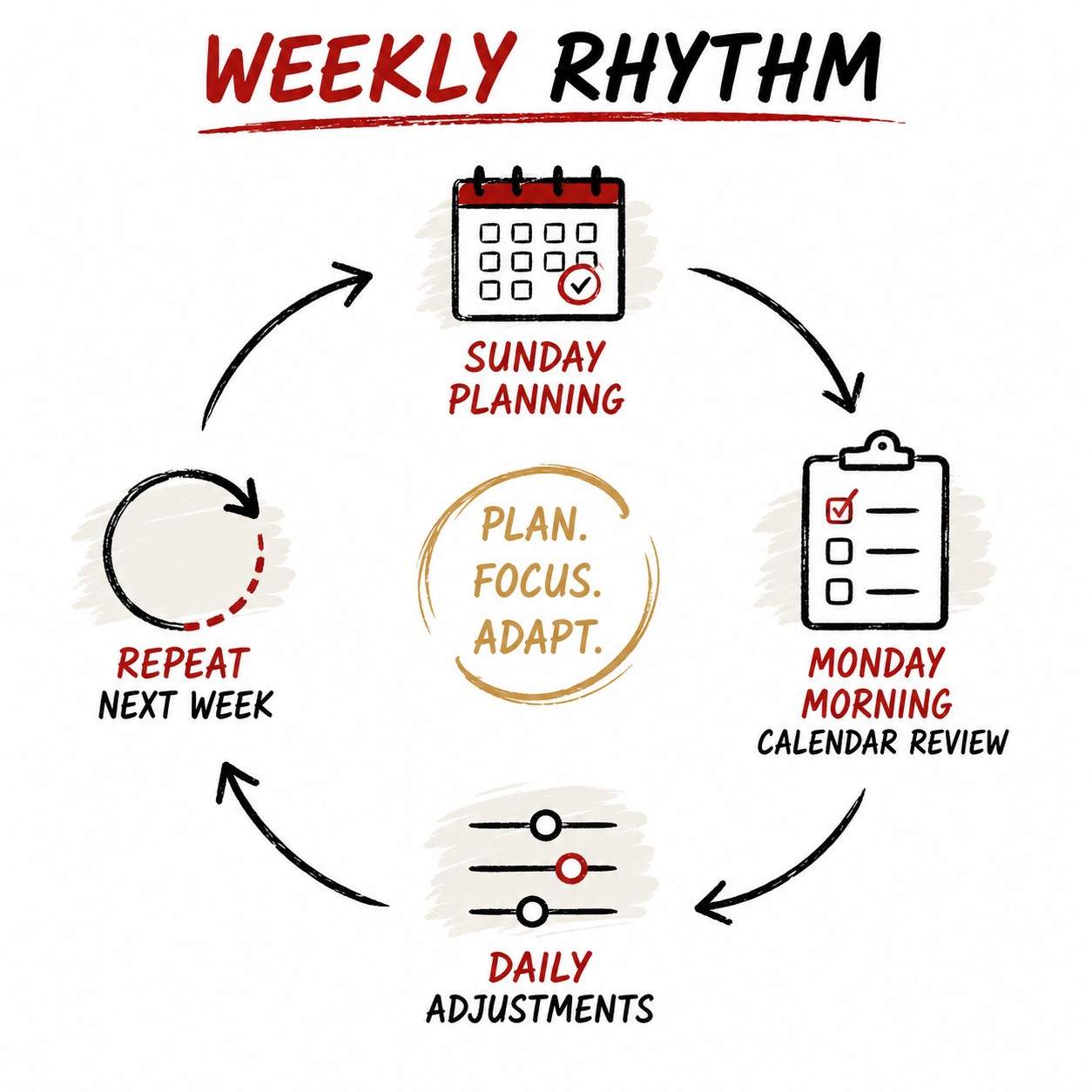
A strong week starts with a planning ritual, ideally done on Sunday night, that sets your calendar before Monday morning arrives.
Reviewing your week in advance means you walk into Monday already knowing what needs to happen, instead of reacting to it. Just as important as the weekly review is a daily calendar check. Priorities shift, emergencies come up, and without a quick daily adjustment, agents end up with tasks piling up at the worst times, like a client call bleeding into a Friday evening because nothing moved earlier in the week.
The Morning Routine of a Successful Real Estate Agent
The best morning routines happen before the phone comes out, not after.
What you do in the first hour of your day sets the tone for everything that follows. A consistent routine; whether that's reading, movement, or simply eating before diving into work, creates the setup needed to perform at a high level. Skipping that routine tends to throw off the entire rhythm of the day, leading agents into reactive mode: putting out fires instead of doing the work that actually grows their business.

Setting Boundaries With Clients as a Real Estate Agent
Protecting your schedule starts with setting clear expectations, not with saying no to every request.
Clients don't need you available every hour. They need to know when you are. If clients expect an agent to answer the phone at any moment, that's usually a sign expectations were never set in the first place. An agent working six days a week from noon to 7 p.m. is already available 42 hours a week, more than most professionals ever offer. No other service provider would drop everything for a same-day request, and agents don't need to either.
For same-day showings and last-minute requests, the practical strategy is simple: don't look. Checking an email or a voicemail pulls your attention, even if you don't act on it right away, so the most effective agents keep their phone out of sight during protected blocks and address requests once the block is done, not the moment they come in.
The mindset shift that makes this possible is remembering that your morning lead generation block is your highest-dollar producing activity. That doesn't change with the market. In a slower market, it might just mean stretching that block longer, since production is driven by the amount of activity an agent is willing to put in, not by how easy the market happens to be.
Common Scheduling Mistakes Real Estate Agents Make
The most common mistake is checking messages before the lead generation block is finished, which breaks focus before the most important work of the day even gets started.
Letting "urgent" crowd out "important" is a close second. Inevitably, something will threaten to interrupt a protected block. When that happens, the fix is to move the block, not delete it, since skipping it altogether comes at a real cost to production. Finally, failing to review and adjust the schedule week to week leaves agents working off a plan that no longer reflects what's actually happening in their business.
How to Build a Schedule That Sticks
Every real estate agent eventually faces the same challenge: a calendar that feels like it's controlling them instead of the other way around. Calls, texts, emails, and last-minute requests will always be part of the job, but they don't have to dictate how your day unfolds.
The agents who build sustainable, successful careers aren't necessarily the ones working the longest hours. They're the ones who consistently protect the activities that create future business: a morning routine that sets the tone, dedicated lead generation time, a weekly planning rhythm, and clear boundaries that allow them to serve clients without burning out. Structure creates freedom.
At Premier Home Team, this isn't just something we teach, it's how we operate. Walk into our office at 10:30 on a weekday, and you'll find agents prospecting because that's the rhythm we've built into our culture. When everyone around you is committed to the habits that grow a business, consistency becomes much easier to achieve.
Ready to build your own weekly rhythm?
Download the Premier Home Team Weekly Rhythm Worksheet, a simple one-page planning tool designed to help you protect lead generation time, organize your week, and build a schedule you can actually stick to.
Frequently Asked Questions
What is the best daily schedule for a real estate agent?
The most effective schedule starts the day with training and lead generation in the morning, followed by client-facing work like showings, listing appointments, and closings in the afternoon.
How many hours do real estate agents work each week?
New agents should plan for roughly 50 hours a week to hit first-year goals, split close to evenly between prospecting and client-facing activities. As agents gain production and leverage, that split can shift further toward prospecting.
How do top real estate agents manage their time?
Through time blocking, protecting a morning lead generation block above everything else, and reviewing their calendar weekly and daily to adjust for shifting priorities.
What should a real estate agent do first thing in the morning?
Top producers avoid opening their phone first thing. Instead, they follow a consistent personal routine before diving into client-facing work, which sets the tone for a focused, productive day.
How do real estate agents build a consistent routine?
Consistency comes from a weekly planning ritual, typically done Sunday night, paired with a quick daily calendar review to adjust for changing priorities and protect the most important time blocks.

Robin Martin
Realtor® | Premier Home Team | Keller Williams Empower | PLACE
or another way