
Categories
Working in Real EstatePublished September 18, 2026
A Real Estate Team vs. Brokerage Breakdown for New Agents


EXECUTIVE SUMMARY
Every real estate agent must be affiliated with a brokerage - that's the law, regardless of whether you're on a team or not. A brokerage handles legal compliance, commission processing, and liability protection. A real estate team exists inside a brokerage and adds what most agents actually need: systems, coaching, leads, and accountability. You don't choose a team or a brokerage. You choose a team, and the brokerage comes with it.
You just got your real estate license. The phone starts ringing, the emails roll in, brokerages are pitching you before you've closed a single deal. But you're also seeing teams advertising for agent roles, and now you're not sure what you're even choosing between. Do you have to join a brokerage to join a team? Are they competing options? And which one will actually support your new career?
It's a confusing moment, and nobody explains it clearly, because most people assume you already know. At Premier Home Team, we have been onboarding agents for the past five years, and we can have this conversation with them at every stage.
In this article, we’ll break down what a brokerage is, what a real estate team really is, what they offer you, and what it means for your career as a real estate agent.
What Is a Real Estate Brokerage?
A brokerage is the legal entity responsible for overseeing how you conduct your business in real estate. Before you can sell a single home in Pennsylvania, Delaware, and New Jersey, you need to be affiliated with a brokerage. This is not optional.
The brokerage ensures you're operating in compliance with the rules governing how you represent clients. More importantly, it's what authorizes you to practice at all. Without that affiliation, your license is just a piece of paper.
Beyond that legal foundation, the brokerage handles commission processing. You cannot walk out of closing and have a client pay you directly. Commissions flow through the brokerage first, and the finance department disperses them to you after ensuring all compliance documents are in order.
Brokerages also offer training, but in our experience it tends to be one-size-fits-all. It doesn't account for where each agent is or what they specifically need to improve.
So What Exactly Is a Real Estate Team?
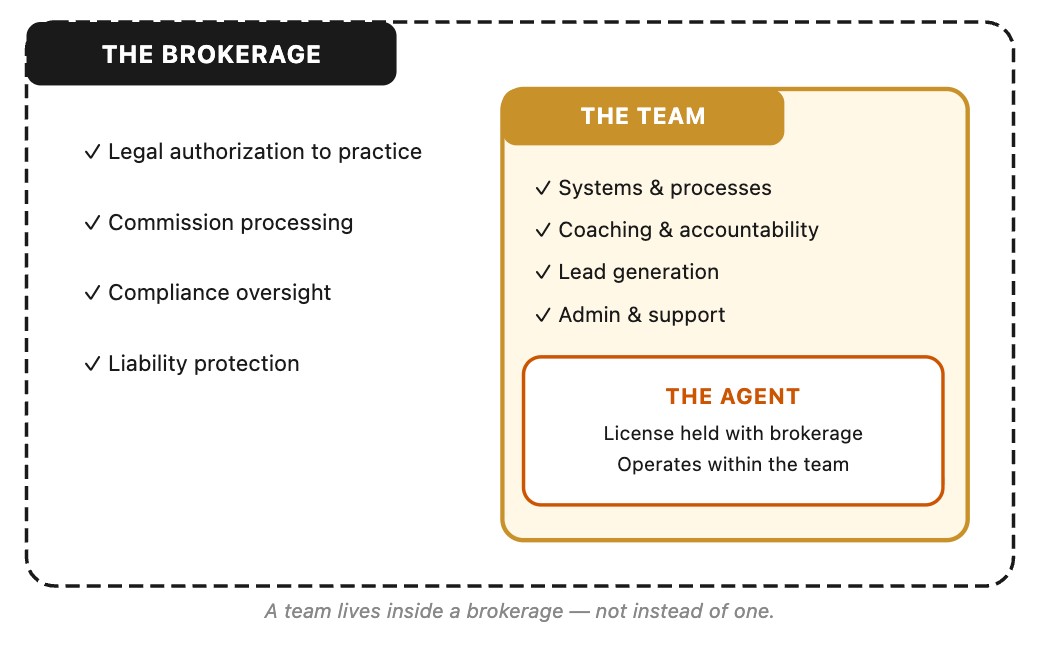
A team is a group of agents, usually built around a team leader, who operate together under a shared brokerage affiliation. Here is the thing that confuses most new agents: a real estate team does not exist instead of a brokerage. It exists within one.
Every agent on the team still has their license with that brokerage. The team adds a layer on top of the brokerage infrastructure, one focused on growth, production, and coaching.
"You can do a brokerage without a team, but you can't do a team without a brokerage."
At Premier Home Team, we operate within our brokerage but function largely independently from the broader office. We have our own space, admin support, a director of operations, and built-out coaching and systems. Most of what an agent on our team needs can be handled internally before it ever needs to reach the brokerage level.
The brokerage handles compliance and commission processing. The team handles everything that actually helps you build a business.
What Does a Brokerage Give You vs. What Does a Team Give You?
The brokerage gives you legal standing. It authorizes you to practice, processes your commissions, oversees compliance, provides liability protection, and connects you to a wider network of agents. A real estate team runs on a different model. On most production-based teams, teams make money when their agents produce. That alignment of incentives changes everything.
When you join a team, a portion of your commission goes into the team's infrastructure: systems, leads, coaching, and support. Think of it less as giving up part of your split and more as investing it. The more you put in, the more the system is built to give back.
Still weighing solo vs. team? We break down that decision in detail here: Solo vs. Team: Which Real Estate career path is right for you?

PERSONAL PERSPECTIVE: Jarred's Experience Going Solo vs. Joining a Team
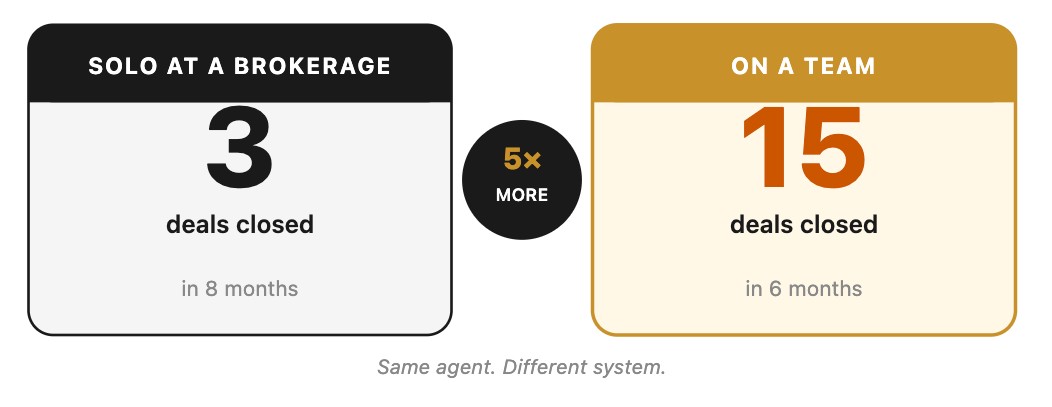
When I went solo at a completely different brokerage, in an eight-month span I did three deals. I had no one to help me with anything: understanding contracts, negotiations, any of it.
For a brand new agent with no sphere, being on a team means you are walking into structure. A system that's tried and proven true. Going solo at a brokerage, you're fending for yourself.
In a six-month span, I closed 15 deals, 5 times the three deals it took me eight months to do. Joining the Premier Home Team provided me with the systems to follow, structure around my work day, and the accountability to execute on the systems. Being in a system designed to help agents scale was the difference maker for me.
Who Is a Good Fit for a Real Estate Team?
The agents who thrive on teams tend to be coachable, collaborative, and willing to follow a proven process. They want to build a business, not just close a deal here and there.
One of the biggest mistakes we believe new agents make is letting the commission split be the deciding factor without understanding what it buys. That split isn't money leaving your pocket. It's being reinvested into the team's operations, systems, and support to help you scale.
When it comes to where to start your search, our advice is simple: the brokerage matters less than the team. Find a system that aligns with your goals and values. What we've seen with agents on our team is that if you're on the right team, you'll be so insulated from the broader brokerage that what they have going on won't really affect your day-to-day.
Find your team first. The brokerage follows.
If you're still working through the commission split question, we break it down in detail here: Real Estate Team Commission Splits: What Every Agent Should Know
Why the Team and Brokerage Difference Matters
A real estate team and a brokerage are not interchangeable options. Every agent needs a brokerage. The choice is whether you want to build your business within that brokerage on your own or with the added structure of a team.
Your brokerage gives you the legal foundation to practice real estate. A team can add the systems, coaching, leads, accountability, and day-to-day support that help you build a business. Now that you understand the difference, you can evaluate each for what it actually provides instead of treating the two as competing choices.
But understanding the difference is only the first step. Not every real estate team offers the same level of training, support, lead generation, or opportunity for growth. Before joining one, you need to know what questions to ask and what to look for in the answers.
That's why we created the New Agent Team Interview Toolkit. It includes questions to ask when interviewing a real estate team, a scorecard you can use to compare multiple teams, and common warning signs to watch for before you commit.
Use it when you start talking with teams so you can evaluate your options based on more than a commission split, and choose the environment that gives you the best opportunity to build the career you want.
Frequently Asked Questions
How do real estate teams work?
A real estate team is a group of agents operating under one brokerage affiliation, led by a team leader. The team provides systems, coaching, leads, and support. The brokerage handles legal compliance and commission processing. Most teams operate semi-independently from the broader brokerage office with their own admin and infrastructure.
How do real estate teams split commissions?
When an agent closes a deal, a portion goes to the brokerage and a portion goes to the team. The agent keeps the rest. The portion of your commission you pay out on a team is higher than going solo, but the trade-off is access to systems, leads, and coaching you'd otherwise have to build yourself. The right question isn't "what am I giving up?" but "what is my commission being invested in?"
Do you have to be part of a brokerage if you join a real estate team?
Yes. Every agent on a team is still affiliated with a brokerage. The team exists inside the brokerage, not instead of it. The brokerage provides your legal standing and processes your commissions. The team provides systems, coaching, accountability and support to help grow your business.

Robin Martin
Realtor® | Premier Home Team | Keller Williams Empower | PLACE
or another way