
Categories
Investment InsightsPublished August 19, 2026
Rental Property ROI: What It Is and How to Calculate It

The Quick Answer
Rental property ROI (return on investment) measures how much a property earns compared to how much it costs to own. To calculate it, subtract your annual operating expenses (mortgage, taxes, insurance, and a maintenance reserve) from your annual rental income, then divide by your total investment (down payment, closing costs, and renovations). In the Philadelphia area, a healthy benchmark is around 10% ROI, though the right target depends on the property and your risk tolerance.
If you're thinking about buying your first rental property, there's a good chance you're feeling more nervous than excited. You've probably heard people throw around terms like "ROI" and "cash-on-cash return" like everyone just knows what they mean, and you're not entirely sure how to calculate whether a property will actually make you money or quietly drain it. Between conflicting online advice and the pressure to make a decision with real money on the line, it's easy to feel stuck before you've even made an offer.
We've helped investors evaluate properties across Greater Philadelphia, Delaware, and South Jersey. We've seen the deals that looked great on paper fall apart, and the ones that looked average turn into someone's best-performing property, and almost every time, the difference comes down to whether the math got done before the purchase.
By the end of this article, you'll know:
- What ROI actually means for a rental property, in plain terms
- How to calculate it yourself, step by step
- What a realistic "good" ROI looks like in this market
- The most common ROI mistakes that investors make
What Is ROI on a Rental Property?
ROI, or return on investment, is a simple comparison: how much money the property generates versus how much it costs you to own and operate it. If a property brings in $2,000 a month in rent, and your mortgage payment plus expenses come to $1,700, your monthly cash flow is that $300 difference.
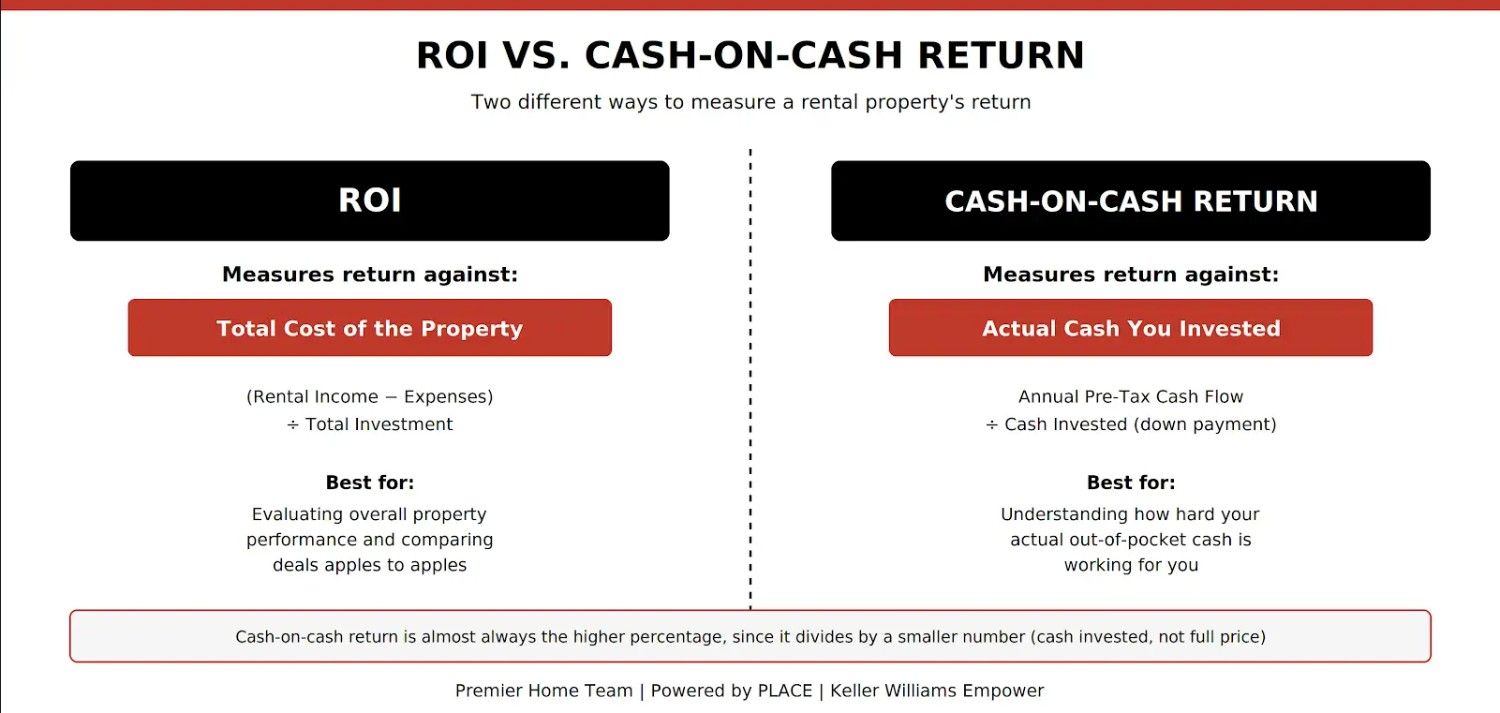
ROI and cash-on-cash return are related, but they're not the same calculation. ROI typically measures return against the total cost of the property. Cash-on-cash return measures your annual pre-tax cash flow against the actual cash you put into the deal, usually your down payment, closing costs, and any renovation expenses. Investors mix these terms up constantly, and it matters because cash-on-cash return will almost always be a higher percentage than straight ROI, since you're dividing by a smaller number (your cash invested, not the full purchase price).
Calculating this before you buy, not after, is what separates a deal that looks good from a deal that actually is good.
How to Calculate ROI on a Rental Property (Step by Step)
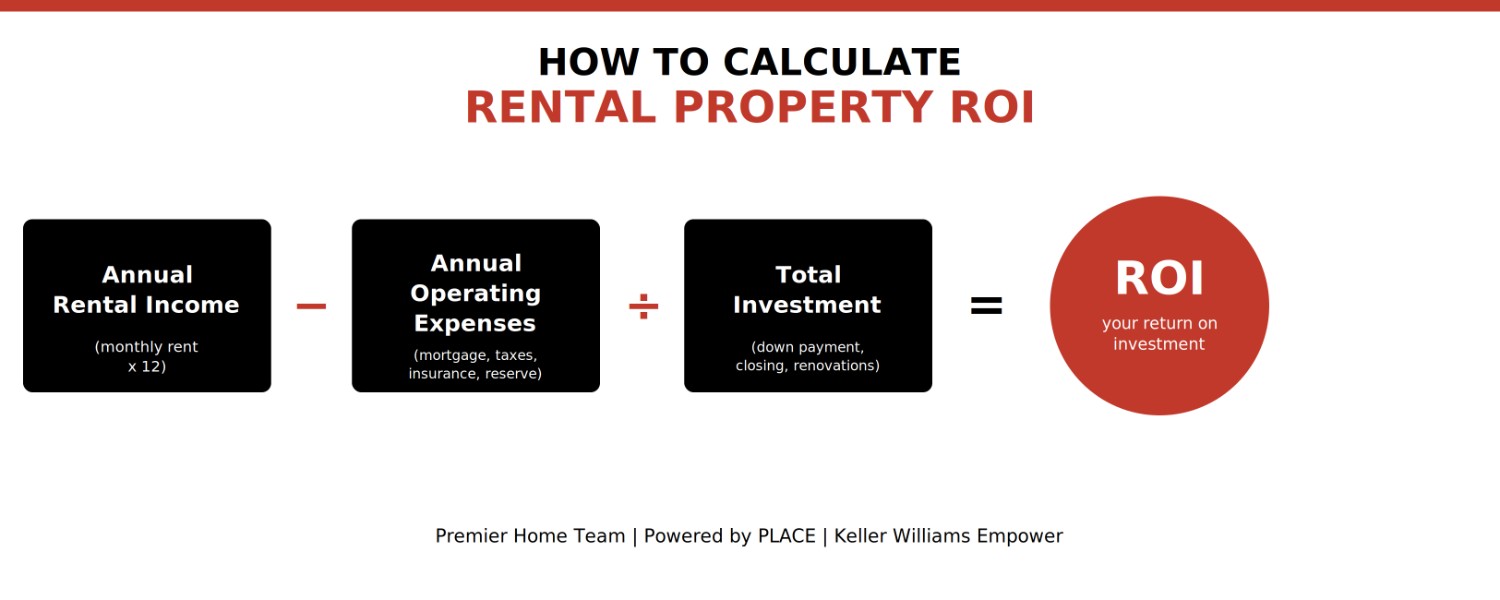
The basic formula is:
(Annual Rental Income − Annual Operating Expenses) ÷ Total Investment = ROI
Annual rental income is straightforward: your monthly rent multiplied by 12. Operating expenses are where most investors underestimate. This includes your mortgage payment, property taxes, insurance, and a maintenance reserve, not just the mortgage. A common rule of thumb is to set aside roughly 1% of the property's value each year for maintenance and repairs, separate from your monthly cash flow, so a broken water heater or a plumbing leak doesn't wipe out months of profit at once.
Total investment covers your down payment, closing costs, and any money spent on renovations or repairs before renting the unit out.
For cash-on-cash return specifically, the calculation is your annual pre-tax cash flow (rent minus all expenses, including your mortgage payment) divided by your actual cash invested, which for most investment properties starts with a 20% down payment.
Sample ROI on a $150,000 property in North Philadelphia (19121)
| Purchase Price | $150,000 |
| Down Payment | $30,000 |
| Closing Costs | $13,000 |
| Initial Repairs | $3,000 |
| Monthly Rent | $1,500 |
| Annual Expenses | $1,500 |
| Annual Net Income | $4,212 |
| ROI | 8.8% |
What Is a Good ROI for a Rental Property?
There's no single number that applies everywhere, but as a general benchmark, many investors in the city of Philadelphia target around 10% ROI, an achievable goal without taking on excessive risk. The right number for you depends on the property, financing terms, and how much risk you're comfortable taking on.
Local market conditions matter too. Right now, property values across the Philadelphia area have continued climbing while rents haven't kept pace at the same rate, which means margins are getting thinner for new investors. At the same time, properties are sitting on the market longer than they were, which suggests some price stabilization may be ahead. Multifamily properties tend to offer more predictable returns than single-family rentals, since income isn't dependent on a single tenant.
What Expenses Reduce Rental Property ROI?
Vacancy. This is one of the biggest hidden killers of returns. First-time investors often price their rental at the top of the market to maximize income, then end up sitting empty for months while they wait for the right tenant. A property priced fairly and rented quickly will almost always outperform one that sits vacant chasing a premium rent.
Maintenance and capital expenditures. Beyond routine repairs, budget for bigger-ticket items like a roof or HVAC system. A pre-purchase home inspection is one of the most valuable tools for understanding what you're likely to face down the road.
Financing terms. Many first-time investors are surprised to learn that conventional or FHA loan products they may have used for a primary residence don't apply the same way to financing an investment property, and investment property loans often come with higher interest rates and larger down payment requirements.
Common ROI Calculation Mistakes Investors Make
Underestimating expenses. The most frequent mistake is calculating ROI based on the mortgage payment alone and leaving out taxes, insurance, vacancy, and a maintenance reserve.
Waiting for the "perfect" deal. Analysis paralysis is real. Investors can spend eight months to over a year searching for a flawless deal, when a solid, well-calculated deal today often outperforms a theoretically perfect one found much later.
Real Deal: Turning a Break-Even Property Into a Cash Flow Winner
[Story below is from an actual Premier Home Team client, details adjusted to protect privacy.]
One investor bought a single-family home mainly to round out his portfolio, not because the numbers were exciting. At purchase, it was barely cash flow positive, netting around $200 a month. Rather than treating that as the ceiling, he converted the basement into a separate unit, creating two income streams from one property. Monthly cash flow jumped to roughly $1,400.
It wasn't part of the original plan. It became one after he recognized the property still had untapped potential. He's since replicated the strategy on two more properties, and it's become his go-to approach for finding value other investors miss.
The takeaway: the "perfect" deal isn't always obvious on day one. A property that looks average on paper can still be a strong investment if you're willing to look at what it could become, not just what it already is.
Ignoring appreciation, cautiously. Appreciation and equity build-up matter over the long term. It's common for a rental property to just break even in the first year or two, with returns improving the longer you hold it as rents and property values rise.
Overlooking tax implications. Rental income, depreciation, and deductible expenses all affect your actual return, and the rules are specific to rental property ownership. The IRS's guide to residential rental property is a useful starting point, though a tax professional familiar with investment property should confirm how it applies to your specific situation.
Why You Should Calculate ROI Before Buying a Rental Property
Not long ago, most first-time investors leaned on word of mouth and gut instinct to decide whether a property was worth buying, which is exactly the kind of uncertainty that makes getting started feel so overwhelming in the first place. Without a clear way to check the math, it's easy to second-guess every deal, or worse, buy one that never had the numbers to support it.
Today, that uncertainty doesn't have to follow you into a purchase. With a clear formula and an understanding of local market conditions, you can evaluate a deal in minutes rather than months, and know with real confidence whether a property will work for you before you ever make an offer.
Looking ahead, the investors who build wealth consistently in this market aren't the ones who find one perfect deal. They're the ones who run these numbers on every deal, every time, so they can move quickly and confidently when the right property does show up.
We've watched investors build real wealth this way, and it's never the ones who go on gut feel. If you want to dig deeper on what could eat into that maintenance reserve, our guide to the different types of home inspections and what they typically cost breaks down everything from sewer scopes to structural engineering inspections.
Download our free rental property ROI Quick Start Cheat Sheet and run the preliminary numbers on your next deal in minutes.
Frequently Asked Questions
How do you calculate ROI on a rental property?
Subtract your annual operating expenses (mortgage, taxes, insurance, and maintenance reserve) from your annual rental income, then divide that number by your total investment, including your down payment, closing costs, and any renovation costs.
What is a good ROI for a rental property?
It varies by location and risk tolerance, but many investors in the Philadelphia area use roughly 10% as an achievable benchmark for a well-run rental property.
What's the difference between ROI and cash-on-cash return?
ROI generally measures return against the full cost of the property, while cash-on-cash return measures your annual cash flow specifically against the cash you invested, such as your down payment and closing costs.
Does appreciation count toward ROI?
Not in a basic ROI calculation, which focuses on income versus expenses. Appreciation and equity build-up are real value drivers over time, but they shouldn't be used to justify a deal that doesn't cash flow well on its own in the near term.
How do I calculate ROI if I have a mortgage on the property?
Include your full mortgage payment (principal and interest) as an operating expense in your calculation, along with taxes, insurance, and a maintenance reserve, before comparing the result to your total cash invested.

Robin Martin
Realtor® | Premier Home Team | Keller Williams Empower | PLACE
or another way