
Categories
Home Owners, Seller StrategiesPublished July 6, 2026
What Is a Pocket Listing? A Home Seller's Complete Guide


What Is a Pocket Listing? A Home Seller's Complete Guide
You are thinking about selling your home, and somewhere along the way you have heard the term "pocket listing." Maybe an agent mentioned it. Maybe a friend or neighbor said they sold their home that way. And now you are sitting with the same questions almost every seller in your shoes asks: what is a pocket listing, really? When does it actually make sense to use one? And how do I know I will not make the wrong call and leave money on the table?
Choosing how to list your home is one of the biggest financial decisions you will ever make, and the conflicting advice online does not exactly help. The fear of getting it wrong is real, especially when "wrong" can mean thousands of dollars and weeks of stress.
At Premier Home Team, we have helped sellers across the Philadelphia suburbs work through this exact question. Our team has sold homes off-market, pre-market, and on the full MLS, so we have a pretty clear picture of where each approach wins and where it falls flat. In this guide, you will get a straight answer on:
- what a pocket listing actually is
- how a pocket listing really works
- the honest pros and cons
- the situations where it is the smart move for your home (and where it is not).
By the end, you should feel a lot more confident about which path is right for you.
What Is a Pocket Listing?
A pocket listing is a home that is for sale, but not advertised on the MLS (Multiple Listing Service, the database of all public listings in the Philadelphia, South Jersey, Delaware, and Northern Maryland region) or any public platform. Instead, we share the listing privately, agent to agent and network to network, with buyers who are already actively looking.
The way we usually explain it to sellers is that a pocket listing is where we are able to list and market your property to other agents we are already in close communication with. It is a more private way to sell your home. It is not going on the MLS. We share it with other agents inside our brokerage, or with agents we are close with who we think might have someone willing to pay top dollar for your home.
You may also hear pocket listings called off-market listings, private listings, whisper listings, quiet listings, or pre-market listings (that last one specifically meaning the home will eventually hit the MLS). The labels overlap, but the core idea is the same: your house is for sale, but only a curated group of qualified people know about it.
How Does a Pocket Listing Work?
Mechanically, the process looks a lot like a traditional listing, just without the public marketing. You sign a listing agreement with a checkbox that keeps the home off the MLS. We prepare the listing internally with photos, pricing, and property details, then share it privately through three channels: our own buyer database, our team's database, and our brokerage's broader agent network. Interested agents bring qualified buyers to private showings by appointment, offers come in, and we negotiate just like we would with any other sale.
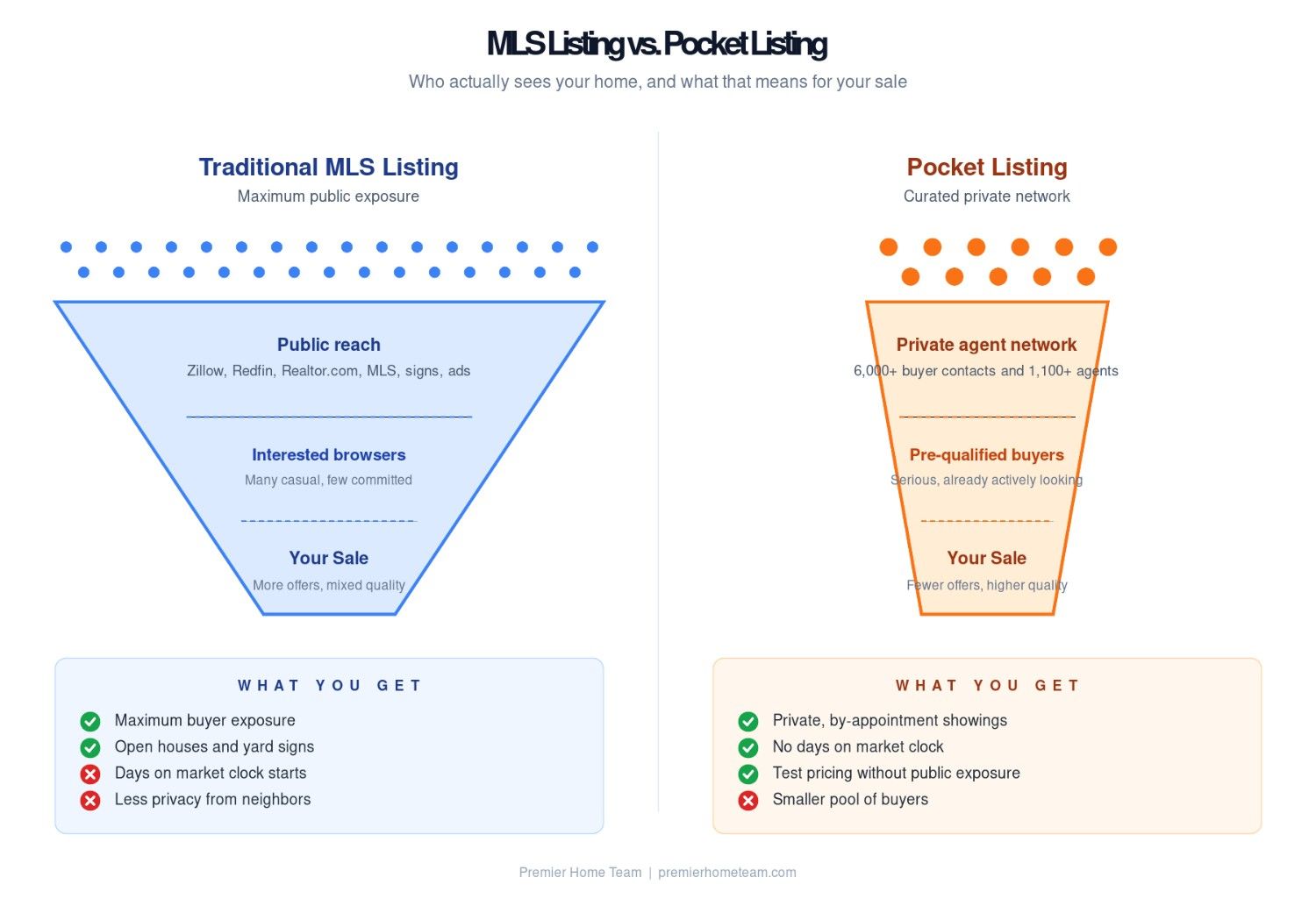
For our team specifically, that private audience is a curated pool of roughly 6,000 buyer contacts plus our 1,100-plus agent brokerage network across greater Philadelphia, and our Main Line partner network. It is a meaningful reach. It is just narrower than the full MLS by design.
The other quietly powerful piece: a pocket listing does not accumulate days on market. Days on market is always going to be one of the biggest factors that drags down your sale price. The longer a home sits publicly, the more buyers assume something is wrong with it. With a pocket listing, that clock does not start, so we can move at a more leisurely pace without that pressure. Most pocket listings either find a buyer within one to three weeks or transition to the MLS at that point.
Should You Choose a Pocket Listing or MLS Listing?
Choosing between a pocket listing and a traditional MLS launch is one of the biggest pricing and strategy decisions you will make as a seller, and the right answer depends on your home, your timeline, and your neighborhood.
Here is the high-level tradeoff most sellers are weighing:
| Factor | Pocket Listing | MLS Listing |
|---|---|---|
| Privacy | High | Low |
| Buyer Exposure | Limited | Maximum |
| Days on Market | No accumulation | Starts immediately |
| Showing Volume | Lower | Higher |
| Competitive Offers | Potentially fewer | Typically more |
In general, sellers who prioritize privacy, flexibility, and a quieter selling process tend to lean toward pocket listings. Sellers who want maximum exposure and the highest chance of multiple competing offers usually benefit more from a full MLS launch.
The right choice depends on your neighborhood demand, your timeline, and how important privacy is to you. Before you commit to either path, schedule a no-pressure conversation with our team and we will give you a clear-eyed read on whether off-market is the smart move for your specific situation.
Pocket Listing vs MLS Listing: What's the Difference?
Before deciding whether to sell privately or publicly, it helps to see the differences side-by-side.
The Benefits of a Pocket Listing for Home Sellers
The clearest win is privacy and control. Most of the sellers we work with on pocket listings choose this route because they simply do not want neighbors, coworkers, or the rest of the internet to know they are selling. The sellers who benefit most are the ones trying to keep it more hush hush. They do not want the big sign out front. They do not want the neighbors knowing their business. They just want to sell as peacefully as possible with as few showings as possible.
Showings are by appointment with pre-qualified buyers only, which means fewer interruptions and almost no casual lookie-loos rummaging through your place. If you have ever gone through the stress of constantly preparing your home for showings, a quieter off-market approach can feel significantly more manageable.
Beyond privacy, you gain real strategic flexibility. You can quietly start the day you decide you might sell, without committing to a hard launch date. You can use a one to two week pocket window to test whether your home will support a stretch price, then either sell off-market or move to the MLS with real data instead of guesswork. And because the days on market clock never starts, you avoid the price erosion that comes with a home sitting publicly too long.
The Downsides and Risks of Pocket Listings
The real trade-off is that fewer eyes usually means fewer offers, and fewer offers usually means less competitive pricing. Fewer buyers means less competition, so a pocket listing might not get you the price you would have hoped for had it gone fully public. In a tight seller's market with low inventory, the gap can be small. In a balanced or buyer's-leaning market, the gap can be meaningful, and you need to go in with realistic expectations.
The other thing every seller should understand is NAR's Clear Cooperation Policy. It says any public marketing of a listing (Instagram, Facebook, a website, an open house sign) triggers a 24-hour requirement to post the home on the MLS. That is not a loophole problem, it is by design. It also means our marketing reach for a true pocket listing is, by rule, limited to private email and word of mouth within the brokerage. Pocket listings are 100% legal in Pennsylvania as long as that rule is honored and the right paperwork is signed.
When a Pocket Listing Makes Sense (And When It Does Not)
In our experience, pocket listings work best for sellers in highly desirable, low-inventory neighborhoods (think school districts like Haverford, Springfield, Wallingford, and Media), for privacy-focused sellers who genuinely want the sale kept quiet, for sellers who want to test a stretch price before committing to a public launch, and for niche properties where a curated investor audience is more valuable than a wide public one.
They tend to underperform when the supply and demand picture favors buyers. The clearest examples we have seen of a pocket listing not working is in areas that did not have higher demand for homes, where the supply demand curve had tipped toward the buyer side.
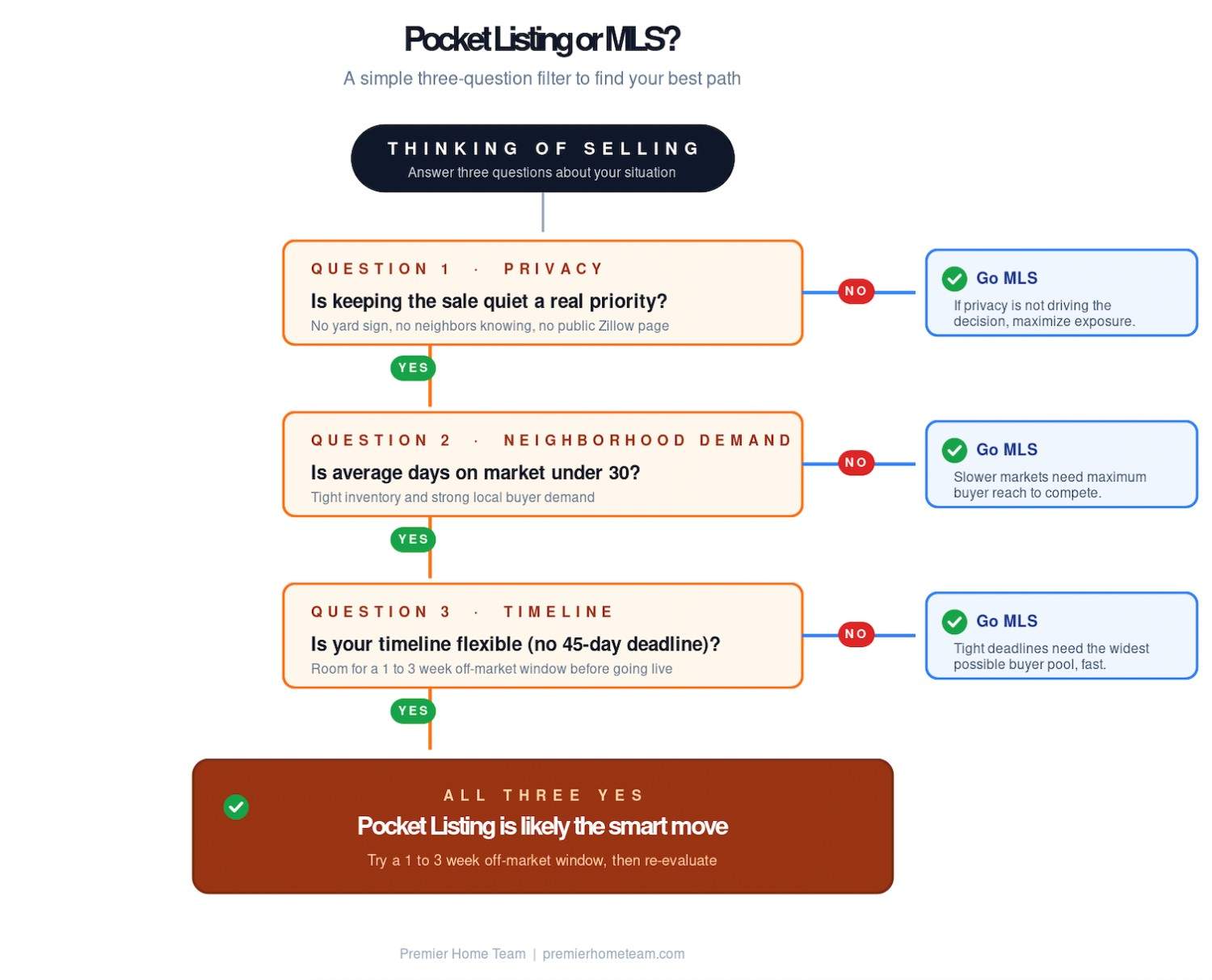
A simple rule of thumb we use: if average days on market in your neighborhood is under about 30, you are in pocket listing territory. If it is closer to a month or more, the MLS is almost always the safer play.
Sellers with a hard closing deadline (45 days or less) should also default to the MLS, because the off-market test takes time you may not have.
How We Handle Pocket Listings at Premier Home Team
.jpeg)
Our default with sellers is to at least consider the pocket listing first. If you start there and realize it is not for you, it is a lot easier to go to the MLS than it is to come back from the MLS to off-market. When we run a pocket listing, we work through it in tiers: our individual agent's own buyer database first, then the broader team's database, then our 1,100-plus brokerage network and Main Line partners. We also use targeted circle-dialing and conversations with neighbors who may know someone hoping to buy into the area.
Most of the time, the right answer is "try the pocket listing for a defined window of one to three weeks, then re-evaluate." That gives you privacy, control, and a chance to test pricing without burning days on market. If it works, great. If it does not, we transition to the MLS having lost almost nothing.
The Bottom Line on Pocket Listings
A pocket listing is a legitimate, legal, and often smart way to sell your home in the Philadelphia area. It works best for sellers in high-demand neighborhoods who value privacy, want flexibility on timing, or want to test a price before committing to a full MLS launch. It works less well in slower markets, for homes that need maximum exposure, or for sellers on a tight closing timeline.
The factors that matter most are how much you value privacy, the level of demand in your specific neighborhood, and how flexible your timeline is. None of those have a one-size-fits-all answer, which is exactly why this decision is worth talking through with someone who has done both.
Ready to figure out whether a pocket listing is right for your home? Talk to our team and we will walk you through your specific situation, your neighborhood data, and whether off-market or MLS gives you the best shot at the price and timeline you want. No pressure, no obligation, just an honest read from a team that has done both in this market.
If you want to explore another flexible alternative to an immediate MLS launch, our complete guide to coming soon listings is the next read worth your time.
Frequently Asked Questions
Are pocket listings legal in Pennsylvania?
Yes. Pocket listings are fully legal in Pennsylvania, as long as your agent follows NAR's Clear Cooperation Policy. You sign paperwork indicating the home should stay off the MLS, and we market it only through private agent-to-agent channels. Public marketing (social media, online ads, public websites) triggers a 24-hour requirement to post to the MLS.
Does a pocket listing accumulate days on market?
No. Because the home is not on the MLS, the days on market counter does not start. That can be a significant advantage if you want to test pricing or sell on a flexible timeline without buyers later assuming something is wrong with the home.
Do pocket listings sell for less?
It depends on your market. In high-demand neighborhoods with short days on market and tight inventory, pocket listings can often match (and sometimes exceed) MLS prices because qualified buyers compete hard for limited opportunities. In slower, higher-inventory markets, you typically give up some price by limiting your buyer pool.
How long should I try a pocket listing before going on the MLS?
One to three weeks is the typical window. If we have not generated serious interest in that time, it usually makes sense to either adjust your price or transition to the MLS.
Can I use a pocket listing if I just do not want neighbors to know I am selling?
Yes, and it is one of the most common reasons sellers choose this route. Privacy from neighbors, family, or even employers is a fully valid reason, and we can even adjust our marketing approach (skipping circle-dialing your immediate block, for example) to keep things truly quiet.
Is a pocket listing better than listing on the MLS?
It depends on your goals and your market. Pocket listings offer more privacy and flexibility, while MLS listings typically provide maximum exposure and the highest chance of multiple competing offers. In high-demand neighborhoods, a pocket listing can work very well. In slower markets, listing publicly on the MLS is often the safer strategy for maximizing buyer interest.

Robin Martin
Realtor® | Premier Home Team | Keller Williams Empower | PLACE
or another way