
Categories
Working in Real Estate, CareersPublished April 15, 2026
An Honest Review of Working for Premier Home Team

.jpeg)
Premier Home Team Review: An Honest Look for Real Estate Agents
If you're a real estate agent researching Premier Home Team online, you're likely trying to answer one core question:
Will joining this team actually accelerate my real estate career, or just change my split?
And maybe a second one:
Is this the kind of environment where I’ll thrive, or will I feel boxed in?
Choosing a real estate team isn’t just about leads or commission splits. It’s about structure, expectations, culture, income tradeoffs, and how you operate.
In this review, you’ll get a clear breakdown of:
- How Premier Home Team is structured
- How leads and splits work
- What support is actually provided
- Who tends to succeed here
- And who should seriously consider a different model
By the end, you should have the clarity needed to decide whether this team aligns with your goals — or whether another path makes more sense.
Who Is Premier Home Team and How Is It Structured?
Premier Home Team operates as a structured, team-based model designed to provide leads, systems, and accountability, without having to build everything from scratch.
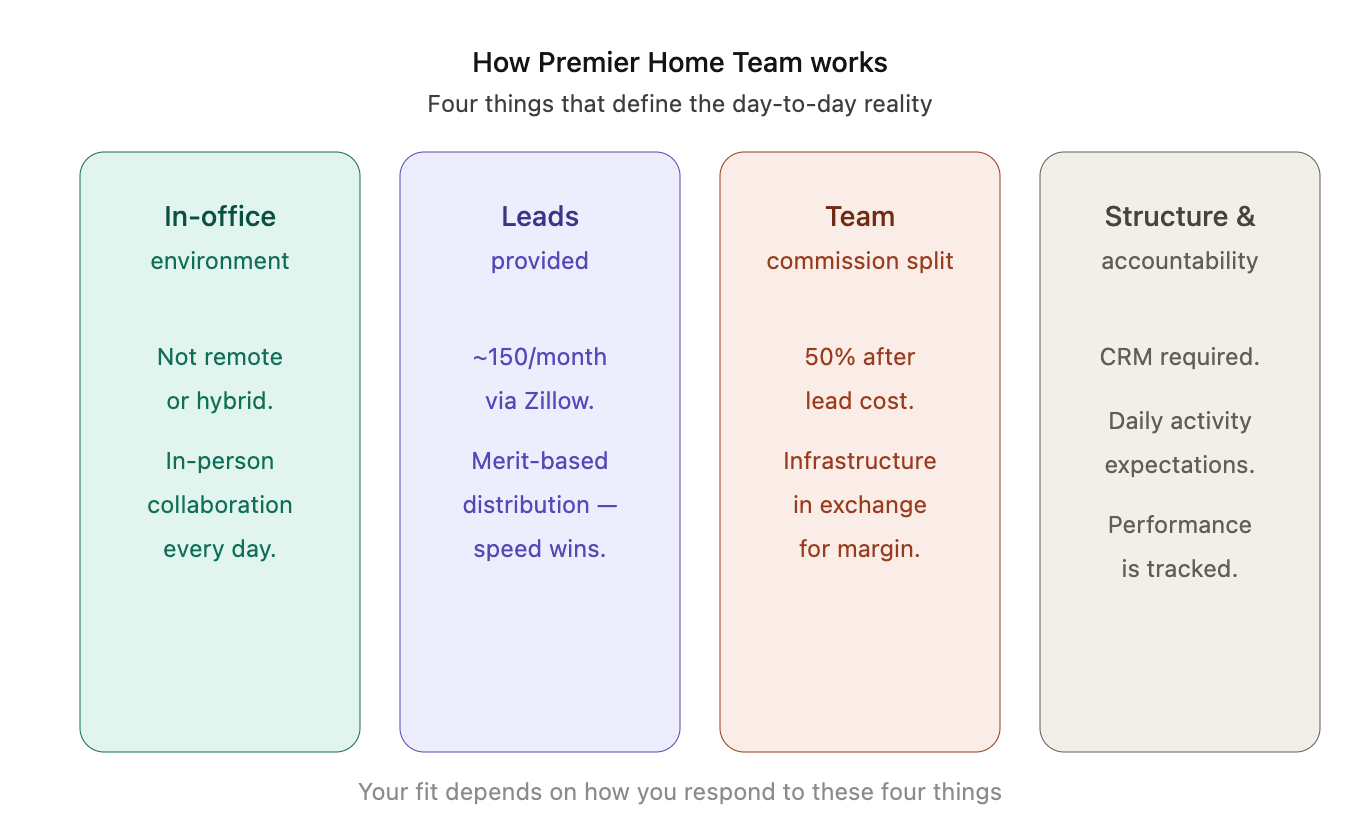
Before evaluating whether it's the right fit, it helps to understand exactly how the model works. There are four things that define the day-to-day reality of being on this team:
It's an in-office environment. This isn't a remote or hybrid model. The team operates primarily in-person, with a strong emphasis on daily collaboration, visibility, and shared energy. If you're around, people notice. If you're not, they check in. For agents who thrive in structured, people-forward environments, that's a feature. For agents who prefer to work independently from wherever, it's an important detail to weigh early.
Leads are provided, and volume is high. The team generates approximately 150 online leads per month, primarily through Zillow. Once agents complete training and launch, they're eligible to receive leads. Distribution is merit-based: the agents who respond fastest and convert most consistently get the best opportunities. There are no favorites, access is earned.
There’s a team commission split. In exchange for leads, marketing, transaction coordination, systems, and coaching, agents operate under a team split. It's not a 100% commission model, and it's not designed to be. The tradeoff is infrastructure and opportunity in exchange for a portion of each commission.
Structure and accountability are non-negotiable. Agents are expected to follow defined workflows, use the CRM consistently, and meet daily activity expectations. Performance is tracked, not as a punishment tool, but as a way to identify where coaching is needed and where momentum can be built.
That's the model in plain terms. Whether it accelerates your career or feels like a poor fit depends almost entirely on how you respond to those four things, and the rest of this article will help you figure that out.
This article includes perspectives from current team members. While experiences vary, we’ve aimed to present both strengths and limitations so you can make an informed decision.
How Do Leads Work at Premier Home Team?
Lead distribution is simple: speed and performance. The agents who respond fastest get the opportunities. As one agent put it, “It’s a meritocracy, you can take a million-dollar lead, you just have to pick up the phone.”
Higher price point leads tend to go to agents who are converting well, ensuring those opportunities are handled effectively. There are no favorites, access is earned through responsiveness and results.
The team leans heavily toward volume over perfection. The philosophy is to work a large number of opportunities rather than wait for the “perfect” lead. While Zillow is considered one of the stronger online sources, success ultimately comes from how consistently you follow up and convert.
Just as important, not every lead needs to convert immediately. Many turn into future business or referrals, which is how agents compound results over time.
Are High-Volume Internet Leads Right for Every Agent?
The real question is whether this type of lead environment fits how you want to build your business.
You may struggle in this environment if you:
- Prefer working exclusively with referrals or sphere-based business
- Get discouraged by rejection or delayed responses
- Want warm, ready-to-transact clients instead of nurturing long-term prospects
- Dislike making frequent outbound calls or responding quickly to new inquiries
- Expect most leads to convert quickly
Internet leads require stamina. Many prospects are early in their search. Some will ghost you. Others may take months to transact. The opportunity is real, but so is the grind.
If you’re looking for low-touch, high-conversion relationships from day one, this model may feel exhausting rather than empowering.
What Support and Transaction Coordination Do Agents Receive?
One of the aspects that current Premier Home Team agents consistently praise is backend support, especially transaction coordination.
Once a deal goes under contract, agents hand off contract-to-close coordination to the Success Team. The team manages contingency timelines, communication between parties, and transaction documentation. Agents remain responsible for negotiation, client relationships, and lead follow-up.
This structure allows agents to focus on new business rather than administrative follow-through.
As Leiny put it: "Being able to handle multiple transactions at a time, it is a lot, and you guys do it all. I love it."
Another big time-saver: the team sends out texts on agents' behalf in the morning to confirm showing appointments. This eliminates wasted drive time to properties where clients forgot about the appointment or decided to cancel. Everything about the support system is built to give agents more time.
How Does Training and Coaching Work at Premier Home Team?
Onboarding at Premier Home Team can feel overwhelming at first, especially for new agents. It's not a passive, nine-to-five training experience. Training includes structured onboarding, required activities, and ongoing performance check-ins.
One agent who came from another team said she had to figure everything out herself initially and wasted a lot of time because she didn't know what she was doing. "Starting the launch program, I think it's the best thing you got," she said. "I did not get this when I started."
Coaching evolves as agents gain confidence. The team is always trying to help people grow and develop in any way possible. If there's a barrier in your way from getting to the next level, they'll help you get through it. And if they can't find someone on the team who's a good enough resource, they'll go outside, across the country, to find the right person who's experienced the same issues.
It's not just about the team within the four walls of the office. It's about the network of other agents and coaches nationwide.
What Is the Premier Home Team Commission Split?
On our team, the split is 50% after the cost of the lead has been satisfied.
Agents should expect to discuss specific split structures directly with leadership during the interview process.
When Does the Team Model Make Financial Sense?
The team model tends to benefit agents who:
- Are new and don’t yet have a predictable pipeline
- Have struggled converting leads consistently
- Don’t want to fund marketing, CRM systems, and admin support out of pocket
- Value speed to production over maximizing margin
If you’re closing 0–6 deals per year on your own, increasing volume, even at a split, can often result in more take-home income than keeping 100% of very little.
When Doesn’t the Team Model Make Financial Sense?
There are also scenarios where staying independent may produce higher margins:
- You already close 15–20+ deals per year from referrals
- You have strong repeat and sphere business
- You’re comfortable paying directly for your own marketing and transaction coordination
- You prioritize autonomy over built-in support
High-producing, self-sourced agents sometimes find that a lower split model increases their net income, provided they can maintain production independently.
What Do Agents Actually Produce?
While individual results vary, available internal data provides additional context around what agents experience inside this model.
Over the past 2 years:
- The average first-year agent on the team closed 6-12 transactions.
- The average agent increased production by 80% within their first 2 years with the team.
- The median time to first closing after joining was approximately 2-3 months.
- Approximately 65% of agents remain with the team beyond 1 year
These numbers don’t guarantee outcomes. Production still depends heavily on individual effort, responsiveness, and consistency.
However, they offer a clearer picture of what is possible within the structure when agents fully engage with the systems provided.
As with any team model, results correlate strongly with participation.
What Is the Culture Like at Premier Home Team?
The word that comes up most often when agents describe the culture is "supportive."
But it's supportive in a specific way. When somebody calls you out for doing something that's not right, it's because they care. "If they didn't care, they'd just keep doing their thing and making their money, and you'd just be behind," one agent explained. "But here, everyone just wants to help you out and push you to do what's right and help you make money."
On top of the caring, there's a competitive edge, but not at anyone's expense. "We don't want to see someone succeed at the cost of someone else failing," one agent said. "We want to see each other succeed together." That mindset; helping each other figure out what needs to be done day in and day out, is what makes the work fun, even when it doesn't always feel fun.
In practical terms, the culture emphasizes visibility, peer interaction, and open performance conversations.
.jpeg)
Why a “Family-Style” Culture Isn’t Comfortable for Everyone
Premier Home Team describes its culture as supportive, collaborative, and invested in each other’s success.
For many agents, that sense of community is energizing. But not everyone thrives in a highly connected environment.
This team may not feel like the right fit if you:
- Prefer keeping work relationships strictly professional and independent
- Dislike public accountability or being called out when you fall short
- Feel pressured in high-energy, collaborative office settings
- Prefer minimal interaction with teammates
- Work best in quiet, self-directed environments
Support can sometimes feel like pressure. Accountability can feel uncomfortable. Being surrounded by driven peers can either motivate you, or highlight performance gaps you’d rather navigate privately.
If you prefer a more transactional, low-interaction team experience, this environment may feel intense rather than inspiring.
Who Thrives at Premier Home Team?
This model isn’t for everyone, and that’s by design. Most agents who explore Premier Home Team fall into a few clear categories:
| Agent Type | Why They Thrive Here |
| Newly Licensed Agents | Don’t want to waste their first year guessing. They benefit from clear daily direction, training, and structure. |
| Stalled or Struggling Agents | Have had leads before, but lacked a system to convert them. Here, they gain clarity, accountability, and a repeatable process. |
| Agents Burned by Other Teams | Have experienced disorganized or unsupported environments and are looking for consistency and real guidance. |
What do Real Estate Agents NOT LIKE about Premier Home Team?
While many agents thrive in our environment, it’s not the right fit for everyone. Most of the friction tends to come down to two key areas:
Fully In Office Model
The team operates primarily in-office. Agents who prefer a fully remote or flexible model may find this structure limiting.
Highly Structured Environment
This may not be the right fit if you:
- Prefer building your business entirely your own way, without standardized scripts or processes
- Already have proven systems in place that consistently generate business
- Dislike strict CRM discipline or daily activity expectations
- Feel drained by performance metrics, tracking, or accountability conversations
- Value flexibility over structure in how you organize your workday
Premier Home Team is built around structure, presence, volume, and accountability. That combination produces strong results for certain personalities and career stages.
This might not be the right fit if you:
- Plan to treat real estate as a part-time venture
- Prioritize maximum commission splits over built-in support
How Does Premier Home Team Compare to Other Real Estate Team Models?
Compared to fully independent brokerage models, Premier Home Team offers more structure, lead access, and operational support, but less autonomy and a lower commission percentage.
Compared to virtual or remote teams, it requires significantly more in-office participation and day-to-day collaboration.
Compared to high-split or 100% commission brokerages, it provides more built-in systems, coaching, and transaction management, but with shared revenue in exchange for those resources.
No model is universally better. The difference comes down to how much infrastructure you want provided versus how much independence and margin you prefer to maintain.
How Is Performance Managed at Premier Home Team?
Like most team-based models, Premier Home Team invests in lead generation and shared systems. Because of that, performance and follow-through matter.
Agents are expected to consistently work the leads they receive, follow the daily workflow, and track activity inside the CRM. Conversion is monitored, as a performance indicator.
If an agent is struggling to convert, the first step is typically evaluation:
- Are leads being responded to quickly?
- Is follow-up consistent?
- Are scripts and systems being used properly?
- Are there skill gaps that need coaching?
In many cases, non-conversion is treated as a coaching opportunity rather than an immediate termination issue. However, as with most team-based businesses, continued access to team-provided resources depends on consistent engagement.
The accountability structure is designed to create clarity. Agents know what is expected, how performance is measured, and where improvement is needed.
For some agents, that transparency feels supportive. For others, regular performance tracking can feel intense.
As with most aspects of the team, the impact depends on how you respond to structured feedback.
Questions to Ask Before Making Your Decision
If you're comparing real estate teams in Pennsylvania right now, the most important questions to ask aren't about commission splits or lead counts. Those matter, but they're not the full picture.
Consider asking:
- What are daily activity expectations?
- What happens if I don’t convert?
- What expenses are included vs separate?
- What does year-one average production look like?
- What percentage of agents stay longer than two years?
- What team culture can I expect?
- What support systems does the team offer?
Is Premier Home Team Worth It for Real Estate Agents?
If you’ve struggled with unclear direction, inconsistent support, or trying to build your real estate business alone, you now have a clearer picture of what Premier Home Team offers, and what it requires.
For some agents, that environment accelerates growth. For others, it feels restrictive.
The deciding factor isn’t whether Premier Home Team is “good” or “bad.” It’s whether the model aligns with how you want to operate.
If you’re serious about evaluating your options, your next step isn’t committing, it’s asking better questions.
Start by speaking with current agents, reviewing the careers page, and comparing this model to at least one other team structure.

Robin Martin
Realtor® | Premier Home Team | Keller Williams Empower | PLACE
or another way