
Categories
Home Buying TipsPublished October 7, 2026
Is 20% Down Really Required to Buy a Home?

Is 20% Down Really Required to Buy a Home?
Executive Summary:
Most buyers don't need anywhere close to 20% down to buy a home. Conventional loans start at 3% down, FHA loans at 3.5%, and VA and USDA loans can go all the way to 0% down for buyers who qualify. The tradeoff for a smaller down payment is usually private mortgage insurance (PMI), which is a monthly cost, not a dealbreaker. The right number for you depends on your monthly payment goals, how much cash you want to keep on hand, and how long you're willing to wait.
If you've been putting off buying because you think you need 20% down, you've been carrying a weight you didn't need. That number gets repeated so often it starts to feel like the rule, and when your savings don't come close, homeownership can start to feel like something that's happening for everyone except you.
Over the past six years, our team has worked with more than 500 buyers, and one of the very first questions many of them ask us is: how much do I actually need to have saved? We hear it often enough to know exactly where the confusion comes from and exactly how to walk you through your real number.
In this article, we’ll break down what you actually need to put down by loan type, what a smaller down payment costs you in PMI, and how to land on the number that's right for your situation.
Do You Really Need 20% Down to Qualify for a Mortgage?
You don't need 20% down to qualify for a primary residence loan, and for most buyers, the real minimum is far lower. The 20% figure gets repeated so often that it starts to feel like a requirement instead of what it actually is: one option among several, and usually not the one most buyers end up using.
Here's what the real minimums look like by loan type:
| Loan Type | Downpayment Minimums |
|---|---|
| Conventional loans | 3% down |
| FHA loans | 3.5% down |
| VA loans | 0% down (for eligible veterans and service members) |
| USDA loans | 0% down (for eligible properties and buyers) |
For someone who assumed they were years away from qualifying, finding out the real number is 3% instead of 20% changes the entire timeline. That relief shows up constantly in early buyer conversations, the moment someone realizes buying is a lot closer than they thought.
What Does Waiting to Save a Full 20% Down Payment Actually Cost You?
Saving 3% to 3.5% down instead of 20% can put you in a home years sooner. Run the math on any given price point and the gap is stark: 20% is roughly six times the size of a 3.5% down payment, so if it would take you six months to save the smaller number, the full 20% is closer to three years away, not six months.
That gap matters because home prices and rents don't wait for you to finish saving. Every year you spend saving toward 20%, two things work against you:
- The 20% target itself grows as home prices rise, so you can end up chasing a moving number.
- You're paying rent in the meantime, and that money builds your landlord's equity, not yours.
Buyers who wait to save the full 20% might end up with a higher monthly payment than they would have had if they'd purchased sooner with a smaller down payment, simply because home prices kept climbing while they saved. Waiting can also mean missing appreciation, equity growth, and some tax benefits of homeownership along the way.
What Is PMI, and How Much Does It Cost?
Private mortgage insurance (PMI) is the trade-off for a smaller down payment, and it's a monthly cost, not a permanent one for most buyers. PMI exists because the lender is taking on more risk when you put down less; it's insurance that protects the bank if you default on the loan, not insurance that protects you. It also isn't optional: if you're putting down less than 20%, your lender will require it, no matter how the paperwork frames it.
Conventional loans and FHA loans handle it differently, and the difference is worth knowing before you decide on a loan type:
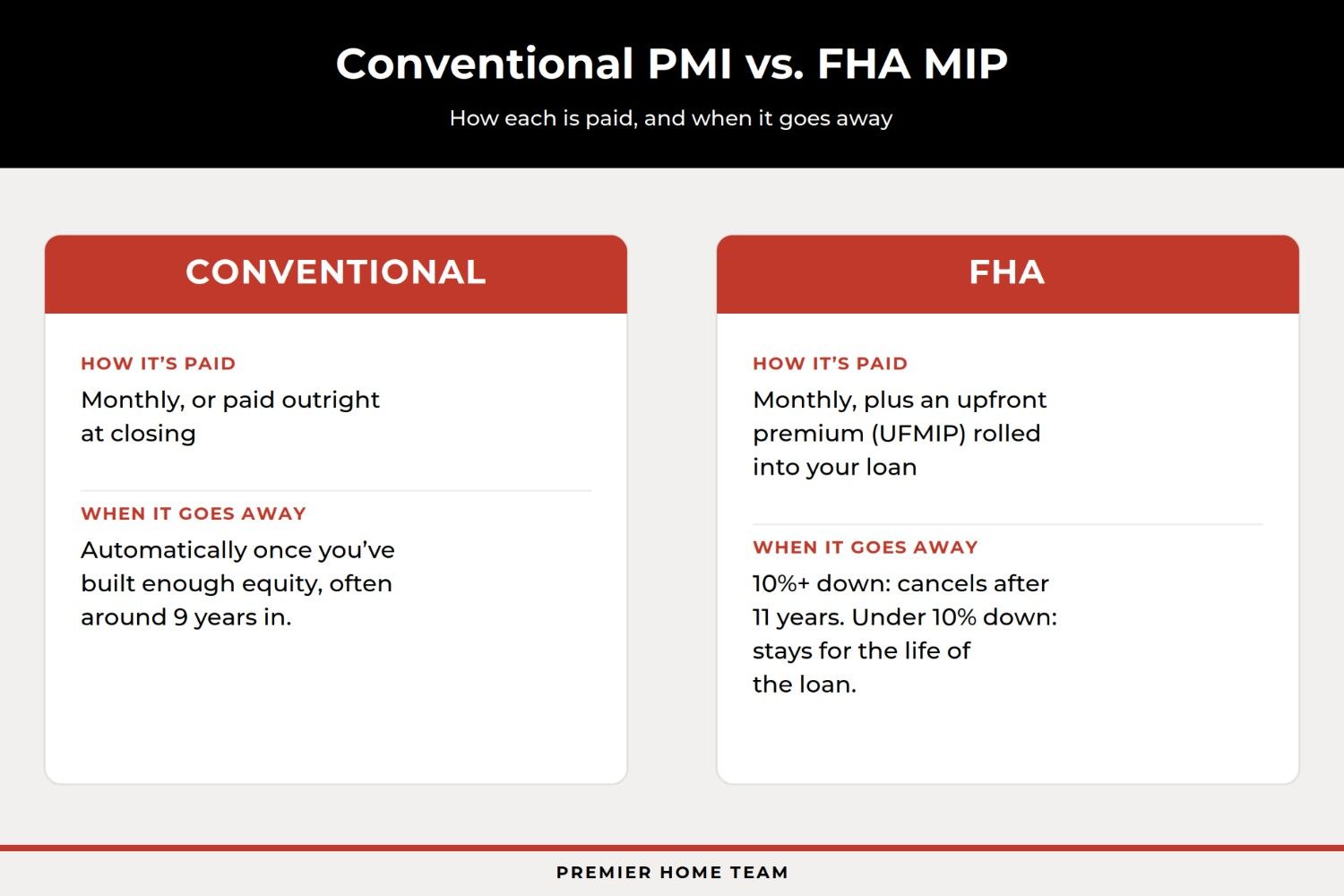
- Conventional loans: PMI is paid monthly or bought outright at closing. Paid monthly, it typically falls off automatically once you've built enough equity, often around 9 years in for many buyers, sooner with a larger down payment or faster appreciation.
- FHA loans: FHA calls it mortgage insurance premium (MIP) instead of PMI, and it comes in two parts: a monthly premium plus an upfront premium (UFMIP) that gets rolled into your loan amount. If you put down less than 10%, MIP stays for the life of the loan; 10% or more gets it cancelled after 11 years.
That gap matters most right around the 10% mark. Once you're putting down 10% or more, conventional usually becomes the better option anyway, since you skip FHA's upfront premium entirely. FHA tends to make the most sense when your credit score is lower, or you're short on cash to close, since it allows larger seller credits and more flexible qualifying than conventional does.
Want to see how renting compares to buying with a smaller down payment? Read our article on Renting vs Buying a Home in Philadelphia
Does a Smaller Down Payment Hurt Your Offer in a Competitive Market?
A smaller down payment doesn't have to cost you the house in a competitive market, though loan type can matter more here than down payment size. FHA, VA, and USDA loans come with their own government-backed appraisal and property guidelines, including FHA’s Minimum Property Requirements, which impose additional program-specific property requirements that the appraisal/property must satisfy, regardless of how much you put down.
Sellers are generally weighing two things above everything else: what they're getting for the home, and how confident they are that the deal will actually close. The strength of your full offer, not just your down payment size, carries the most weight:
- How your inspection contingencies are structured
- How strong your lender and preapproval are
- Overall certainty that the deal reaches closing without surprises three weeks in
A well-structured offer with a smaller down payment can still beat a shakier offer with more money down. Down payment size is a factor sellers weigh, not the only one.
How Much Down Payment Do You Actually Need?
The right down payment isn't a fixed number; it's whatever balances your monthly payment, your PMI exposure, and how much cash you want to keep on hand. Every buyer's situation is different, which is exactly why the answer isn't one-size-fits-all.
Some buyers prioritize a lower monthly payment and choose to put more down. Others would rather keep cash available, whether for renovations, an emergency fund, or other investments, and put down less even though their monthly payment is higher. Neither approach is wrong; they're different tradeoffs based on what matters most to you right now.
The way to land on your number is to run the actual scenarios: what a given down payment does to your monthly payment, your PMI, and your cash reserves. Your lender should always confirm your final numbers, but we can walk through preliminary scenarios well before you're ready to make an offer, using your preapproval or estimated costs as a starting point.
The Real Number Is Probably Smaller Than You Think
The 20% down payment rule has kept plenty of ready buyers waiting for a number they never actually needed. Most buyers qualify with far less, whether that's 3% on a conventional loan, 3.5% on an FHA loan, or 0% on a VA or USDA loan, and a smaller down payment isn't the dealbreaker it's made out to be.
The factors that actually matter - your monthly payment, your PMI exposure, and how much cash you want to keep on hand - are specific to your situation, and running those numbers is exactly what a lender and an experienced agent are for. That's what we do with buyers every week: take the myth out of the equation and replace it with real numbers.
If you've been putting off house hunting because of a 20% number that doesn't apply to you, reach out to Premier Home Team for a no-pressure conversation about what's actually possible for your situation.
Frequently Asked Questions
Are there down payment assistance programs available in Pennsylvania? Yes. The Pennsylvania Housing Finance Agency (PHFA) offers statewide down payment and closing cost assistance programs, and several counties in our market, including Philadelphia, Montgomery, Bucks, and Delaware, run their own local programs on top of that. Most of these programs are geared toward FHA loans specifically, so if you're planning to use one, an FHA loan is usually the natural pairing.
Should I always put down less than 20% if I qualify for a low-down-payment loan? Not necessarily. It depends on your goals: buyers who want the lowest possible monthly payment often choose to put more down, while buyers who want to keep cash available, for example, to invest elsewhere, often choose to put less down and accept a higher payment.
Will Premier Home Team or my lender give me my final down payment numbers? Your final numbers should always come from your lender. We can walk through preliminary scenarios with you using your preapproval or estimated costs, but your lender confirms the numbers you'll actually use to make an offer.
How does my down payment affect my mortgage over time, not just at closing? Your down payment shapes your monthly payment and how long you're paying mortgage insurance (sometimes a matter of years, sometimes the life of the loan depending on your loan type), not just the amount you bring to closing. A common mistake buyers make is focusing only on the closing-day number instead of what it means over the years that follow.
Is PMI something I can opt out of if I put down less than 20%? No. PMI isn't optional once you're putting down less than 20%, whether it's PMI on a conventional loan or MIP on an FHA loan; it's required by the lender to protect their side of the loan. The confusion usually comes from the word "insurance," which makes it sound optional when it isn't.
Robin Martin
Realtor® | Premier Home Team | Keller Williams Empower | PLACE
or another way