
Categories
Home Buying TipsPublished November 2, 2026
Why You Might Only Qualify for an FHA Loan vs. a Conventional One

Executive Summary
If your pre-approval came back FHA instead of conventional, the reason is almost always your credit score, your debt-to-income (DTI) ratio, or your down payment. In most cases, FHA allows 3.5% down with a 580 score and a DTI up to 56.99%. Conventional rarely approves above a 50% DTI, and in our experience, scores below 680 get priced so much worse that FHA usually wins unless you have 10 to 15% down. The catch: with less than 10% down, FHA mortgage insurance lasts the life of the loan.
You got pre-approved, and the letter says FHA, not conventional. Now you're wondering whether something is wrong with your finances, and whether you're stuck with FHA for good.
We've been doing this for 12 years, and for every buyer we pre-approve, we run FHA and conventional side by side. The reason someone only qualifies for FHA is almost never a vague sense that they "aren't ready." It's a specific number.
Here are the numbers that separate the two, what each loan really costs, and how to move from FHA to conventional.
FHA vs. conventional loans at a glance
| FHA loan | Conventional loan | |
|---|---|---|
| Credit score | 580+ for 3.5% down; 500 to 579 with 10% down. Lenders may set higher minimums | No hard Fannie Mae minimum since November 2025, but in our experience below 680 usually needs 10 to 15% down; best pricing at 740+ |
| Maximum DTI | Up to 56.99% overall and 46.99% for the housing payment alone, with an automated approval; lower below a 580 score | About 49.99%; rarely approved above 50% |
| Minimum down payment | 3.5% (580+ score) or 10% (500 to 579) | 3% for first-time or income-qualified buyers; 5% otherwise |
| Mortgage insurance cost | 1.75% upfront (usually financed) plus 0.55% a year for most 30-year loans | Monthly, or paid once at closing; cost varies with credit and down payment |
| How long mortgage insurance lasts | Life of the loan under 10% down; 11 years at 10%+ down | Can be canceled at 20% equity; ends automatically at 22% |
| Seller credits | Allows larger seller credits toward closing costs | More limited |
Figures as of October 2026.
What actually makes an FHA loan different from a conventional loan?
In practice, FHA is usually for people with slightly lower credit and less money to put down. It can also make more sense if you're carrying more debt, because FHA allows a higher debt-to-income ratio (DTI). Each of those three numbers can push you one way or the other, so let's take them one at a time.
How does your credit score decide between FHA and conventional?
Credit score is usually the deciding factor, and the reason is pricing. On FHA and other government loans, the rate spreads between credit tiers aren't that wide. A buyer with a 640 and a buyer with a 740 will see pretty similar FHA rates. Conventional is different: the lower the score, the bigger the hit to your rate. If you go from a 740 on a conventional loan to a 680 or below, your pricing is a lot worse, and at that point FHA usually gives you the better rate and the better payment. The biggest pricing hits of all come once you're below 620.
How low can your credit score be for an FHA loan?
FHA's own rules allow a score as low as 500, but the down payment required depends on the credit score: 3.5% down with a 580 or higher, and at least 10% down between 500 and 579. Individual lenders can set higher minimums.
Depending on the investor on the back end, approvals can go lower than most buyers imagine.
In summer 2026, we got a buyer approved with a 560 credit score. That's pretty low in the eyes of most lenders, but they had assets, they had reserves, they had enough funds to bring to the table, and their DTI was actually pretty low. It just worked for that buyer.
If you're hoping to use grant funds or a first-time homebuyer program, realistically you need about a 640. There is a program that goes down to 600, so it's assessed on a case-by-case basis.
What credit score do you need for a conventional loan?
Fannie Mae removed its 620 minimum credit score for loans run through its automated underwriting system in November 2025, though lenders and mortgage insurance companies can still set their own minimums.
In practice, if you're below a 680, you're likely not going to get approved for conventional unless you have probably 10 to 15% down.
How does your debt-to-income ratio push you toward FHA or conventional?
DTI isn't about how much you owe in total. It's your monthly obligations, like car payments, credit card minimums, and student loans, plus your new mortgage payment, divided by your gross monthly income. That percentage is your DTI, and it tells us which programs you're eligible for.
How high can your DTI be for an FHA loan?
With an automated approval, which typically needs at least a 580 credit score, FHA allows a back-end DTI, which counts all of your debt plus the new mortgage, as high as 56.99%. Below 580, or when a loan has to be manually underwritten, the limits are much tighter. What most people don't realize is that there's also a front-end ratio, which is the housing payment alone. On FHA, we know we can't get an approval if the front-end ratio is over 46.99%, even though the back end can go to 56.99%. So we have to make sure we're putting you in a house that's going to be approvable.
How high can your DTI be for a conventional loan?
On conventional loans, you very rarely get an approval with over 50% DTI. There are certain Fannie Mae and Freddie Mac programs that allow slightly over 50%, so we don't want to say never, but a good rule of thumb is 49.99%.
One honest caveat: these limits use gross income, but we all live in a net world. If your DTI is maxed out, we'd rather talk about what this payment will do to you in two to three years. A DTI in the 30% range is usually pretty strong and affordable for most people.
What's the minimum down payment for an FHA vs. a conventional loan?
FHA's minimum is 3.5% down with a 580 or higher credit score, and 10% down if your score is between 500 and 579.
Conventional technically starts at 3%, but there are caveats. The 3% option is only for first-time buyers, or for HomeReady and Home Possible if your household earns under 80% of the area median income for your county. Everyone else needs at least 5% down.
A bigger down payment can sometimes make conventional worth it even with a lower score, which is why we run both. FHA also helps buyers who are short on cash: down payment assistance programs are geared toward FHA loans, and FHA allows larger seller credits that can offset your closing costs.
How does mortgage insurance differ between FHA and conventional?
Mortgage insurance is often the deciding cost if you qualify for both, so it's worth seeing the math.
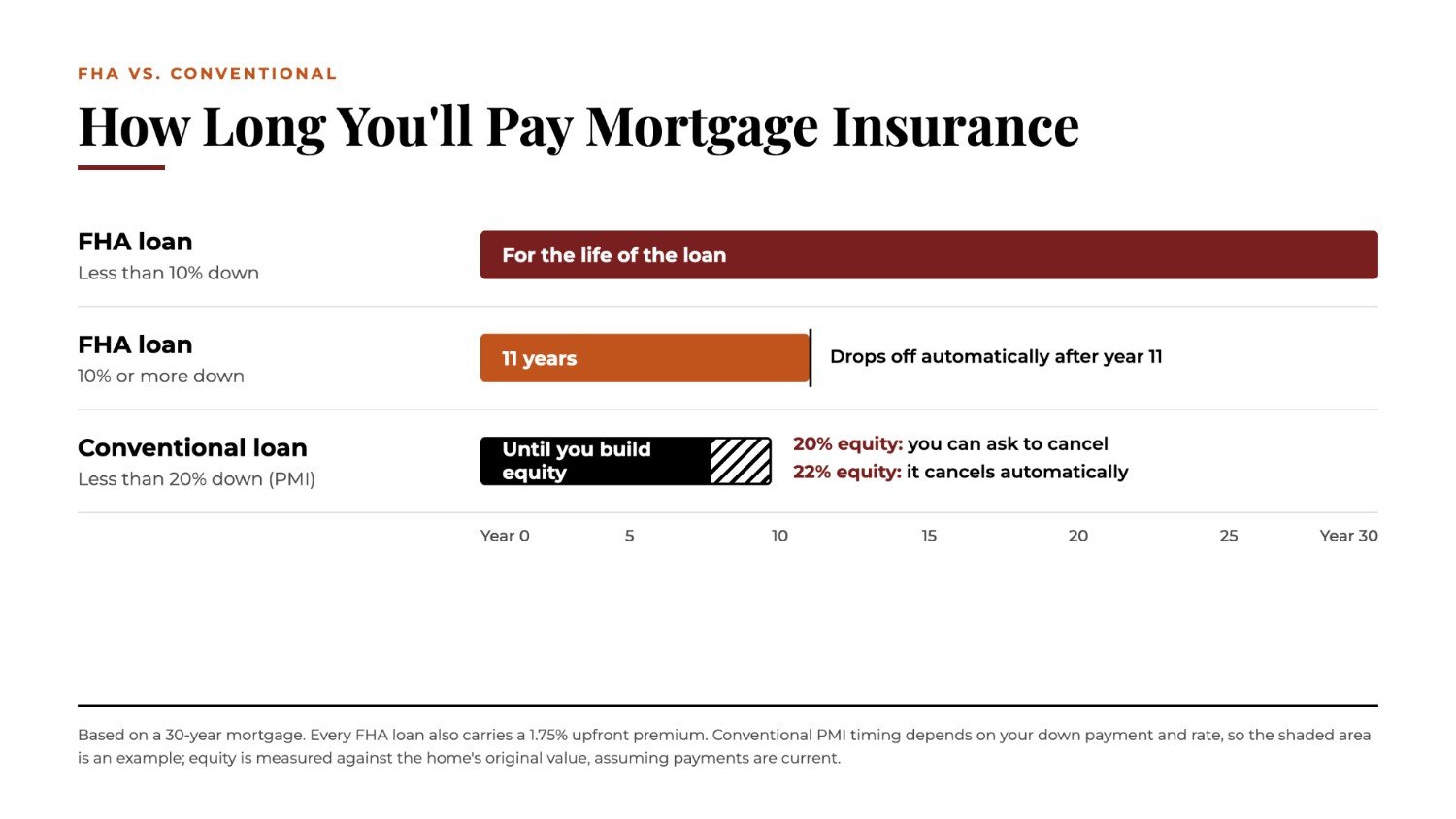
FHA charges two premiums. There's an upfront premium of 1.75% of the loan amount, usually rolled into the loan, and an annual premium of 0.55% for most 30-year loans, paid monthly. Put down less than 10%, and the annual premium lasts for the life of the loan. Put down 10% or more, and it falls off after 11 years.
For example only, not a real client: on a $300,000 FHA loan, the upfront premium would be $5,250, and the annual premium would start around $1,650 a year, or about $137.50 a month.
Conventional mortgage insurance can be paid monthly or bought outright at closing, with no upfront premium financed into the loan. Under federal rules, you can generally request cancellation when your loan balance reaches 80% of the home's original value, and PMI typically ends automatically at 78%, assuming you're current on payments. How long that takes depends on your down payment and rate.
That's why FHA rarely makes sense once you're putting 10% or more down, unless your credit is too low for a conventional approval. That 560-score buyer put 15% down on FHA because it was really their only option at the time. Once their credit is higher, we'll refinance them into a conventional loan.
What are the real downsides of choosing FHA?
Beyond mortgage insurance, the biggest one is perception. A lot of listing agents prefer to see a conventional offer. Much of that comes from older assumptions that FHA appraisals were much harder to pass, because they used to be.
The government agencies have lightened up on FHA appraisals so the ticky-tacky things get by. What gets flagged now is a health or safety issue, like a missing handrail on the basement stairs, and that gets flagged on any loan. Conventional is still easier on appraisals, though.
How do you move from qualifying for FHA to qualifying for conventional?
On the DTI side, there are two paths. If your income is the issue, a higher-paying job or a co-signer can get you there. If your debt is the issue, paying some of it down improves your DTI.
On the credit side, the biggest mistake is trying to fix it on your own and paying off debts or collections that don't move your score. For anyone below about 620, we run a credit simulator to find what will actually help. Often it's just credit card utilization.
What to do if you only qualify for FHA right now
If you only qualify for FHA, it's almost always one number: a credit score below about 680, a DTI above about 50%, or not enough saved for the conventional down payment. That's not a verdict on whether you're ready, and it doesn't lock you into FHA forever.
Your next step is to have a lender run both loans on your actual numbers before you tour homes. Seeing the payment and cash to close side by side tells you whether to buy now with FHA or take a few months to close the gap.
If you're buying in the Philadelphia Metro, Delaware, or South Jersey areas, Premier Home Team's agents and our lending team work on this together. Talk to the team, and we'll help you map out whether FHA, conventional, or a short game plan to get there is right for you.
Frequently asked questions
Do sellers really prefer conventional offers over FHA? Many listing agents do, mostly because FHA appraisals used to be harder to pass. The guidelines have loosened, but conventional is still somewhat easier.
If I have 10% or more to put down, should I still use FHA? Usually not. With 10% or more down, conventional typically comes out ahead because there's no upfront premium financed into the loan. FHA still makes sense if your credit score is too low for a conventional approval.
Can I refinance from an FHA loan into a conventional loan later? Yes. Many buyers use FHA to buy now, then refinance into a conventional loan once their credit improves and they've built enough equity, which ends the FHA mortgage insurance. Your rate and costs at that time will decide whether it makes sense.

Robin Martin
Realtor® | Premier Home Team | Keller Williams Empower | PLACE
or another way