
Categories
Careers, Working in Real EstatePublished April 23, 2026
Your First 90 Days as a New Real Estate Agent on Premier Home Team


Are you stepping into real estate for the first time, filled with excitement—but also uncertainty?
Do you wonder what success actually looks like when no one’s telling you what to do, and you’re suddenly your own boss?
At Premier Home Team, we’ve helped dozens of new agents launch fast by following a structured, supportive 90-day onboarding plan.
In this article, you’ll discover exactly what those first three months look like: the systems you’ll learn, the habits you’ll build, the discomfort you’ll face—and how that all adds up to the foundation of a career that can truly change your life.
.jpg)
What Does the First 90 Days Look Like in Practice?
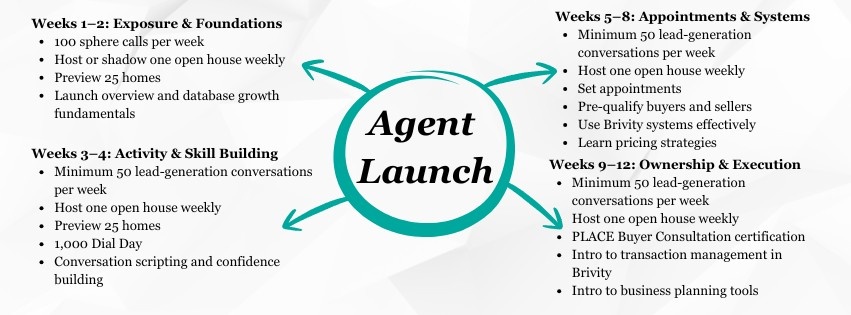
From a day-to-day standpoint, your first 90 days are intentionally full. This isn’t a slow ramp-up where you sit on the sidelines and observe. You’ll be learning by doing.
Early on, new agents are immersed in technology, systems, and proven methods. You’ll get up to speed on tools that support your business, along with scripts and strategies for open houses, working your sphere, and converting internet leads. These aren’t random tactics—they’re lessons pulled from top performers in the industry.
Just as important, you’re not only learning these ideas in theory. You’re putting them into action right away. That means making phone calls, hosting open houses, going on appointments, and seeing firsthand how real estate works in the real world.
Premier Home Team’s launch process includes a structured program that pairs new agents with experienced, successful agents. You’ll spend time in classes and then out in the field, watching how those lessons translate into results. The goal is simple: shorten the learning curve by surrounding you with people who have already done what you’re trying to do.
What Mindset is Necessary in the First 90 Days?
While the activity is intense, the mindset shift is just as significant.
For many new agents—especially those coming from non-entrepreneurial backgrounds—the first 90 days require a new level of personal accountability. No one is clocking you in or out. You’re learning how to run your own business, make yourself uncomfortable, and grow through that discomfort.
There’s an important distinction here: discomfort isn’t pain. Growth always feels uncomfortable, but that’s how progress happens. During this phase, you’re stretching new muscles - professionally and personally - and that transformation is part of what the team is designed to support.
Of course, mindset alone isn’t enough. To truly grow, that mindset needs to be paired with specific, repeatable actions. That’s where the next phase comes in.
What Activities Matter Most in the First 30 Days?
Although there’s a lot happening early on, a few activities matter more than anything else.
First, new agents must connect with their sphere. The people who already know, like, and trust you need to know you’re in real estate—or that you’ve joined a new team. These conversations don’t just create awareness; they create opportunity. Your immediate network often becomes your first and fastest source of clients.
Second, new agents learn how to proactively create clients instead of waiting for them. Many agents make the mistake of assuming business will simply appear. In reality, learning how to go out find people to serve right away is a critical early skill.
Finally, the first month is about building habits. For many agents, this is the first time no one is telling them exactly what to do each day. Creating consistent routines around lead generation, follow-up, and skill-building early on provides stability as the business becomes more complex.
.jpeg)
What Does “Success” Looks Like by the End of 12 Weeks
Success in the first 90 days isn’t defined by perfection—it’s defined by activity and momentum.
By the end of the first month, new agents should be having real estate conversations with roughly 50 people per week and hosting multiple open houses consistently. As those habits compound, deals begin to follow.
By the end of 12 weeks, agents who are doing the work should have a few deals under contract, active clients they’re serving, and a growing database of people they’ll continue to help in the months ahead. At that point, you’re building a pipeline for the future.
As new agents begin to gain traction, one internal challenge can still slow them down: rejection.
The Biggest Mindset Shift New Agents Must Make
One of the earliest mindset shifts is learning to accept rejection as part of the process.
The team uses a simple framework: some will, some won’t—so what, someone’s waiting? Hearing “no” is hard at first, but it’s unavoidable. What matters is understanding that those no’s are simply part of finding the people who truly need your help.
No one's good at something when they get started, no matter what social media might suggest. The reality is we have to go through being okay at it, and then mediocre at it, then pretty good at it. Skill comes from repetition, coaching, and consistent effort. On the team, agents are constantly developing their abilities so they can move from uncomfortable to confident as quickly as possible.
What part of the PLACE Agent Launch Makes an Impact on Agent’s Growth?
The parts of the PLACE Agent Launch that have the biggest impact on an agent’s growth are the pre-launch phase—especially 1000 Dial Day—and learning the buyer consultation.
Pre-launch is where agents are immersed in the team’s systems, processes, and, most importantly, daily productivity rhythms. Consistently making dials, having real conversations, and connecting with clients—while surrounded by others doing the same work—sets the foundation for long-term success in real estate. The 1000 Dial Day pushes agents to get comfortable being uncomfortable and shows them, firsthand, what sustained effort can actually produce.
Just as transformative is the buyer consultation, which fundamentally changes how agents interact with clients. It clarifies why our team is different, how we deliver a higher level of service, and how we help clients think beyond a transaction. The buyer presentation becomes a true game changer because it shifts the role of the agent from simply opening doors to helping people build long-term wealth and financial security—something that makes this work especially meaningful.
Once agents complete the pre-launch, they’re ready to start generating leads—but that’s often where hesitation kicks in.
What’s the Hardest Part of Lead Generation? (And How We Help…)
The hardest part of lead generation isn’t knowing what to say—it’s picking up the phone and getting started. Some days, that phone can feel like it weighs 20 pounds.
The truth is, motivation doesn’t come first; it’s built through repetition.
On our team, we see this hesitation show up in two ways: some agents are nervous about calling people they already know, like, and trust, while others are more anxious about calling complete strangers. It’s almost a 50/50 split, but a healthy business requires both, which is why we coach agents through that discomfort instead of ignoring it.
We take time to unpack what they’re actually afraid of and guide them through it in a supportive, intentional way. Over time, confidence grows from doing the work, and that action is what ultimately creates real momentum.

Why Does Structure and Support Matter Early On?
A strong daily schedule plays a huge role in early success. Mornings are reserved for the hardest—and most important—work: prospecting, follow-up, and skill development. When that work is done early, it sets the tone for the entire day.
Afternoons are focused on serving clients—showings, appointments, and open houses. And if there aren’t clients to serve yet, that time goes back into lead generation. The principle is simple: if you’re not servicing clients, you’re seeking them.
This structure helps new agents avoid one of the most common pitfalls in real estate—losing momentum when results don’t show up immediately.
What Early Wins Can Agents Expect in the First 90 Days?
In the first 90 days, wins don’t always look like immediate closings—but they show up fast in momentum.
We’ve seen agents book their very first real appointment on day one, and most can expect to schedule conversations within their first week or two, even if those clients aren’t ready to buy right away.
The quickest traction almost always comes from an agent’s sphere—simply letting people they already know, like, and trust know that they’re officially in real estate can help lead to deals.
Open houses also play a critical role early on, giving agents a rare opportunity to meet motivated buyers while standing inside the very product they’re helping people acquire. Especially before an agent is busy servicing clients, open houses become a powerful way to grow their database, build confidence, and practice real conversations.
Once agents embrace the mindset that if they’re not servicing clients, they should be seeking them, the business starts to flow—and that’s when those early wins begin to stack up.
.jpg)
Why Many New Real Estate Agents Struggle Around the 30-Day Mark (and Where Results Really Come From)
About a month into a real estate career, many agents hit a mental wall. The initial excitement wears off, the workload is real, and the results don’t yet match the effort.
That’s normal—because people don’t make $600,000 decisions on a whim. Unlike selling a low-cost item with instant gratification, real estate has a long sales cycle.
You might be having great conversations and doing everything right, but it can take months from first contact to a closed deal. That lag between effort and reward is where many agents get discouraged.
At Premier Home Team, we help agents understand that this phase is the foundation. By focusing on daily activities they can control—conversations, follow-up, and consistent outreach—agents build momentum long before the commission check arrives.
The agents who stay committed, ‘trust the process’, and keep showing up are the ones who see their effort compound into real, sustainable results.
Why Does the Team Support Make a Difference?
The difference between going solo and joining a team is night and day—especially in the beginning. Agents who start on their own often spend their early months guessing what to do, how to do it, and whether they’re even doing it right, all without real support or accountability.
That uncertainty can feel overwhelming, particularly during the early disillusionment phase when the work is heavy and results haven’t arrived yet.
On our team, that guesswork is replaced with structure. Agents are supported with training, technology, and administrative help that removes unnecessary weight and allows them to focus on what they do best: building relationships and serving clients.
Just as important, they’re surrounded by other motivated agents running the same plays and seeing success. In those tough early moments, being able to look around and see progress happening in real time can be the difference between burning out and pushing through. Success is no longer something you’re chasing alone, but something you’re building together.
That support becomes even more powerful when it’s paired with clear expectations, consistent lead opportunities, and daily accountability—because momentum is easier to build when you’re not starting from zero.
.jpeg)
Your First 90 Days Are the Foundation
Your first 90 days in real estate are the foundation of your career.
If you’ve ever felt overwhelmed, unsure where to start, or afraid you’re doing it wrong, you’re not alone.
With the right systems, support, and habits, it’s absolutely possible to build traction fast and create a business you’re proud of.
At Premier Home Team, we’ve helped dozens of new agents do just that—by surrounding them with coaching, clarity, and community from day one.
👉 Book a call with our team leader to find out what your first 90 days could look like—and how we’ll help you hit the ground running.
Robin Martin
Realtor® | Premier Home Team | Keller Williams Empower | PLACE
or another way