
Categories
Home Owners, Post ClosingPublished August 10, 2026
How the PA Homestead Exemption Works in Philadelphia & the Suburbs

Executive Summary
The Pennsylvania homestead exemption lowers the taxable value of your primary residence, reducing your property taxes each year. Philadelphia homeowners save about $1,399 annually, while savings in Bucks, Chester, Delaware, and Montgomery Counties vary by local exemption amounts. You only need to apply once, though application deadlines differ by county.
If you've just bought a home in Pennsylvania, you've probably heard people mention the homestead exemption without anyone clearly explaining what it actually is, or why it seems to work differently depending on where you live. That usually leads to the same question: what is the homestead exemption, and does it actually save you money?
The answer depends on where you live. Philadelphia homeowners may save well over $1,000 a year, while homeowners in Bucks, Chester, Delaware, and Montgomery Counties often see more modest savings. Different deadlines, eligibility rules, and application processes only add to the confusion.
In this guide, we'll explain how the Pennsylvania homestead exemption works, who qualifies, how to apply, and what homeowners in Philadelphia and the surrounding counties can realistically expect to save on their property taxes.
This guide is based on official information from Philadelphia and county tax offices, along with the real questions our team answers every day from homeowners across the Greater Philadelphia area. By the end, you'll know exactly what to expect from the homestead exemption, how it fits into your long-term property tax picture, and when it's worth getting help to make sure nothing slips through the cracks.
What Is the Homestead Exemption in Pennsylvania?
Before getting into definitions, it's important to understand one thing upfront: the homestead exemption does not work the same way everywhere in Pennsylvania.
Philadelphia runs its own version of the program, while most surrounding counties follow a state-authorized homestead and farmstead system that's administered locally. The goal is similar across the board; lowering property taxes for homeowners, but the rules, savings, and application process can look different depending on where you live.
At its core, the Homestead Exemption is a property tax relief program that reduces the taxable value of your primary residence. In plain English, it lowers the portion of your home's assessed value that gets taxed, which reduces your annual property tax bill. Think of it as a built-in discount on the home you live in — not extra money from the government, but less of your home's value being subject to tax each year.
The program exists to help homeowners, especially those on fixed or modest incomes, keep housing costs more predictable and make long-term homeownership more affordable. It's designed specifically for owner-occupied primary residences, not rental properties, vacation homes, or investment properties. How much it helps, and how you access it, depends heavily on whether your home is in Philadelphia or in a surrounding county.
How does the Homestead Exemption Work in Philadelphia County?
In Philadelphia County, the Homestead Exemption currently reduces the taxable assessed value of a qualified home by $100,000. This means that if your home is assessed at $300,000, you're taxed as if it's only $200,000.
With the city's current property tax rate (1.3998%), that $100,000 exemption can translate into roughly $1,399 in tax savings each year.
Philadelphia's program differs from many other PA counties because the exemption is a fixed value (rather than a percentage). Once approved, it stays on your property every year, you don't re-apply unless the deed changes.
Now that you know what the exemption is, let's look at whether your home qualifies.
Who Qualifies for the Homestead Exemption in Pennsylvania?
Here's how eligibility works:
- Owner-occupied homes only - You must live in the home as your primary residence; seasonal homes aren't eligible.
- Not for rentals or investment properties - If you own other properties you don't live in, those don't qualify.
- No age or income limits in Philadelphia - Whether you're young, old, have a mortgage, or earn a higher income, you can still qualify.
Some scenarios confuse new homeowners — for example, if you inherit a home or are in a rent-to-own situation, special conditional rules may apply.
How do you Apply for the Homestead Exemption in Philadelphia (Step-by-Step)?
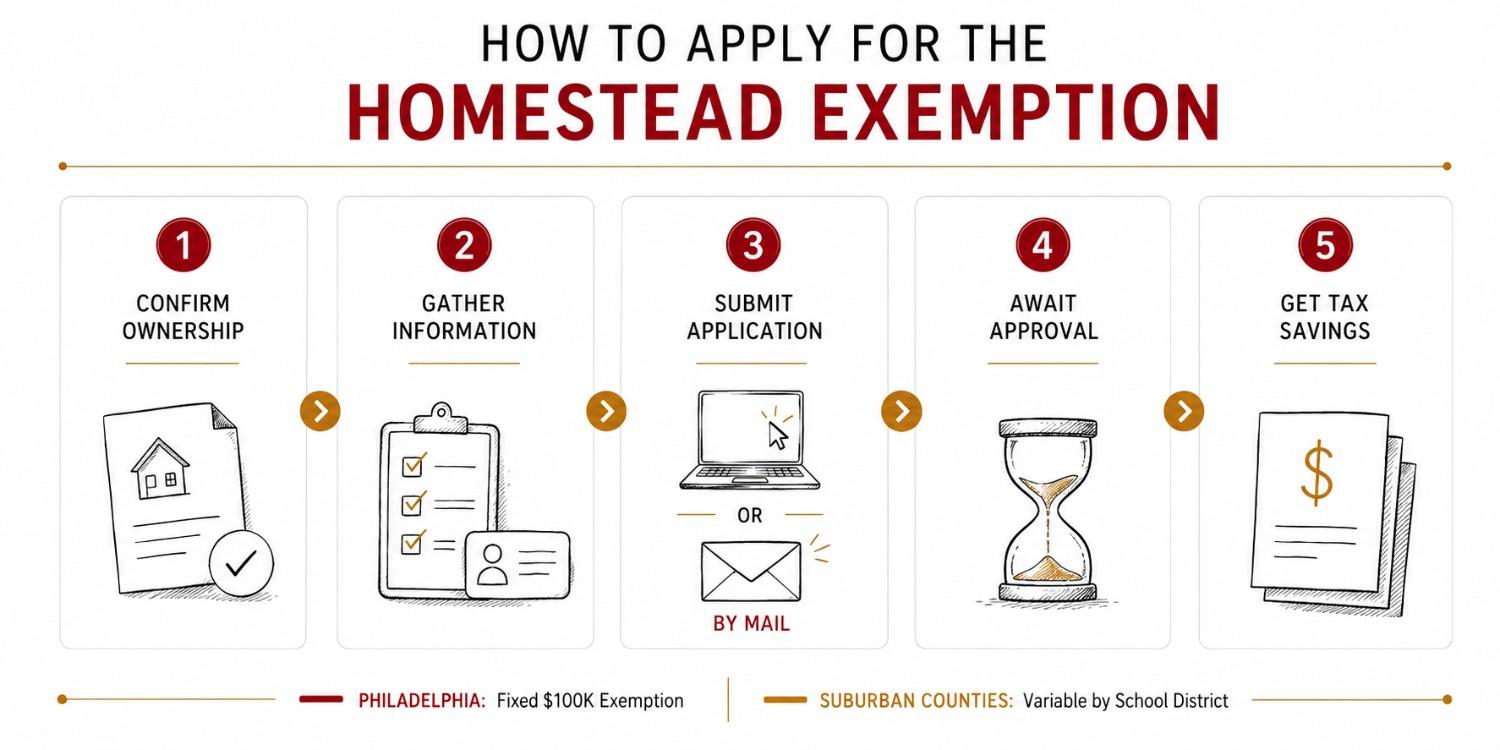
- Apply soon after your purchase - While you can apply any time after taking ownership of the home, applying early ensures you don't miss the important deadlines.
- Gather needed information - You'll need your property address and deed information; if a previous owner is still on the record, you may need additional documentation.
- Submit online or by mail - Philadelphia accepts applications through the Philadelphia Tax Center, by phone, or by mail
- Typical turnaround - Once your application is accepted, you'll see savings on your next bill — and the exemption stays applied year after year unless your deed changes.
In Philadelphia, the final deadline to apply each year is usually December 1, with earlier filing (by October 1) recommended to see adjusted tax bills in the next cycle.
📄 Follow Along Step-by-Step
Want a visual walkthrough of the Philadelphia Tax Center application? Download our free Homestead Exemption application guide (PDF) — it walks you through finding your property and submitting the application, screen by screen.
How does the Homestead Exemption Work in Suburban Philadelphia Counties (Delaware, Chester, Montco & Bucks)?
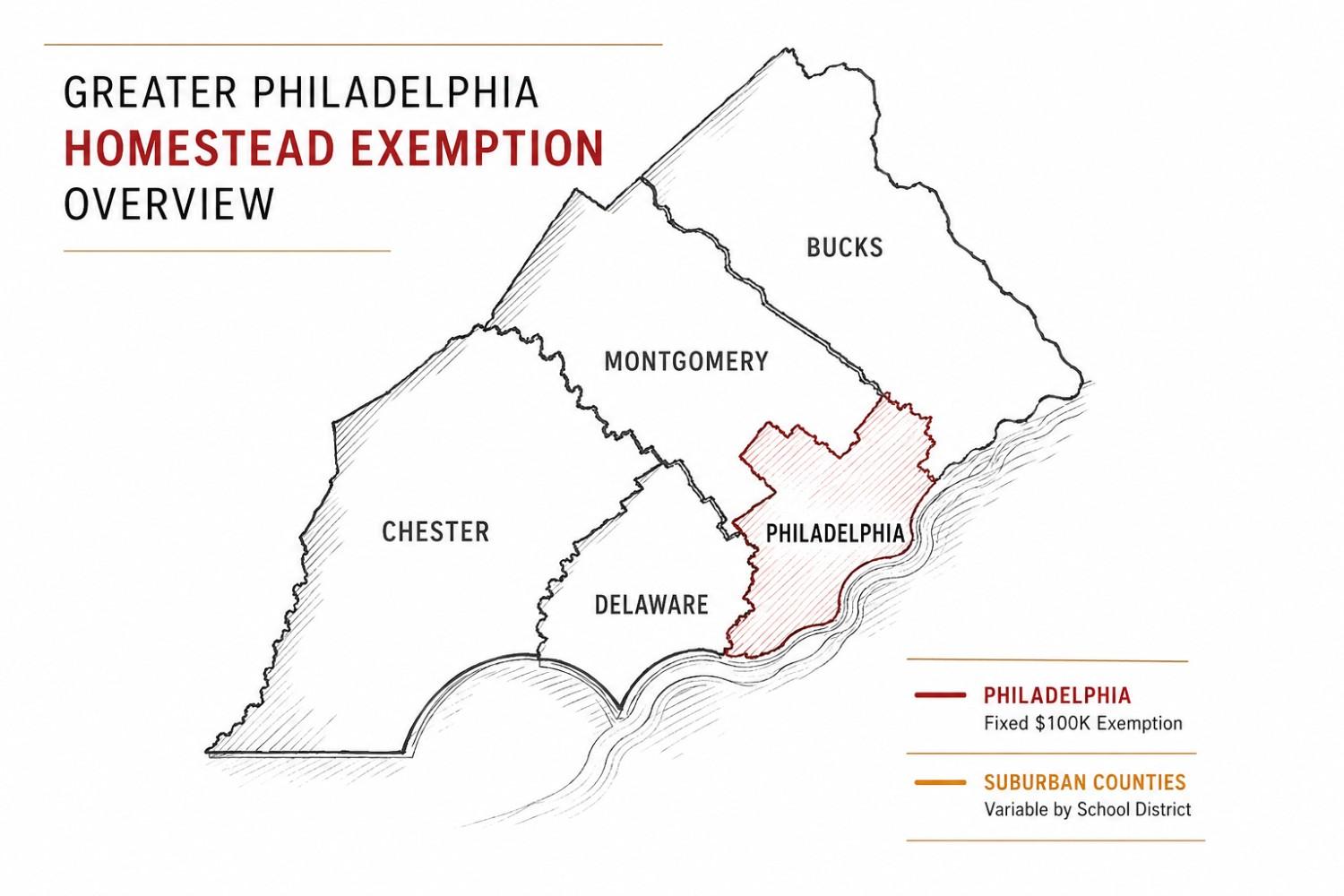
Most Pennsylvania counties offer a Homestead/Farmstead Exclusion under state law, but the value and process vary:
| County | Program Offering | File With | Filing Deadline |
| Montgomery | Homestead/farmstead exclusion program - approved properties receive a reduction of $30,000 from the assessed value - actual dollar amount savings varies by County & School District | Montgomery County Board of Assessment Appeals | March 1 |
| Delaware | Homestead/farmstead exclusion program - reduction is a variable amount set by each individual school district | Your local school district | March 1 |
| Chester | Homestead/farmstead exclusion program - reduction is a variable amount set by each individual school district | Chester County Assessment-Homestead Office | March 1 |
| Bucks | Homestead/farmstead exclusion program - reduction is a variable amount set by each individual school district | The Bucks County Board of Assessment Appeals | March 1 |
Savings can vary widely because the exclusion amount is set locally and depends on tax rates in each district. In some areas, the impact on your bill may be modest; in others, it's more meaningful.
What are the Key Differences between Philadelphia and the Suburban Counties?
| Feature | Philadelphia | Suburban Counties (e.g., Delco, Montco, Chesco, Bucks) |
| Exemption Type | Fixed dollar ($100K) | Varies by county school district |
| Filing Deadline | December 1 | Typically March 1 |
| Multi-year Carryover | Yes (auto each year) | Once approved, typically stays without yearly renewal |
| Savings Consistency | Predictable citywide benefit | Depends on local rates and exclusion amount |
Because tax rates and exemption amounts differ, moving counties can change your overall property tax cost.
What are some Common Homestead Exemption Mistakes New Homeowners Make?
- 🛑 Assuming it's automatic - You must apply once; otherwise, you won't get the benefit.
- ⏰ Missing application deadlines - Most counties use a March 1 deadline; Philadelphia County uses December 1.
- 📝 Not updating after deed changes - If the deed changes, you need to re-apply.
What Happens to Your Homestead Exemption If You Sell or Move?
The exemption stays with the home, not the homeowner. When you sell, the new owner must qualify on their own. If you move to a new primary residence, you'll need to apply again in the new County.
How does the Homestead Exemption Affect Your Property Tax Bill Long-Term?
Even with the exemption, your bill can still rise due to:
- Changing assessments
- Increases in tax rates
- Shifts in local budgets
The exemption reduces taxable value, but it doesn't freeze taxes forever. Planning and budgeting for your property taxes remain essential.
Is the Homestead Exemption Worth It for Every Pennsylvania Homeowner?
For owner-occupied homes, the savings can be significant, especially in places like Philadelphia County, where the exemption amount is large relative to many property values.
However, in some suburban areas with smaller exclusions, the impact on your bill may be less noticeable. Homeowners should set realistic expectations based on local tax rates and exemption values.
When to Talk to a Real Estate Professional or Tax Office
If your situation is complex; tangled titles, recent deed changes, or dual residences, talking with a real estate agent or county assessor early can save you stress and unexpected costs later.
Understanding property taxes early in the buying process helps you plan for true ownership costs, not just the mortgage payment.
Your Next Step
You now know exactly what the homestead exemption is, how to apply in Philadelphia vs. surrounding counties, and how to estimate your potential savings.
But if you're still navigating deed changes, multiple properties, or county-specific forms, you're not alone. Property tax relief can be confusing, and missing a deadline might mean missing out on hundreds in savings.
Your best next step? Reach out to your county tax office, or connect with Premier Home Team. We help new homeowners navigate the homestead application process and understand the full cost of ownership — so you can avoid surprises and make smart, confident decisions.

Robin Martin
Realtor® | Premier Home Team | Keller Williams Empower | PLACE
or another way