
Categories
Careers, Working in Real EstatePublished May 20, 2026
What Does Leverage Look Like for Real Estate Agents?

.jpeg)
Real estate is one of those careers where you can technically “be in business”, and still feel like you’re building it alone.
Many agents eventually hit the same questions:
Why does my income feel inconsistent?
Why does it feel like I’m doing everything myself?
Would joining a real estate team actually help me grow faster?
You might be working nonstop but still wondering why income feels inconsistent. You might be juggling prospecting, showings, contracts, follow-up, marketing, and admin work, and realizing that every time you focus on one, something else slips. Or maybe you’re producing, but you can feel the ceiling approaching because everything still depends entirely on you.
That tension is where the conversation about leverage begins. In real estate, talent helps. Work ethic helps. But neither replaces structure. For many agents, especially early in their careers, building without systems, mentorship, administrative support, or consistent lead flow can feel slower and less predictable. Some agents prefer that autonomy, but others find that structured support reduces friction and accelerates clarity.
Over the last five years, working with agents building their businesses from the ground up, we’ve seen the same challenge appear again and again: talented agents struggling not because of effort, but because they’re trying to build everything alone.
In this article, we’re going to discuss what leverage actually looks like for real estate agents? And how does the right team change the trajectory of your business, whether you're just starting out or trying to reach your next level.
What Is Leverage for Real Estate Agents?
Leverage for real estate agents is the support, systems, mentorship, brand, and lead flow that allow you to produce more results in less time with less friction.
It’s the difference between trying to build everything yourself, and plugging into something that already works.
Leverage can take many forms:
- Direction and a clear daily game plan
- Mentorship from agents who have already built successful businesses
- Lead generation systems with real intent behind them
- Administrative support to handle contract-to-close
- Brand credibility you can borrow while building your own
In other words, leverage is anything that removes unnecessary trial and error from your early career.
Does Leverage Matter More Than Commission?
Commission splits are important. They determine how much money you keep from each closing, and for experienced agents with a consistent pipeline, that percentage can significantly impact take-home income.
But commission is only one part of the equation.
If you’re still learning how to consistently generate business, follow up effectively, convert conversations, or manage transactions, the size of your split may matter less than your ability to produce reliably.
Many agents who start independently discover that:
- No one tells you what to focus on each day
- You’re experimenting with lead sources without clear direction
- You’re unsure whether your daily activities are the right ones
- Income fluctuates more than expected
Real estate only pays when you close. If you don’t know how to generate closings, you don’t get paid. That slow learning curve costs more than money. It costs confidence. It costs time. And for many agents, it can even shorten their time in the industry.
A strong team can often shorten the learning curve by providing structure and shared experience. Instead of riding the “kiddie train,” you step onto the roller coaster.
When deciding whether to join a team, it helps to compare the structure side by side. Here’s how a solo real estate agent model typically differs from working on a real estate team:
| Factor | Solo Real Estate Agent | Real Estate Team |
| Commission Split | Typically higher split per transaction | Often lower split in exchange for shared resources |
| Lead Generation | Self-generated through prospecting, referrals, marketing | Combination of team-provided opportunities and personal prospecting |
| Administrative Support | Agent manages contracts, deadlines, and paperwork independently | Dedicated transaction coordinators or admin support handle backend processes |
| Mentorship & Training | Self-sourced through outside coaching or experience | Often built-in mentorship and structured skill development |
| Brand Recognition | Relies on personal brand and reputation | Leverages established team branding and production history |
| Accountability Structure | Self-managed schedule and goals | Defined expectations, activity tracking, and collaborative oversight |
| Scalability | Growth depends on personal systems and capacity | Systems and support may allow for faster expansion |
| Autonomy | High independence and control | Collaborative environment with shared standards |
While both paths can work, we believe leverage matters because it gives agents the systems, support, and structure needed to scale their business faster than most can realistically achieve on their own. For agents who feel like they’re doing everything themselves, that kind of support can dramatically shorten the learning curve. The key difference isn’t which is “better,” but which structure aligns with your experience level, risk tolerance, and long-term goals.
What Kind of Leverage Does a Strong Team Provide?
1. Direction and Accountability
Real estate is unique because nothing has to happen today.
If you don’t prospect today, no one fires you, and if you skip follow-up, no one disciplines you. The consequences show up 60–90 days later when your pipeline is empty.
Strong teams provide:
- A clear daily schedule
- Defined prospecting blocks
- CRM systems that tell you who to call
- Expectations around activity
Natural ability, strong communication skills, and drive absolutely matter in real estate. Many agents build early momentum on personality and hustle alone.
Studies on habit formation show that over the long term, consistent systems often create more predictable results than relying solely on motivation or talent. Structure helps ensure that prospecting happens even when you don’t feel like it. Follow-up continues even when you’re busy. Marketing stays consistent even when closings demand your attention.
For some agents, especially those who thrive on routine and process, systems become the foundation that supports sustainable growth. Talent may open the door, but consistency is what tends to keep it open.
2. Real Lead Leverage
When teams say, “We provide leads,” you need to ask: What does that actually mean?
A “lead” could be:
- A random name and phone number
- A cold contact scraped from a list
- Someone who actually requested a showing
- A buyer who asked for an appointment
Intent matters. Warmer leads, those who have already expressed interest, shorten your timeline to closing. Cold leads can work, but they require long-term nurturing.
In real estate, even hot leads often close 180 days later. Imagine how long completely cold ones can take.
In our experience, effective leverage includes:
- Systems to generate consistent inbound interest
- Technology that supports follow-up
- Multiple lead sources working simultaneously
- A predictable pipeline instead of random spikes
Consistency creates stability. Stability creates confidence.
Not all real estate leads are equal. The term “lead” can mean very different things depending on intent, timing, and readiness to transact.
Here’s a breakdown of common lead types and what they typically involve:
| Lead Type | Buyer Intent Level | Typical Time to Close | Follow-Up Required | Example Scenario |
| Cold Contact List | Low | 6–12+ months (if at all) | High, long-term nurturing | Purchased contact list or scraped data with no prior inquiry |
| Online Inquiry Form | Moderate | 3–6 months | Consistent follow-up | Buyer fills out a “More Info” form on a listing |
| Property Showing Request | High | 1–3 months | Focused and timely | Buyer requests to tour a specific property |
| Pre-Qualified Appointment | Very High | 30–60 days | Transaction-focused | Buyer is approved and ready to actively purchase |
Understanding lead quality helps you evaluate what “we provide leads” really means — and how much time, skill, and follow-up effort each category requires.
3. Administrative and Transaction Support
There’s a common real estate curse:
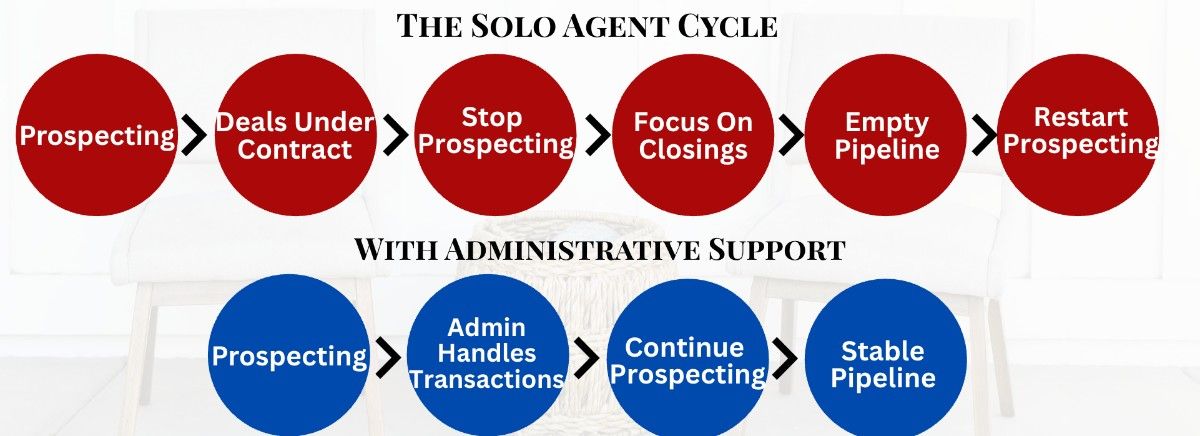
You finally generate business, you get multiple deals under contract, you stop prospecting to manage closings, then two months later… your pipeline is empty.
Without support, you risk becoming trapped in maintenance mode.
Strong teams provide admin leverage so you can:
- Focus on generating business
- Step in only for client communication
- Trust systems to manage deadlines and paperwork
That freedom allows you to scale rather than stall.
4. Mentorship vs. Generic Coaching
There’s a difference between generalized coaching advice and hands-on mentorship from someone actively building in today’s market.
Generic coaching often sounds like:
- “Make your calls.”
- “Follow up consistently.”
- “Do open houses.”
That’s advice. Mentorship is different.
It comes from someone who:
- Started from zero
- Built a real pipeline
- Closed real deals
- Navigated real market shifts
Mentorship is personalized. It adapts to your strengths. It helps you handle real conversations, pricing objections, listing appointments, and negotiation issues.
And for experienced agents, leverage doesn’t disappear. It evolves.
Instead of learning how to get clients, you refine:
- How to handle specific pricing conversations
- How to manage time better
- How to scale beyond your current ceiling
Growth never stops.
5. Brand and Borrowed Trust
When you’re new, you don’t have stats. You don’t have reviews. You don’t have a track record.
But your team might.
Brand leverage allows you to:
- Reference team production
- Lean on past success stories
- Borrow trust in conversations
- Reduce skepticism on cold calls
In many cases, recognizable branding can lower skepticism.
Over time, you build your own reputation—but strong branding gives you credibility from day one.
How Can You Tell if a Real Estate Team Actually Provides Leverage?
Not all teams provide real leverage. Some are simply mini-brokerages with a shared logo.
Here’s what to look for:
- Do agents across experience levels produce consistently?
- Is there visible camaraderie and collaboration?
- Are you meeting regularly with leadership?
- Can you talk candidly with current agents?
- Does the environment feel energized—or isolated?
Production tells a story. Culture tells another.
If only a few agents are succeeding while everyone else struggles, that’s a red flag. On the flip side, if most agents on a team rely solely on team-provided leads and haven’t built independent skill, that may also be something to evaluate.
Real leverage shows up in outcomes.
.jpg)
How Do You Know If Leverage Is Right for You?
Ask yourself:
- Are you satisfied with your current production?
- Do you have a clear path for growth?
- Is your income predictable?
- Do you know exactly what to do each day?
Some agents thrive solo. But many eventually join a team after realizing the learning curve is steeper than expected.
The decision isn’t permanent. You can always pivot. For many agents, building with structured support can feel more stable and less overwhelming than building entirely on their own.
And here’s the part most new agents don’t realize:
You don’t fully understand what leverage means until you experience it.
Many agents discover that time alone doesn’t automatically create structure or consistency.
When Isn’t a Team the Right Fit?
A team isn’t the right fit for everyone.
If you already have consistent referral business, strong systems in place, and prefer full autonomy over collaboration, building independently may align better with your goals.
Some agents prioritize higher commission splits and are comfortable absorbing the inefficiencies that come with building solo.
The key is understanding what trade-offs you’re making, and whether they align with your long-term vision.
Should You Join a Real Estate Team for Leverage?
The answer depends largely on where you are in your business and how you prefer to grow.
For many newer agents, joining a team can dramatically shorten the learning curve by providing mentorship, structure, and lead opportunities that would otherwise take years to build independently.
More experienced agents may also seek leverage when they want to scale beyond their personal capacity, using systems, administrative support, and collaboration to increase production without increasing their workload.
Ultimately, the decision comes down to whether the structure and support of a team would help you reach your goals faster than building everything on your own.
Your Next Step
At the end of the day, leverage for real estate agents isn’t about giving up independence. It’s about gaining structure, support, and momentum.
Leverage means having systems that keep your pipeline full. It means mentorship from people who’ve already built what you’re trying to build. It means administrative support so you’re not stuck choosing between managing closings and generating new business. It means brand credibility, community, and a clear path forward instead of guessing your way through growth.
Real estate can be an incredible career, but many agents discover the hard way that working harder isn’t always the answer. Often, the difference between plateauing and scaling comes down to whether you have the systems and support around you to keep moving forward consistently.
If you’ve ever felt like your income is inconsistent, like you’re carrying the entire business on your shoulders, or like you’re working hard but not scaling, that’s usually not a work ethic problem.
That’s a leverage problem.
For agents who value structure, collaboration, and support, the right team can dramatically shorten the learning curve and create a more predictable path to growth. If you're still evaluating whether a team environment would fit your goals, you may also want to read “Solo vs Team: Which Real Estate Career Path is Right for You” where we break down the trade-offs agents consider before making that decision.
The next step is simple: schedule a quick call with our team leader to see whether our systems, mentorship, and support structure would actually help you grow faster.
If you’re evaluating whether team structure might accelerate your growth, a conversation can help you gain clarity.
Frequently Asked Questions About Leverage for Real Estate Agents
What does leverage actually mean for real estate agents?
Leverage in real estate refers to the systems, support, and resources that help agents produce more results with less friction. This can include mentorship, lead generation systems, administrative support, brand credibility, and accountability structures. Instead of building everything from scratch, agents plug into proven systems that help them generate business more consistently.
Is joining a real estate team worth it for new agents?
For many new agents, joining a team can shorten the learning curve significantly. Teams often provide mentorship, lead generation systems, transaction coordination, and structured training. While commission splits may be lower than working independently, the increased production and support can help agents build momentum faster.
Do real estate teams actually provide leads?
A “lead” can range from a cold contact list to a buyer actively requesting a showing. When evaluating a team, it’s important to ask what types of leads are provided, how they are generated, and what follow-up systems exist to help convert them.
Can experienced real estate agents benefit from leverage too?
Yes. While new agents often use leverage to learn the business faster, experienced agents often use it to scale. Administrative support, marketing systems, and team collaboration can allow experienced agents to handle more transactions, focus on higher-value activities, and grow beyond the limits of working alone.
How do you know if a real estate team provides real leverage?
The best way to evaluate a team is by looking at outcomes. Ask whether agents across the team produce consistently, whether mentorship is active and hands-on, and whether systems exist for lead generation, accountability, and transaction management. Real leverage should make the business easier to grow.
If you’re exploring whether leverage could change the trajectory of your real estate business, the best next step is simply having a conversation. Schedule a call with our team leader and let’s talk about where you are and where you want to go.

Robin Martin
Realtor® | Premier Home Team | Keller Williams Empower | PLACE
or another way