
Categories
Careers, Working in Real EstatePublished October 16, 2026
Spotting Real Estate Agent Burnout Before It Costs You Deals


Quick answer: Real estate agent burnout isn't a rough week. On a rough week you don't feel like doing the work, but you do it anyway. Burnout is when you stop believing the work will produce anything. The first signs usually show up in your activity, not your income: outbound calls drop, your time blocks slip, and you start checking out earlier. Getting out starts small, with one good conversation, a protected morning, and people around you doing the same work.
You're putting in the hours, the calls, and the weekends, and it feels like none of it is turning into business. That's when burnout starts to creep in. The work hasn't necessarily gotten harder, but believing that all that effort will eventually pay off has. Left alone, it shows up as fewer calls, slipping follow-up, and eventually an empty pipeline.
At Premier Home Team, we've spent more than five years working alongside agents at different stages of their careers, from newer agents struggling to build momentum to experienced agents closing dozens of deals a year. Through weekly accountability and daily prospecting, we've learned to recognize the warning signs of burnout before they show up in closed transactions. And one pattern keeps coming up, particularly toward the end of the year: the calls start dropping off first.
In this article, we'll walk you through the warning signs we watch for in agents, what causes each one, and what our team does about it before it costs you deals.

What Does Real Estate Agent Burnout Actually Look Like?
On a rough week, you don't feel like doing the work, but you do it anyway. You can still see the bigger picture and know you're doing the right things. Burnout is losing that hope. It's believing that no matter how much energy and effort you put in, none of it is going to produce anything, and that's what makes it so much more exhausting. That distinction matters because burnout isn't simply being tired or having a bad week. The World Health Organization classifies burnout as an occupational phenomenon rather than a medical condition.
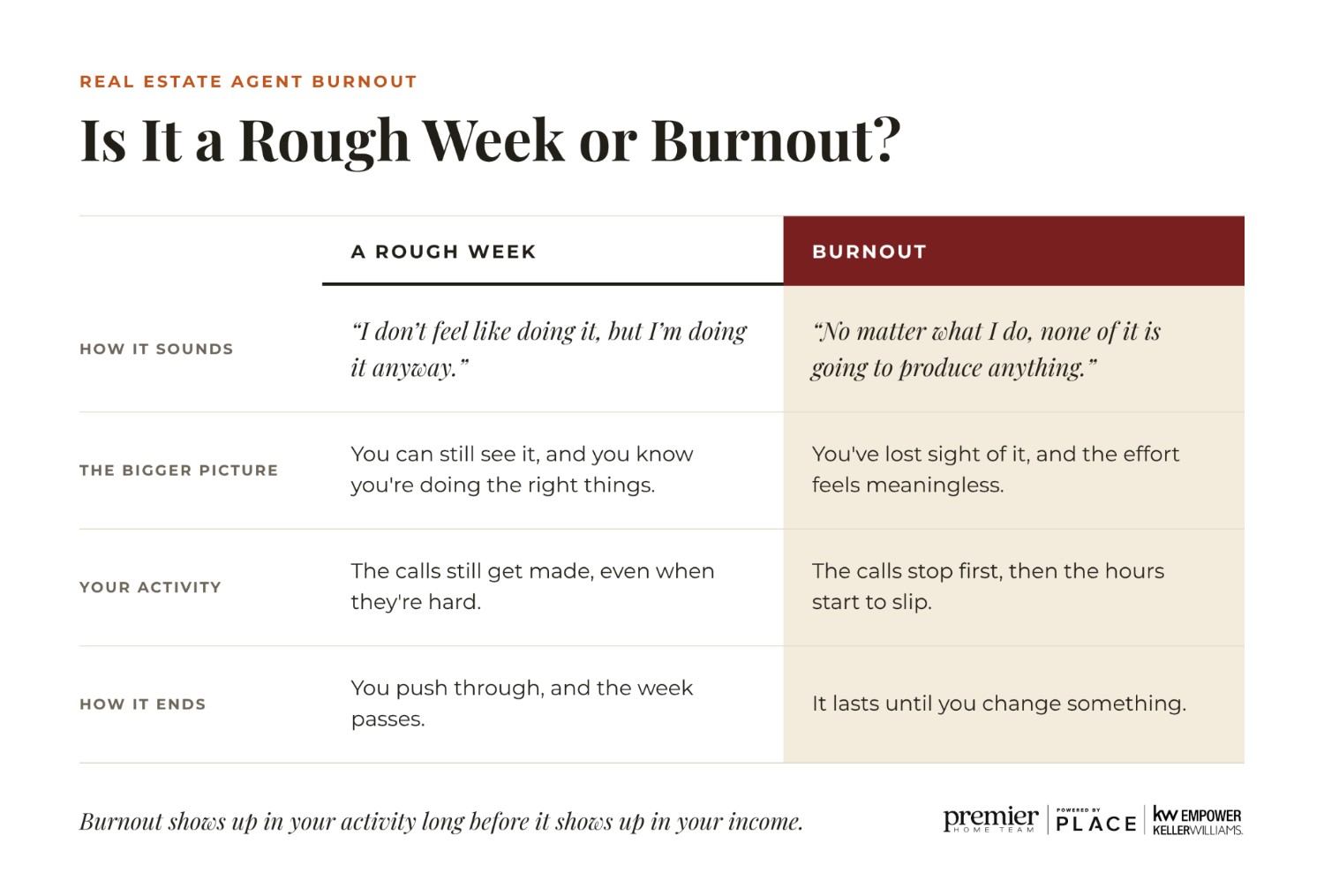
Why is real estate so prone to burnout?
Mostly because it's a delayed-gratification business. Your first few successes can take a lot of time, effort, and energy, and without experience you can't see the business coming down the pike. The U.S. Bureau of Labor Statistics notes that earnings can be irregular for new real estate agents, who may go weeks or months without a sale. You have to get through the valley before you reach the upslope.
The other half is the six inches between your ears. The biggest opponent you'll face is yourself, and that battle is harder when friends and family don't understand how you get paid. You aren't paid for showings or evenings with clients. You're paid on the back end, after a client finds the right home and settles.
PERSONAL PERSPECTIVE: What Got Me Through Three Months Without a Sale
In my first year in real estate, I went three months without selling a house. I didn't take a single day off during those three months, weekends included.
What got me through was the agents around me and the success they'd already had.
Four years into real estate, I've closed more than 100 deals, including 48 last year, and burnout still creeps in every now and then.
How Does Burnout Quietly Cost You Deals?
The first thing to go is outbound calling. Calling people you feel like you're bothering is draining, so you text instead and tell yourself they'll like you more for it. Next are the hours you're working. When you're pushing hard, you put in the time the work requires. When you're burned out, you start checking out earlier. On our team, that might look like a high performer suddenly deciding that 5 o'clock means they've done enough. Neither shows up in your numbers right away. It shows up later, as a pipeline with nothing in it.
What Are the 6 Warning Signs of Real Estate Agent Burnout?
Burnout shows up in your activity before it shows up in your income, so the signs are easy to miss if you're only watching closings. Here are the six we watch for, and what we do about each one.
1. You Dread Picking Up the Phone
It feels like every call is an interruption. In our experience, it rarely is. Most clients appreciate the follow-up because it shows you care enough to check in.
Start in first gear
When motivation dips, we lean on discipline. If you can do the work on the days you least feel like it, the good days get easy. On our worst days, we don't decide who to call. We let our CRM tell us who's next. One good conversation makes the second call easier, and two make you realize it isn't as bad as you thought. Don't try to jump straight into sixth gear. When it's really bad, shrink the goal to one question: what's the minimum number of people we can help today?
2. Your Time Blocks Keep Slipping
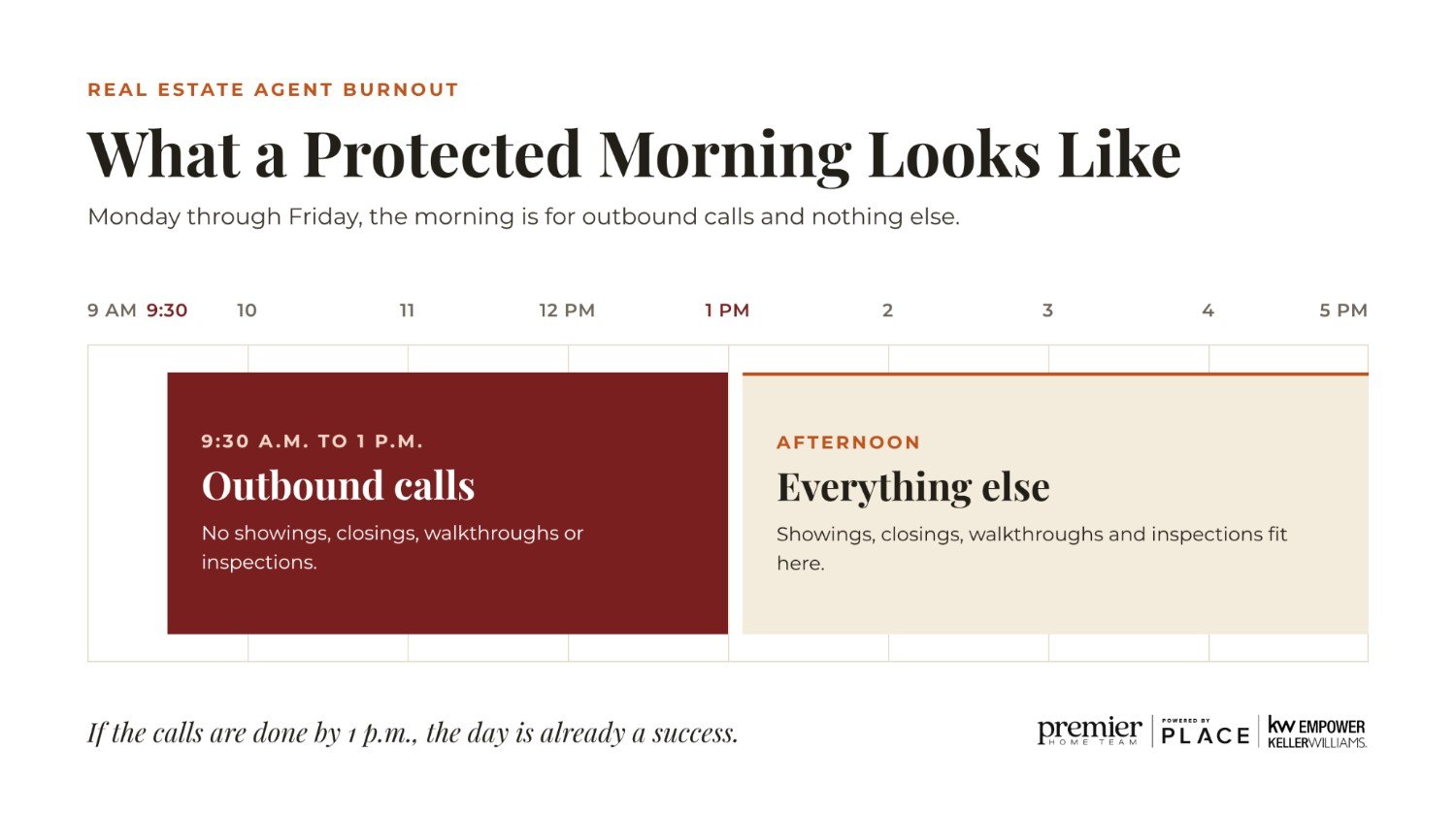
Our earliest warning sign is our schedule. Monday through Friday, 9:30 a.m. to about 1 p.m. is for outbound calls, and on a good morning we reach 60 to 70 people. When burnout creeps in, that drops to 40, then 30, sometimes 20. The rest of the morning is filled with real estate tasks that feel productive but aren't the fundamentals.
Protect your mornings
We don't book showings, closings, walkthroughs, or inspections in the morning. That window is for calls. If we've made all the calls we're supposed to by 1 p.m., the day is already a success, even if we never get the chance to pick up the phone again. A successful day starts with a successful morning.
Your evenings deserve some protection too. Client texts, late showings, and after-dinner offers will fill every hour you leave open, so decide when your workday ends and let clients know up front when they can expect to hear back from you.
3. The Transaction Side Is Eating Your Day
The first time you have two clients under contract at once, it can be difficult to focus on anything else. Early on, trying to hold every deal together crowds out everything else, including finding your next client.
Let go of some responsibility.
Letting go makes the job less stressful, not more. If you have a transaction coordination team, the daily stress of each deal can shrink as your capacity grows because the team and the systems behind it keep every nook and cranny of a deal on track to close.
If the admin side is what's wearing you down, our article on leverage for real estate agents covers what to hand off first.
4. Your Income Swings Between Feast and Famine
When nothing is under contract, you can see the slow month or quarter coming, and it drains you mentally and financially.
Track conversations, not just closings
Conversations are the easiest outbound effort to measure. As a general rule of thumb, we work from a funnel of about 100 conversations to 10 prospects, 2–3 clients, and one closing. Your numbers will vary, but once you know your own conversion rate, you know what today needs to look like. You may not feel on track today, but you'll know you're on track for the week and the month.
5. You Feel Like You're Doing It All Alone
Burnout gets harder when you feel like you're the only one struggling through the work.
Borrow energy from people doing the same work.
On low days, we run off the energy of the agents around us, and on high days we give it back. Seeing everyone focused on the same calls reminds you that you're not crazy for making them. It also reminds you of something less comfortable: if you won't do the work, there are hungry agents who will, and they'll take your future clients.
6. You've Lost Sight of the Bigger Picture
When you're burned out, it's easy to focus on getting through today and lose sight of what your business needs from you this week or month.
Let your business plan carry the bad days.
Our annual business plan gives us the week-in, week-out and month-in, month-out view. Skip today's calls, and they don't disappear. They shift to another day, and that day gets harder. You can decide you're okay with moving them, but you can't pretend they're gone.
How Do You Recover From Burnout Without Walking Away?
Start small. These three changes do the most to pull you out of the valley:
- Get around agents working at a higher level. Ask a team if you can spend a day with them, or find someone at your brokerage who's grinding the way you want to grind and work near them, at least once a week.
- Make calls every day, not one day a week. Saving every call for a weekly call blitz feels efficient, but it quietly costs you deals you'll never know you lost.
- Keep calling through the holidays. November and December bring more calls for fewer answers. Skip the follow-up then and two slow months turn into four.
When Is Joining a Team the Right Move for a Burned-Out Agent?
In your first year, burnout often comes from not knowing what to do or how to do it, and a successful team can show you what you were getting wrong. By your third or fourth year, it's usually about using your time well. Teams already have systems that real people use every day, so you don't have to build them from scratch.
What a team can't do is do the work for you. The calls and the follow-up are still yours.
A team also isn't the right fit for everyone, and it isn't free. You give up part of your commission on every deal, and some of your autonomy, because teams have systems and expect you to follow them. If full independence matters more to you than growing faster, the split probably won't feel worth it. If you're weighing that trade, our breakdown of whether a team's commission split is worth it walks through the real math.
Frequently Asked Questions
Is real estate a stressful job?
It can be, mostly because the work comes months before the pay. Early on, it's hard to trust that business is coming, and people outside the industry often don't understand why you're working evenings and weekends before a client settles.
When do real estate agents burn out most?
In our experience, November and December are when we see it most. Fewer motivated buyers and sellers mean more calls for fewer results, and the follow-up agents skip, then it shows up as a slow start to the new year.
Should I quit real estate if I'm burned out?
Before you decide, look at the effort you've already put in and ask whether you're okay with all of it being for nothing. Slow stretches come from seasons and market conditions nobody controls. More often the answer is changing a few things, not crumpling it all up and throwing it in the trash.
What Should You Do If You're Feeling Burned Out in Real Estate?
If you've been running on empty, you're in the valley, not at the end of the road. We've been there too.
Now you know the signs: the calls that quietly stop, the mornings that slip, the deals that eat your day, the swings in income, and the feeling that you're doing it alone. Each one has a small first step, starting with one conversation in first gear.
The best place to start is seeing where you stand right now. Download our free guide, Reset Your Real Estate Business in Two Weeks, to check which warning signs you're showing and map out a simple plan to protect your mornings, rebuild your conversations, and get yourself back in the right rooms.

Robin Martin
Realtor® | Premier Home Team | Keller Williams Empower | PLACE
or another way