
Categories
Working in Real Estate, CareersPublished May 6, 2026
10 Problems Real Estate Agents Face (And Why the Right Team Changes Everything)

10 Problems Real Estate Agents Face (And Why the Right Team Changes Everything)
Are you working 60+ hours a week but still falling short of your goals?
Have you ever wondered how other agents seem to grow faster, earn more, and stress less—while you're juggling everything alone?
You’re not underperforming. You’re operating inside a system that isn’t built for solo success.
In this article, we’ll walk through the 10 most common (and costly) problems agents face before they find the right real estate team. If several of these sound familiar, you’ll know exactly what to look for—and what to avoid—when planning your next move.
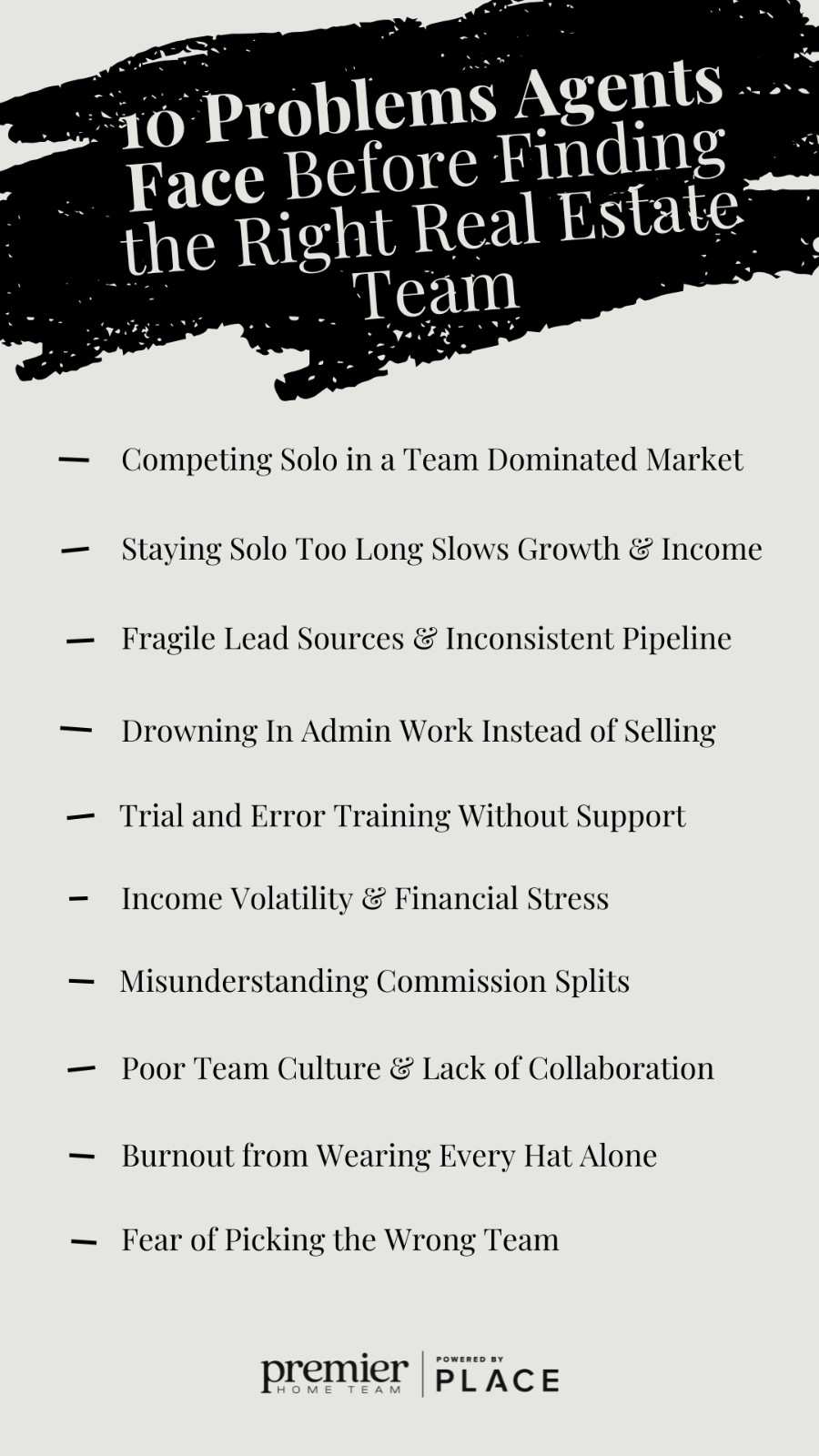
1. Why Solo Agents Struggle in a Team-Dominated Market
Philadelphia is a team-heavy market. Certain teams and brokerages have spent years building name recognition, systems, and infrastructure that give them a massive market share advantage. They're not just well-known—they've created repeatable processes that consistently generate business.
For newer agents, this creates an uneven playing field. You're learning the fundamentals of real estate while competing against teams with dedicated marketing budgets, admin support, CRM systems, and deep local expertise across multiple neighborhoods and zip codes.
Gaining traction alone in a team-heavy market is difficult. The resources required to compete are already baked into successful teams. In a market built around teams going solo makes the progress slower and far more demanding that it could be.
2. Why Staying Solo for Too Long Slows Growth and Income
Going solo can feel like the "pure" way to build a career. Full control. Full commission. Independence.
The tradeoff? You're responsible for every part of the business: prospecting, follow-up, marketing, paperwork, compliance, and client experience. Over time, that load stretches attention thin and slows momentum.
The warning signs are clear: deals take longer to close. Your pipeline shrinks. Effort increases while income stays flat. You might even find yourself juggling multiple jobs just to stay afloat, which only accelerates burnout.
Solo agents simply don't have the means to grow and scale their business while competing against teams that have no problem acquiring market share.
If you’re starting to see those warning signs, exploring a team built for agent success could be the most important move you make this year.
3. The Problem with Fragile Lead Sources (and How Teams Fix It)
Friends, family, and paid portals like Zillow are common starting points, but they're unreliable foundations for long-term growth.
Each lead source has its season. If your friends and family live in a certain area or income bracket, external factors—market shifts, economic changes, life transitions—can disrupt that pipeline overnight. Paid portals are expensive and competitive, and the leads often go to multiple agents.
When you rely too heavily on one source, your business becomes volatile. Strong months feel great, but slow months feel catastrophic. While platforms like Zillow Premier Agent can seem like a reliable source of leads, Zillow advertising costs can range from several hundred to over a thousand dollars per month — and individual leads often cost $20–$60 or more, depending on ZIP code and demand.
The right team teaches you how to generate leads through multiple channels—and provides the resources to help you do it. Without that diversification, most agents remain stuck in a feast-or-famine cycle.
4. How Admin Tasks Eat Away at Your Income Potential
Let's put a number on it: most solo agents lose 25–30 hours a month to paperwork, CRM management, and compliance tasks. That's time that could be spent talking to clients, generating new business, or maintaining existing relationships.
The impact compounds over time. Missed follow-ups. Stalled pipelines. Neglected relationships. You're losing clients and missing opportunities without even knowing it because you're so bogged down in admin work.
Before joining our team, many agents report spending half their time on non-income-producing activities—managing poor CRMs, disorganized spreadsheets, and endless paperwork.
Some setups expect agents to manage every backend detail themselves. Others protect income-producing time by design. The difference shows up quickly in both results and stress levels.
5. Why Trial-and-Error Training Sets New Agents Back
Many brokerages offer freedom without structure. New agents are encouraged to learn through trial and error, often without meaningful feedback or accountability.
The problem? You don't know what you don't know. You learn things at a much slower pace. And mistakes in real estate are expensive—both financially and reputationally.
Real mentorship is different. The leaders take accountability for your level of success. There's a different level of investment, an investment in time dedicated to making sure you're successful. When you can learn from people with 20 years of experience, you avoid pitfalls that would have taken you years to discover on your own.
There's a meaningful difference between independence and neglect. Some environments invest deeply in development. Others leave growth entirely up to the agent—with predictable results.
6. When Inconsistent Income Makes You Question the Career
Inconsistent systems lead to inconsistent income. Solo agents often experience dramatic swings between busy months and dry spells.
Two things make this especially difficult: First, you may not have systems in place to do things consistently. Second, on days when you don't feel like it, there's no team accountability to keep you moving forward. When you're solo, it's just easier to skip the hard work.
Over time, that financial stress creates emotional fatigue. According to the 2025 NAR Member Trends Report, even as market activity slows, agents are reporting income plateaus and increasing career uncertainty. The way most agents look at it: "If I'm going to put in X amount of hours and not get anything out of it, I might as well just go do something else."
The difference usually isn't effort. It's whether you're operating within a system designed for consistency or one that depends entirely on individual momentum. If you’re tired of the emotional whiplash of solo income, learn how our team creates consistent growth through built-in systems
7. Why Commission Splits Aren’t the Whole Story
Here's the truth: most agents don't understand where the split actually goes.
They see a 50/50 or 35/65 split and immediately think the team is "taking" half their commission. In reality, the majority of what you're investing goes toward the infrastructure that helps you scale your business: lead generation, training, admin support, CRM systems, and marketing.
Most agents evaluate opportunities from a per-check perspective—"How much will I take home on each transaction?"—instead of looking at total annual GCI. They stop at what's coming out of each check instead of seeing how the team could exponentially increase the number of checks they're getting.
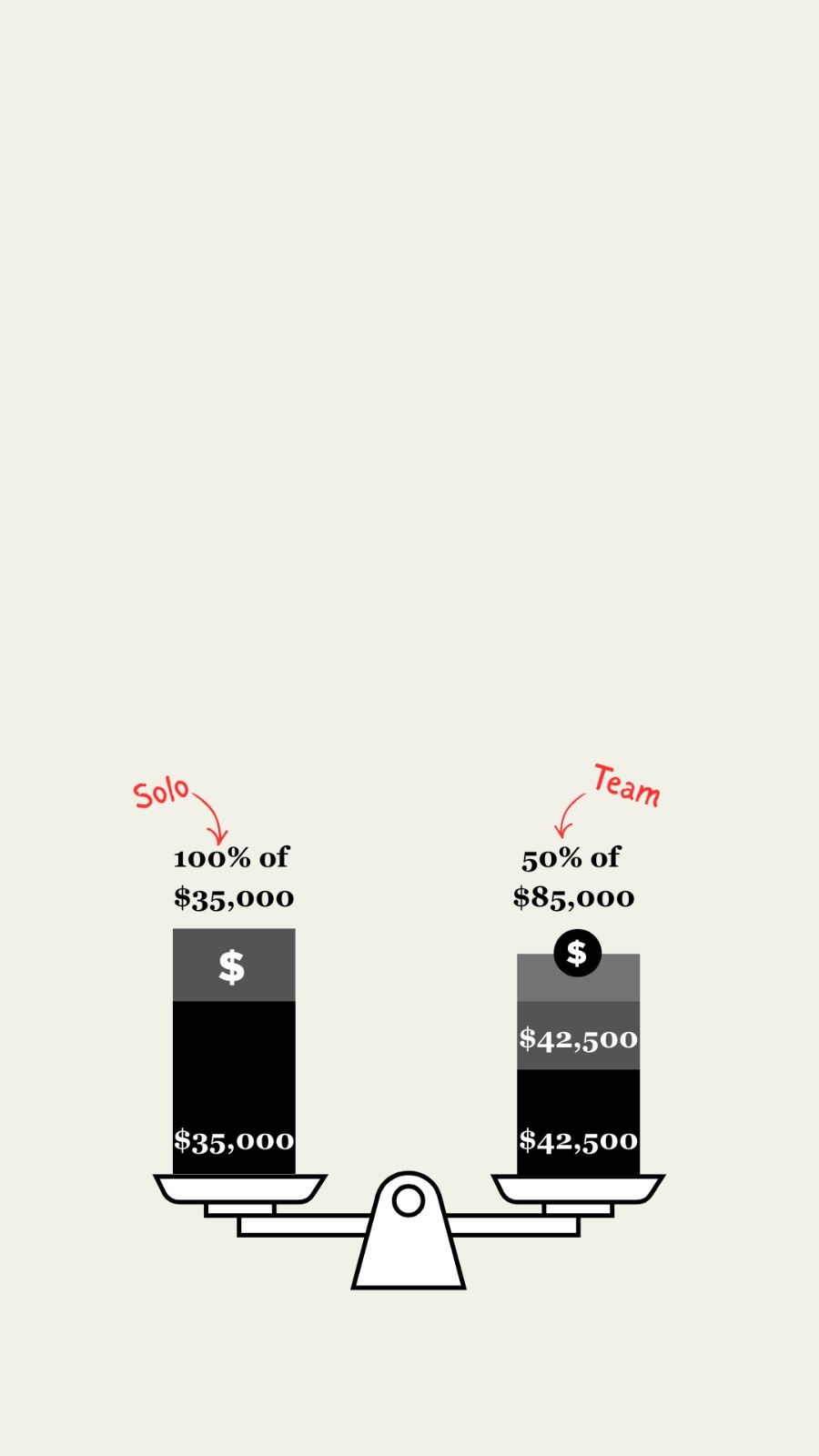
Here's a question worth asking: Would you rather keep 100% of $35,000, or 50% of $85,000? If getting from $35,000 to $85,000 means sharing part of your commission to access the systems that make it possible, is that worth doing?
Total GCI tells a much fuller story than any single commission check. When agents can shift their perspective from net per transaction to total annual income, teams start to make a lot more sense.
8. When Real Estate Teams Don’t Feel Like Teams
Most agents join teams for camaraderie. They want to feel appreciated, work with people they like, and be part of something bigger.
The problem? Many teams—whether it's the fault of the agents or the team leads—are built on the wrong principles. They're not really collaborative environments. They're just a bunch of people under the same umbrella still competing with each other for business.
In environments like that, if you need help with a showing or information on how to get something across the closing table, you'll find that most people aren't invested in your success. That isolation compounds stress and slows development.
When culture is treated as an afterthought, even talented agents struggle to thrive.
9. The Hidden Burnout That Comes from Doing Everything Alone
Handling marketing, prospecting, operations, and client service alone takes a toll.
Burnout often shows up quietly at first: slower response times, missed details, declining enthusiasm. You're managing multiple aspects of the business, and while you may not notice it immediately, you're working far less efficiently than you could be.
From a results perspective, burnout looks like this: no results to show for the actions you're putting in.
And because you're so bogged down with the day-to-day, you can't invest in the things you need to do to grow your business. Some business models create space for strategic growth. Others trap agents in perpetual maintenance mode. Over time, only one of those paths leads to higher-quality work and sustainability.
10. How to Evaluate a Team Without Risking Your Career Momentum
This fear is real—and it's human. The concern isn't just joining the wrong team. It's losing momentum or having to start over.
That fear often leads to inaction, which can be just as costly as a poor decision.
So what should you focus on? Average agent productivity across the team. Here's what most people don't tell you about teams: a team might be large, but there might only be a handful of agents doing all the business. Teams market their services based on the success of those top performers.
The best way to see if you're going into the right system is to check if that productivity is spread out across the entire roster. If success is evenly distributed—not concentrated in just a few top performers—it's a sign the system works for everyone, not just a select few.
Also, talk to individual agents on the team. Find someone who's been there for a while and someone who just started. Ask them how they like it. How they feel about the leads, the education, the culture. Honest conversations reveal far more than marketing materials ever will.
Your Next Step
You’ve just explored 10 real-world problems that agents face—most of which are built into the solo-agent model.
If you're feeling exhausted, stuck, or like you're falling behind, it’s not because you’re not cut out for real estate. It’s because you’re trying to thrive in a system that doesn’t support your growth.
Take 10 minutes to explore what a supportive team structure could actually look like. Visit our Careers page to see how agents on our team are scaling faster—with less burnout, more consistency, and better quality of life.
We’re a team built by agents, for agents—designed to remove the friction points you’ve just read about. If you're ready to shift from surviving to thriving, we’d love to talk.
Robin Martin
Realtor® | Premier Home Team | Keller Williams Empower | PLACE
or another way