
Categories
Home Buying TipsPublished March 11, 2026
What Do You Need to Apply for a Mortgage?


If you're thinking about buying a home, you've probably asked yourself a version of this question already: What do I actually need to apply for a mortgage?, and is my credit score good enough to do this?
For many buyers, the uncertainty around credit, income, debt, and down payments is enough to stop them from taking the next step at all. Instead of getting answers, they assume they're not ready—or worse, that they won't qualify—and put the idea of buying a home on hold.
As real estate professionals, we have worked with over 500 new buyers in the last five years. Buyers often come to us believing they need perfect credit, a 20% down payment, or a flawless job history, only to learn that mortgage qualification is far more flexible and individualized than they were led to believe.
In this article, we'll walk through exactly what lenders look at when you apply for a mortgage—credit, income, debt, and employment—so you can understand what actually matters and feel confident starting the process.
What Credit Score Do You Really Need to Buy a Home?
Credit is one of the first things lenders review, but it's not as simple as hitting a single "magic number."
Different loan programs have different minimum credit requirements. Scoring can generally give us an idea of what loan programs you might qualify for, for example:
- FHA (Federal Housing Administration) loans have a minimum credit score of 580
- Conventional loans have a minimum credit score of 620
Beyond credit scores, lenders look at the full credit profile: how long you've had credit, how consistently you've made payments, and what types of accounts appear on your report.
Things like collections, charge-offs, or deferred student loans don't automatically disqualify you from getting approved. Lenders will look at this all in context, to determine when those items occurred, how they're reported, and whether there's a pattern of repayment.
In other words, two buyers with the same credit score can have very different outcomes depending on what's actually behind the number, and your lender will dive deeper into this process with you to determine how they can structure the loan best to suit your circumstances.
What does 'Bad Credit' really mean?
When people hear the term bad credit, they often assume it comes down to one single number. In reality, credit is more nuanced than that.
.jpg)
In general, credit scores below 580 are often labeled as "poor," but lenders don't look at your score in isolation. They also consider why your score is where it is and what your recent payment history looks like.
"Bad credit" can reflect things like:
- Multiple accounts in collections
- Missed or late credit card payments
- Late mortgage payments
- Several disputed accounts that haven't been resolved
On the other end of the spectrum, having little or no established credit can also make qualifying more difficult. Even without negative marks, a limited credit history gives lenders less information to work with.
If you discover any of these issues, the next step is finding clarity. A mortgage or financial professional can review your full financial picture, help you understand which items matter most, and outline steps to address them. In many cases, that means resolving collections, correcting errors, or building positive payment history over time.
From there, your lender can help you create a realistic timeline toward pre-approval, so you know exactly what needs to happen — and when — to move forward with confidence.
How Do Lenders Determine What You Earn?
Income is another major piece of mortgage qualification, and how it's calculated depends on how you earn it.
Salaried (W2) income is the most straightforward and easiest to qualify, and the lender looks at gross income.
Hourly employees are qualified slightly differently, because hours can fluctuate. The lender will take recent and year end paystubs to determine a baseline on the gross income. Depending on the loan type, overtime, bonuses, commissions, and tips can often be used if they've been earned consistently and are likely to continue.
Self-employed buyers (say 1099) and business owners are evaluated differently again. Lenders typically look at net income from tax returns and may be able to add back certain expenses like depreciation or mileage, depending on how the business is structured.
| Salaried (W2) | Hourly | Self Employed (1099) | Business Owner |
| Annual salary __________ 12 (months) |
YTD income from previous & current year _____________ No of months |
Earnings - deductions | Earnings - deductions |
| = Baseline monthly rate | = Baseline gross income (plus overtime/bonuses averaged over the amount of time earned) | = Baseline net income | = Baseline net income |
Income is calculated VERY differently across loan types and how people earn income. An experienced mortgage professional can help to ensure your income is calculated correctly from the start, to avoid any surprises on the mortgage approval once it's in underwriting.
How Is The Debt to Income Ratio Evaluated?
When you apply for a mortgage, lenders don't just look at how much you earn—they look at how much of that income is already committed.
This is measured using a debt-to-income ratio (DTI). Your gross monthly income is compared to your existing monthly debts plus the expected mortgage payment.
What is considered debt?
Auto loans, credit cards, student loans, and other obligations all factor into your DTI. Even smaller recurring payments (such as from internet payment systems such as Klarna, Affirm, Apple Pay) can impact buying power, especially if they don't show up as traditional credit card debt but still represent long-term obligations.
How is the debt-to-income ratio calculated?
A simplified version of how debt-to-income ratios work would be:
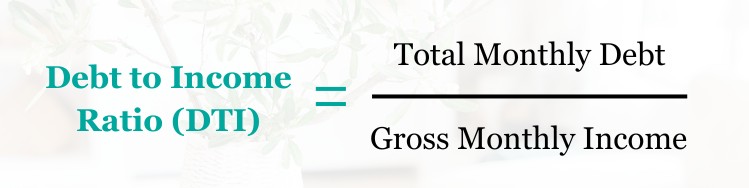
Different loan programs allow different maximum ratios:
- Conventional loans - DTI cannot exceed 50% of gross monthly calculated income
- FHA loans - DTI cannot exceed up to 56% of gross monthly calculated income.
As long as borrowers don't exceed these DTI ratios and maintain credit worthiness, they can typically garner an approval, under one program or the other.
Do You Need Two Years of Job History to Qualify for a Mortgage?
A common misconception is that you need to be at the same job for two years to apply for a mortgage. What lenders usually want is two years of consecutive employment history, not necessarily two years with the same employer.
Job changes within the same field are often acceptable. Gaps can be explained with documentation. In some cases, salaried buyers may even qualify with less than two years at their current job.
Self-employed buyers typically need a longer documented history, but transitions from self-employment to W-2 work in the same field can sometimes shorten that timeline.
What are Cash Reserves, and Do I Need to Save More?
Assets include the funds you'll use for your down payment and closing costs, but lenders may also look for cash reserves—money left over after closing.
For example, on a $200,000 mortgage payment, we would need to show that the borrower has the ability to produce $2000 either in their accounts, or by way of a gift, or alternate funds, such as retirement).
Reserves are individual, and measured in months of mortgage payments and vary based on the loan type, credit strength, and property type. Typical, on a standard, primary residence, there can be a recommendation of anywhere between 0 to 3 months of reserves, whereas, on an investment, there will always be a mandatory minimum of six months reserves.
Why does the Home You're Buying Matter?
Mortgage approval isn't based only on the buyer—the property plays a role too.
Single-family homes are typically the simplest to finance because the loan is going to be based on the borrower, their profile, and how much they're putting down.
When it comes to Multi-unit properties or homes with accessory dwelling units, then the lender will potentially add projected rental income to help qualify a borrower, which comes with its own specific set of rules.
Reviewing properties with your lender early can help avoid surprises later, especially when borrowers are considering nontraditional or income-producing homes.
So, What Do You Really Need to Apply for a Mortgage?
At a high level, lenders are looking to understand a few core parts of your financial picture. That includes your credit profile, so they can see how you've managed credit over time; verifiable income, to confirm what you earn and how it's calculated; and manageable monthly debt, to make sure your new mortgage fits comfortably alongside your existing obligations.
They'll also look for a stable employment history, which helps show consistency, and sufficient assets to cover your down payment, closing costs, and any required reserves. None of these factors exist in isolation—what matters most is how they work together in your specific situation. When you understand these pieces, uncertainty fades, and clarity creates momentum and gives you a strong foundation to build on.
Your Next Step: Talk to a Lender Early
At this point, you should have a much clearer understanding of what it actually takes to apply for a mortgage. From how your credit is evaluated to how your income is calculated, you now know the key factors lenders consider—and that no single detail determines your eligibility.
We know how overwhelming this process can feel—especially when myths about needing perfect credit, a 20% down payment, or years at the same job are everywhere. Those misconceptions stop too many buyers before they even start.
If you're still unsure how your personal finances stack up, the best next step is to talk to a lender. A quick conversation can help you understand where you stand today, and what steps—if any—are needed to move forward.
As real estate professionals, we help buyers navigate this process every day. Whether you're ready to apply or just starting to explore your options, we can connect you with the right mortgage experts to give you honest answers and a clear plan. When you're ready, fill out our contact form and we'll be in touch —we're here to guide you.

Robin Martin
Realtor® | Premier Home Team | Keller Williams Empower | PLACE
or another way