
Categories
Home Buying TipsPublished April 6, 2026
What to Expect During a Home Inspection in PA & NJ

You’ve found the house. Your offer was accepted. You’re excited.
And then someone says, “Next up, the inspection.”
Suddenly, what felt certain can feel fragile.
What if they find something major?
What if the report is terrible?
What if the deal falls apart?
If you’re feeling anxious about your home inspection, you’re not alone. Almost every buyer does. The good news? The inspection isn’t designed to scare you, it’s designed to protect you.
We’ve reviewed hundreds of inspection reports and negotiated repairs across every price point - from first-time home buyers in rowhomes to new construction properties, and we can confidently say this: a home inspection is one of the most empowering steps in the entire home-buying process, when you understand what it really is.
Let’s walk through what to expect.
What Happens During a Home Inspection?
At its core, a home inspection exists for one reason:
To give you more information so you can make a fully informed decision.
In both Pennsylvania and New Jersey, the inspection contingency is a protective clause in your agreement of sale. It allows you to bring in an expert to get an in-depth understanding of what you’re actually buying.
Think of it like buying a used car. You wouldn’t skip having a mechanic look at it first. A home inspection works the same way — except a house is far more complex than a car. You want trained eyes evaluating its soundness and giving you their best advice about what you’re facing.
That information then becomes part of a larger equation.
It’s not a test the house has to pass. It’s not a moment where everything is black or white. It’s one important piece of the overall equation; alongside price, market value, location, condition, and your comfort level.
The inspection simply gives you better data to plug into that equation.
.jpg)
Why Do Inspections Feel So Overwhelming?
Even buyers who love their house often feel nervous before inspection day.
Why? The unknown.
Anytime we look deeper into something we care about, there’s a natural concern about what we might find. Once you’ve emotionally committed to a home, the idea of uncovering problems can feel threatening.
But here’s the shift:
More information actually reduces the risk.
The inspection is just another piece of information, much like the market analysis you reviewed before submitting your offer. It helps you confirm, refine, or adjust your decision based on facts rather than fear.
Where does the Inspection Fit in the Buying Timeline?
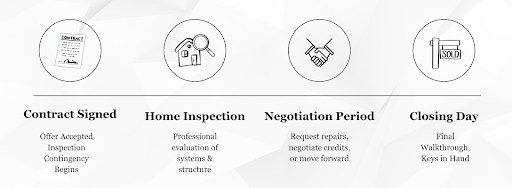
The inspection typically happens in the first half of the contract period — between when you go under contract and when you receive the keys.
That timing is intentional.
The earlier we gather information, the more flexibility we have to find solutions. If there are concerns, we have time to negotiate. If something fundamentally changes the equation, you have time to reassess.
Clarity early in the process protects everyone involved.
What Do Inspectors Actually Do?
A common misconception is that inspectors check a few visible items and move on. In reality, inspections are thorough and methodical.
Inspectors evaluate nearly everything they can access; the roof, foundation, plumbing, electrical systems, HVAC, appliances, outlets, doors, windows, and visible structural components.
They can’t see behind walls, they don’t have X-ray goggles, but they may use tools like moisture meters or infrared technology to detect hidden concerns.
They open electrical panels. They test outlets. They run systems. They operate windows and doors. They examine what’s visible and accessible.
That’s why inspections often take two to three hours, and sometimes longer for larger or older homes. The size and age of the property play a significant role in how long the process takes.
Why Are Inspection Reports So Long?
One of the biggest surprises for buyers is the length of the inspection report.
It could be 80-100 pages, sometimes it’s even longer.
That doesn’t mean something is wrong.
A home is made up of thousands of components, some estimates put that number above 3,000. And every one of those components is on a timeline, from the day it’s installed to the day it reaches the end of its usable service life.
Roofs age. HVAC systems age. Water heaters age. Nothing lasts forever.
An inspection report is essentially a roadmap of where major components are on that timeline. Some items may need attention now. Some may be nearing the end of their service life. Others simply require monitoring.
Inspectors tend to err on the side of including more information rather than less. In a litigious world, thorough documentation protects both you and them.
Length does not equal severity. It means you’re receiving detailed information, exactly what the inspection is meant to provide.
How Do You Read a Home Inspection Report Without Panicking?
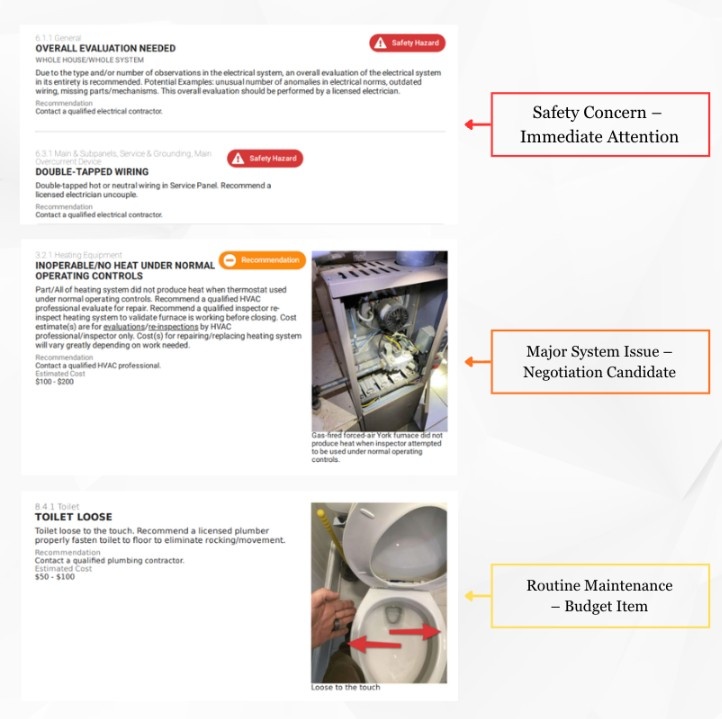
A reputable inspection company will usually separate findings into categories such as safety issues, major defects, maintenance items, and cosmetic concerns.
These are not the same thing.
An aging water heater is different from a gas leak. A loose handrail is different from a structural failure.
There are many shades of gray in an inspection report.
This is also why we strongly recommend attending the inspection in person. When you’re there, the inspector can explain not just what they’re seeing, but how important it is. You gain context about the gravity, or lack of gravity, behind each item.
If you only read the written report later, everything can appear equally urgent. Being present helps you understand what truly matters.
Here’s an example of how inspection findings are typically categorized:
Why Should You Attend the Home Inspection?
We recommend every buyer attend their home inspection.
Here’s why:
First, it’s essentially a tutorial on your home.
You’ll learn:
- Where the water shut-off valve is
- How often to change filters
- What seasonal maintenance looks like
- How systems operate
Second, you’re renting an expert for a few hours. You have the opportunity to ask questions, clarify concerns, and most of all, gain perspective.
That context you gain at the home inspection makes the written report much easier to interpret.
Is a Home Inspection Pass or Fail?
There are many shades of gray in a home inspection.
Homes in Pennsylvania are sold “as is,” which can be confusing. It doesn’t mean you have no protection. It means the inspection is not a simple pass/fail test.
Instead, it’s part of a larger equation:
You might discover several issues, but if the home is priced accordingly or located exactly where you want to be, it may still make sense.
On the other hand, you might find only one major issue, but if you were already paying top-of-market, that one repair could tip the balance.
It depends on:
- the price
- the condition
- how much you want the house
- your comfort with repairs.
The inspection simply gives you the clarity to make that call.
What Are Your Options After a Home Inspection?
Once you receive the inspection report, you typically have three options.
1. Accept the home as-is
If the findings are minor, or if you’ve already factored condition into the price, you may decide to move forward without requesting repairs.
This is common when:
- The home is competitively priced
- The issues are mostly maintenance-related
- You’re comfortable handling future repairs
Choosing to move forward as-is means you’re confident the value still makes sense.
2. Negotiate repairs or credits
If the inspection reveals hidden and material issues - especially those related to safety, structure, roofing, plumbing, or HVAC - your may request:
- Specific repairs to be completed before closing
- A credit toward closing costs
- A price reduction
This is where your agent helps you determine what’s reasonable based on:
- What was visible before you made your offer
- The overall price of the home
- Market conditions
Negotiation isn’t about “winning”; it’s about restoring balance to the value equation.
3. Walk away (if the contingency allows it)
If the inspection reveals significant issues that materially change the risk or cost of the home, and negotiations don’t resolve them, you may choose to terminate the agreement under your inspection contingency.
This is protection working exactly as designed.
You are never stuck, the inspection gives you leverage.
.jpeg)
If you decide to negotiate, here’s what typically qualifies.
What Inspection Issues Should You Negotiate?
There’s no universal formula, but in general, negotiations often center around items that are hidden and broken — things you couldn’t reasonably see during your initial walkthrough and that materially affect safety or major systems.
If you put an offer on a house with an issue that’s clearly visible, it’s difficult to later argue that it’s new information. But when a concern was not apparent at the time of your initial walk through, and that issue changes the value equation, that’s where negotiation conversations usually begin.
Context matters most of all.
A $20,000 repair means something very different in a below-market purchase than it does in a top-of-market property. When you plug that repair into the overall equation and the numbers no longer make sense, that’s when the negotiations usually begin. If the seller can’t bring the transaction back to a place where it works for you, that’s when you would consider your options.
Adjusting Expectations Based on Age and Price
An inspection on a rowhome built in 1900 will be completely different to an inspection on new construction built in 2022.
A well-priced home in a desirable neighborhood may come with projects. A premium, turnkey property should meet higher expectations.
Age, price, condition, and market timing all influence how you interpret inspection findings. The inspection doesn’t stand alone — it fits into the broader context of the transaction, and your agent will help you interpret and understand these findings.
When Should You Walk Away After a Home Inspection?
The inspection contingency exists for a reason. It protects you from being forced into a purchase that no longer works once new information is revealed.
If, after plugging everything into the equation — price, repairs, location, long-term plans — the purchase no longer makes sense, negotiations begin. If those negotiations can’t restore balance, walking away becomes a strategic decision, not an emotional one.
That’s exactly why the contingency is there.
The Bottom Line: Inspections Create Clarity, Not Chaos
When you first heard the word inspection, it may have felt like the most fragile moment in the home buying process, the point where everything could fall apart.
That anxiety is normal.
But now you understand something important:
A home inspection isn’t a pass-or-fail test. It’s a structured opportunity to gather information before making one of the biggest financial decisions of your life.
The inspection doesn’t create problems, it reveals information so you can decide confidently.
You’ve moved from uncertainty to clarity. That clarity is exactly what the inspection was designed to give you.
And once you see the inspection as part of the larger equation, price, condition, location, long-term plans, it becomes a tool, not a threat.
If you’re approaching your inspection and want to talk through what to expect in your specific situation — or if you’ve received your report and need help interpreting it; our team is here to walk you through it calmly and strategically. Reach out to your agent directly to discuss your inspection.
Because the goal isn’t just getting you to closing.
It’s making sure you feel confident every step of the way.
Frequently Asked Questions About Home Inspections
1. What happens during a home inspection?
During a home inspection, a licensed inspector evaluates the major systems and visible components of the home, including the roof, foundation, plumbing, electrical systems, HVAC, windows, doors, and structural elements.
They test systems, open electrical panels, operate appliances, and document anything that may require repair, replacement, or monitoring.
The goal isn’t to “pass or fail” the house — it’s to give you detailed information so you can make a confident decision.
2. How long does a home inspection take?
Most home inspections take 2–3 hours, though larger or older homes may take longer.
The length depends on the size, age, and condition of the property. Afterward, you’ll receive a detailed report — often 80–100 pages — outlining findings and recommendations.
3. Should I be worried about my home inspection?
It’s normal to feel nervous, but a home inspection is designed to reduce risk.
Most reports include a mix of maintenance items, aging components, and occasional larger concerns. Very few homes are “perfect,” and that’s expected.
The inspection simply gives you clarity so you can decide whether to move forward as-is, negotiate repairs, or walk away if necessary.

Robin Martin
Realtor® | Premier Home Team | Keller Williams Empower | PLACE
or another way