
Categories
Working in Real EstatePublished July 24, 2026
Joining a Real Estate Team: Is the Commission Split Worth It?


Joining a Real Estate Team: Is the Commission Split Worth It?
EXECUTIVE SUMMARY
Real estate agents evaluating a team split often focus on what they give up instead of what they gain. This article breaks down how commission splits actually work, what they get you in return, and how to run the real math on whether a team is worth it at your production level. You will learn the most common mistakes agents make when calculating take-home pay, which agents genuinely come out ahead on a team, and the three questions you should always ask before signing anything.
Every time you look at a real estate team's commission split, it's hard not to think the same thing: "Why would I give away 30%, 40%, or even 50% of my commission?"
It's a fair question. On the surface, a team split can feel like you're paying someone else to do a job you are already doing yourself.
But that's also where many agents make a costly mistake. They judge a team by the percentage it takes instead of the value it creates.
At Premier Home Team, we've spent the past five years helping agents work through this exact question. The biggest mistake we see isn't choosing the wrong path, it's evaluating the decision based on the commission split alone.
In this article, we'll show you how to evaluate a team split the way a business owner would, what you're really paying for, the expenses most solo agents overlook, and how to calculate whether joining a team will leave you with more money, or less. We'll also look at the types of agents who tend to thrive on teams, those who may be better off going solo, and the questions you should ask before signing any agreement.
How Real Estate Team Commission Splits Actually Work
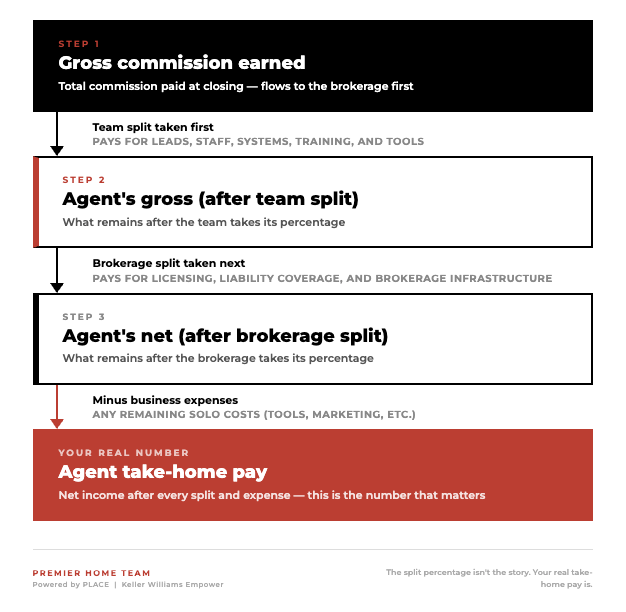
One of the biggest misconceptions about joining a real estate team is that there's just one commission split. In reality, there are usually two. First, the team takes its agreed-upon split in exchange for the services and support it provides.
In return, the team typically provides leads, administrative support, transaction coordination, marketing, coaching, technology, and accountability. Exactly what you receive depends on the team, which is why comparing commission percentages alone rarely tells the full story.
Not sure whether a team is the right fit in the first place? Read our guide Solo vs. Team: Which Real Estate Career Path Is Right for You?, before you compare commission structures.
Then the brokerage takes its split for operating under its license and infrastructure. Whether you're on a team or not, you'll usually still pay your brokerage a split unless you've reached a cap or negotiated a different compensation model.
So, if you close a $10,000 commission, you might pay a percentage to the team and a separate percentage to the brokerage. What is left is your take-home. That number looks different on every team, which is why "what is your split?" is only the starting question. The real question is whether what you're getting is worth what you're paying.
Team Split vs. Brokerage Split: What Is the Difference?
Agents sometimes mix these up, and it is an expensive mistake to make.
A team split goes to the team. A brokerage split goes to the brokerage. These are separate, and both come out of your commission before you see anything. Some agents assume the team split replaces the brokerage split. It does not. They stack.
Why does this matter when you run the math? Because an agent comparing a team offer to going solo needs to account for both. A solo agent still pays a brokerage split. They just do not pay the team on top of it. So the real comparison is not "what does the team take" but "what do I net, all in, with and without the team?"
What You Are Actually Buying With Your Split
This is where most agents underestimate the value, and it is the part that changes the math the most.
When we think about what it would cost to rebuild what a team provides from scratch, the number is staggering. Most agents never see these costs because the team absorbs them. At Premier Home Team, our staff salaries alone run north of a quarter of a million dollars a year. That does not include technology, data, marketing materials, or transaction support. Recreating that infrastructure independently takes significant time and money.
But the real cost is not even the money. It is the production you would lose without the support.
The question an agent needs to ask is not "can I recreate what the team does?" It is "what happens to my business if I do not?" How many homes would you sell without the leads, the mentorship, the systems, the accountability? That gap in production is the actual cost of going solo.
Based on our experience at Premier Home Team, the agents on our team tend to do about 2.5 times more business than they would on their own. That doesn't happen because the split magically makes someone a better agent. It happens because they're spending more time selling homes and less time running a business.
When you run that against the roughly 30% more they pay in splits compared to what they would pay solo, the math is not even close. Two hundred and fifty percent more production for thirty percent more cost is not a split. It is an investment.
WHAT THE 2.5X NUMBER ACTUALLY LOOKS LIKE
Say an agent closes 10 deals a year solo, averaging $8,000 net commission per deal after the brokerage split. That is $80,000 a year before solo expenses.
That same agent on a team closing 25 deals a year (2.5x production) at the same $8,000 average, minus an additional 30% team split, nets roughly $140,000 a year.
Even after paying more in splits, the agent on the team is taking home significantly more, before factoring in the thousands per month most solo agents spend on tools and systems the team already provides. These are illustrative numbers. Your actual production and splits will vary, which is exactly why running your own numbers matters.
What You Give Up When You Join a Team
We want to be direct here, because the answer matters.
You give up some money on every deal. That is real. But more than the money, you give up a degree of autonomy. Teams have systems. They have a way of doing things that works, and they expect you to follow it.
If you want to build your own process from the ground up, even if it takes longer, even if it costs you deals along the way, a team is going to feel like a constraint. For some agents, that constraint is exactly what they need. For others, it is a dealbreaker.
Agents who tend to struggle on teams are those who want to do a small number of deals as supplementary income, or those who simply want full independence above everything else.
If you're planning to sell only a handful of homes each year as a side business, it's difficult for a team to deliver enough value to justify the split. The benefits do not kick in at low volume. And if being your own boss matters more to you than growing faster, there is no split that will make that trade feel worth it.
The Expenses Solo Agents Almost Always Forget
When agents leave a team for the first time, most of them underestimate what running a business actually costs. When everything is handled for you, you stop noticing what it costs.
That's because most of these expenses aren't paid all at once. They creep in one subscription, one service, and one hire at a time until you're spending thousands every month just to keep the business running.
Here is what adds up fast:
- A CRM: often $100-200 per month, or more for a premium service
- A triple-line dialer: around $500 per month
- Data for prospecting (phone numbers, email addresses): $100 to $200 per month
- Signs, business cards, and marketing materials
- Transaction coordination services
- Your own staff, if you want support
That list adds up to several thousand dollars a month before you close a single deal. Add in the production you lose when you are handling all of that yourself instead of selling, and the solo math gets uncomfortable quickly.
Solo vs. Team: A Side-by-Side Expense Snapshot
| Monthly Expense | Solo Agent | On a Team |
| CRM | $100+ | Included |
| Dialer / outreach tools | $500 | Included |
| Prospecting data | $100-$200 | Included |
| Marketing materials & signage | Varies, out of pocket | Included |
| Transaction coordination | Per-transaction fee or DIY | Included |
| Mentorship & training | Self-directed | Included |
| Time spent managing the business | High | Lower |
| Estimated monthly overhead | $700-$800+ | Covered by team split |
Figures are estimates for illustration. Actual costs vary by market, tools, and team.
Every agent should run this calculation at least once a year. Not just when they are thinking about leaving, but every year. Lay out your true expenses as a solo agent, estimate your production in both scenarios, and let the numbers tell you what is right.
Want to run your own numbers? We've created a free Solo vs. Team Pro Forma Worksheet that walks you through your projected production, commission splits, business expenses, and real take-home income so you can compare both paths using your own numbers, not generic examples.
Recently, we sat down with an agent who was considering leaving our team and worked through the numbers together. In the end, they still decided to leave, and we supported that decision. The exercise wasn't about convincing them to stay. It was about making sure they understood exactly what they were gaining, what they were giving up, and what it would really cost to run the business on their own.
At What Production Level Does Going Solo Start to Make Sense?
There is no clean number. But around $10 million in volume, or roughly 40 deals a year, agents tend to start doing the math more seriously. Around that point, the additional splits you're paying become large enough that it's worth asking whether you're still receiving enough value in return.
At that level, the split feels significant because the base commission is significant. And solo starts to look attractive, at least on paper.
The challenge is that one person can only scale so far. At 40 deals a year, most individual agents are close to their ceiling, especially buyer-focused agents who are handling every step of every transaction themselves. You can shed expenses by going solo, but you may also cap your upside.
The teams where the math stays in their favor well past 40 deals are the ones adding real leverage: staff, systems, and structure that let their agents keep growing beyond what any one person could do alone. Those teams can get agents to 60, 80, 100, even more deals in a year without the agent managing the support infrastructure that makes it possible. Those teams are not common, but they are out there.
The question isn't whether you've outgrown your team. It's whether your team has kept pace with your growth. If a team cannot show you how they help their best agents grow past 40 deals, that is worth asking about before you commit.
Three Questions to Ask Before Signing a Team Agreement
If you are sitting across from a team leader reviewing a split offer, these are the questions that matter most:
1. What value are you providing in exchange for this split?
Ask the team to justify it. Some teams charge higher splits than they have earned. Others have absolutely earned the right to charge what they do. You need to know which one you are looking at. Get specifics.
2. How is that value translating into real agent performance?
Ask to see concrete examples of agents who came in at your level and grew significantly. Where were they when they joined? Where are they now? And look at the average, not just the standout. Every team has a story about their top producer. What does the middle of the roster look like?
If you're preparing for recruiting conversations, you may also want to review our guide to Real Estate Team Interview Questions.
3. What does the team commit to in writing?
It is completely reasonable to ask a team to put their commitments in the contract alongside yours. You are contractually obligated to pay the split. They should be contractually obligated to deliver what they promised in exchange for it. If a team promises coaching, leads, administrative support, or marketing, ask how those commitments are documented and how they're measured. A handshake is easy. Accountability is harder.
Make the Decision Like a Business Owner
A commission split isn't something to judge by percentage alone. It's a business decision that should be evaluated based on what you earn, what you spend, and what support helps you grow.
If you've been wondering whether joining a team means giving away too much of your commission, hopefully you can see that the percentage is only part of the equation.
The next step isn't to make a decision today. It's to run your own numbers before making one of the biggest business decisions of your career. That's exactly why we created our Solo vs. Team Pro Forma Worksheet. It'll help you compare your expected production, expenses, and take-home income in both scenarios so you can make the decision with confidence instead of assumptions.
If you'd like a second set of eyes once you've completed it, we're always happy to sit down and walk through the numbers with you. Sometimes that conversation confirms you're better off on a team. Sometimes it confirms you're ready to go solo.
Whether you ultimately decide to join a team or go solo, our goal is the same: helping you make the right business decision. Schedule Your Worksheet Review
Frequently Asked Questions
Does joining a real estate team cost me money upfront?
No. Most team splits are taken directly from your commission at closing, not charged as a flat fee. You pay the split when you earn a commission. There is no out-of-pocket cost to join.
Can I negotiate my split on a real estate team?
It depends on the team. Some teams have fixed splits for all agents. Others negotiate based on production history or the role you will play. The more important question is not whether the number is negotiable but whether the value being offered justifies what they are asking.
How do I know if a team is actually worth the split they charge?
Ask for agent performance data, not just testimonials from the top producer. Look at how the average agent on the team performs year over year. Then compare your expected production on the team versus going solo, accounting for the full cost of running your own business.
What happens if I leave a team to go solo?
You take on all of your own expenses: CRM, data, marketing, transaction support, and more. Some agents who leave teams and go solo come out ahead, but they tend to be the exception. The ones who succeed solo are usually those who ran an honest numbers comparison first and had enough volume to absorb their own overhead. The financial impact isn't just the additional expenses, it's whether your production stays the same once you're responsible for everything the team used to handle.
Are team splits worth it for newer agents?
For most new agents, yes. Teams offer mentorship, leads, systems, and accountability that take years to build independently. The split you pay early in your career is often what shortens your learning curve and gets you to real production faster. The math typically works strongly in favor of a team for agents who are still building their business.

Robin Martin
Realtor® | Premier Home Team | Keller Williams Empower | PLACE
or another way