
Categories
Careers, Working in Real EstatePublished August 7, 2026
What to Look for in a Real Estate Brokerage Before You Join

EXECUTIVE SUMMARY: Most new agents treat brokerage selection like an afterthought. They take the first call, like the split they hear, and sign. Six months later they're in the wrong environment and starting over. This guide gives you the framework we wish more agents had before they made that call: what to ask, what good answers actually look like, and what should make you walk away.
When you got your real estate license, did anyone actually teach you how to evaluate a brokerage? Do you know what to ask before you sign?
Most new agents don't. They go with whoever reaches out first, like the split they hear, and figure they'll sort the rest out later. What that costs them is time: months, sometimes a full year in the wrong environment before they realize they need to start over. A transition out of a brokerage is never clean.
I didn't shop around either. I went through two rounds of interviews with one team, got a no, and ended up on my current team through a referral instead of a deliberate search. It worked out for me, but I got lucky. That's not a strategy I'd recommend, and I'll be the first to say so. What I do have is years of watching agents join, struggle, and leave, cohort after cohort, long enough to see exactly which decisions early on predict who's still in the business a year later.
This guide is built on that pattern, not a theory. You'll learn:
- what a strong training program actually looks like
- how to evaluate commission splits beyond the headline numbers
- what healthy brokerage culture looks like in practice
- how lead generation really works at most brokerages
- the red flags that should make you think twice before signing
Why Your Brokerage Choice Matters More Than The Commission Split
Here's what most new agents get backwards: they focus almost entirely on the commission split before they've asked anything else. A high split means nothing if you don't know how to close deals.
We've seen agents choose a brokerage because of a 90/10 split, only to realize they had no structured training and struggled to close their first few deals. Meanwhile, agents at brokerages with lower splits but stronger support often became productive much faster.
The brokerage you join is more than a place to hang your license. It's the environment where you'll develop your habits, build your skills, and figure out how to run your business.
The agents who build sustainable businesses early almost always point to the training and support around them as the reason, not the percentage they were keeping. The brokerage interview is your opportunity to evaluate them as much as they're evaluating you. Most agents don't approach it that way.
| Brokerage A | Brokerage B | |
| Split | 90/10 | 70/30 |
| Desk Fee | $500 monthly fee | $150 monthly fee |
| Tech | Extra | Included |
| Mentor | No | Yes |
| Leads | None | Some |
Training and Support: What to Ask and What to Listen For
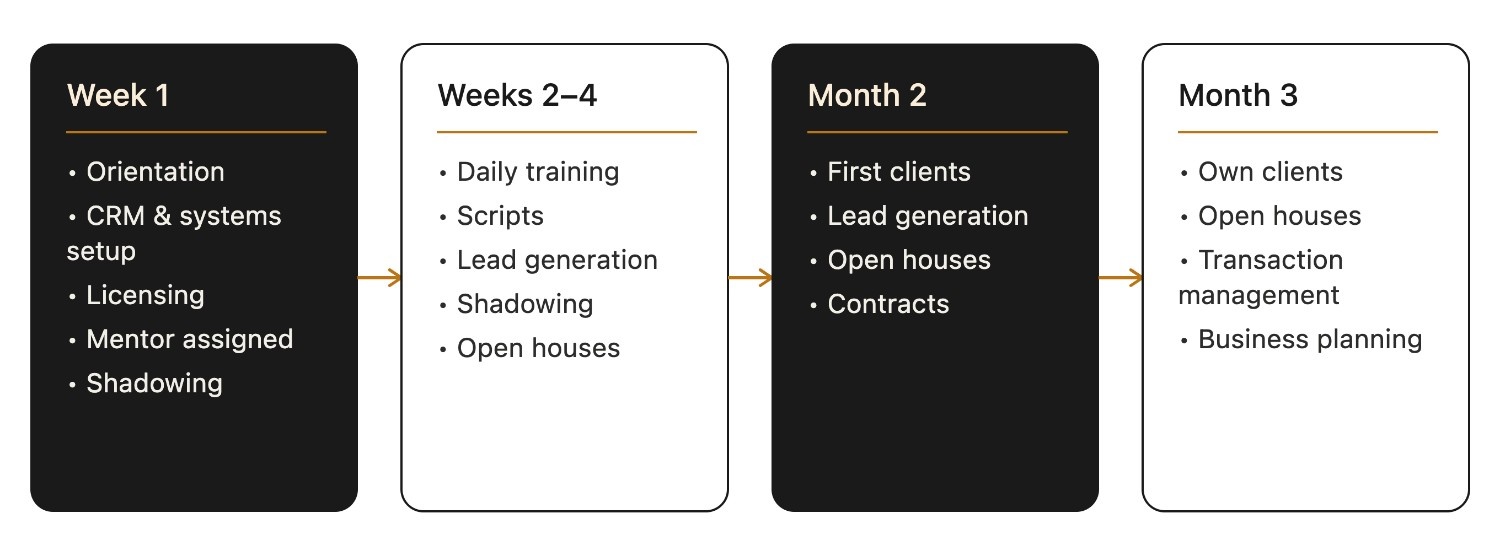
Ask every brokerage what onboarding looks like. Then listen carefully to how they answer. For an example of what a structured onboarding process can include, see what new agents can expect during their first 90 days at Premier Home Team.

A real training program has structure: defined timelines, specific curriculum, and someone accountable for your progress. "You'll shadow some of our top agents" is not a training program; it's hoping you figure things out by watching someone else.
In our experience, a strong first 90 days includes daily classes, a coach or mentor, and a clear plan starting with the people you already know: letting the important people in your life know you've started this journey, and learning the people skills before you get into the technical side.
Ask what coaching looks like past day 90, too. If something goes sideways on a transaction after 5pm, you're probably not reaching your broker, and that's worth knowing before you need help on a Friday evening.
Not every brokerage assigns a mentor automatically. Some just let you park your license and leave you to figure things out on your own. In our experience, the biggest separator between a brokerage that develops agents and one that hangs your license is the education and the resources they offer. The boutique shops without that structure tend to see the highest turnover, and it's rarely a coincidence.
What Commission Split Should I Look For?
The right compensation model depends on your production level, how much support you need, and what services the brokerage includes.
The short version: never evaluate a brokerage on the headline split alone.
Ask about monthly desk fees, transaction fees at closing, whether E&O insurance is included, and what technology fees actually cover. Some brokerages advertise 100% commission and recover the margin through higher monthly costs; others have a lower split but cover things that would otherwise come out of your pocket. Neither is automatically better, but you need the full picture before you sign.
Need help comparing commission splits?
Before you decide based on a 70/30 or 100% split, learn how commission splits, caps, desk fees, and team models affect what you actually take home.
→ Read our guide to comparing real estate commission splits and team models.
Ask about whether the brokerage has a commission cap too. Some brokerages offer significantly better rates once you hit a certain production threshold. If no one's brought it up, ask directly.
What Makes a Good Real Estate Brokerage Culture?
Culture is easy to perform during a 30-minute recruiting conversation. It depends on who's there, the average production level of the agents, and how willing people are to interact with one another. Some offices feel like libraries, others feel like social rooms. Neither is wrong. But you need to know which one you're walking into.
Ask the broker what they're most proud of about how the office functions day-to-day. Ask whether agents collaborate or compete. Pay attention to whether the answers are specific or vague, and if you can, ask to stop by on a regular morning and talk to agents without a recruiter in the room.
Lead Generation and Marketing: What's Provided vs. What's on You
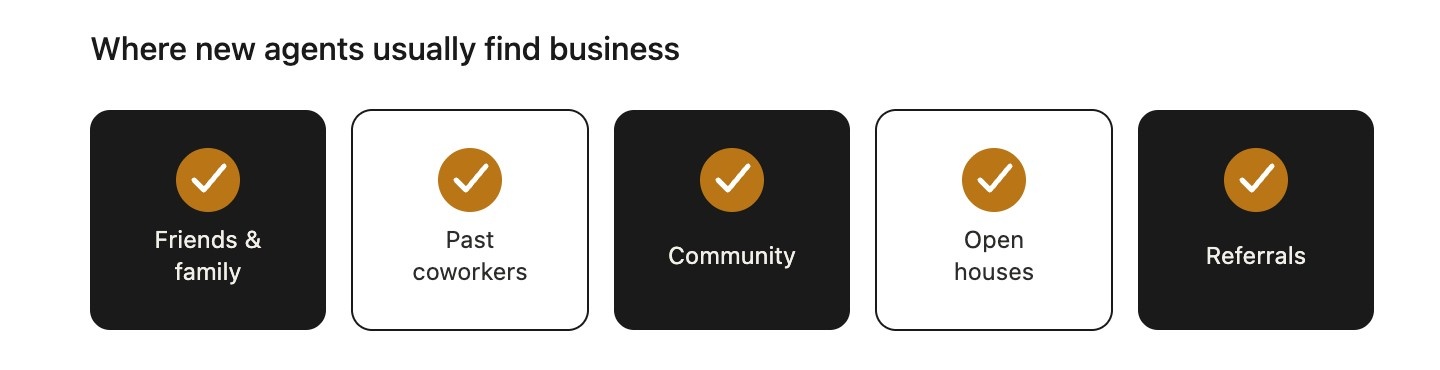
Ask every brokerage about leads, and push past the first answer. At most brokerages, lead support is limited to floor time and open houses on other agents' listings. Past that, there isn't much. As I tell new agents, BYON: Bring Your Own Network. That's the foundation most successful agents build on, regardless of where they hang their license.
Find out where leads actually come from, how they're distributed, and how many agents are competing for them. Also ask for a list of the technology platforms included in your monthly fees. A portion of what you pay typically goes toward technology, and what's included varies significantly from one brokerage to the next.
Common Brokerage Interview Red Flags
"100% commission" as a headline is worth a closer look. That margin is being recovered somewhere: through higher monthly fees, per-transaction charges, or both. Do the math before you assume it's a better deal.
Vague answers about fees or training are the other big one. If specific questions keep getting redirected to "we'll go over that once you join," they're disorganized or not being as transparent as they should be, and either way, you want to be able to trust the people you're working with.
The Bottom Line on Choosing a Brokerage
Choosing a brokerage is one of the most consequential decisions you'll make as a new agent. Most people rush it, and they feel that decision for months.
You now have the framework to walk in prepared: what to ask about training, fees, culture, and lead support, and what strong answers look like versus the evasive ones.
Your next move is simple. Before you take another brokerage call, download our Brokerage Interview Questions, and take them to your next interview. If the commission math is still fuzzy, read our full breakdown in Real Estate Commission Splits: Solo vs Team Models so you're not doing that calculator live in front of a recruiter.
We spend our time helping agents figure out where they actually fit, whether that's the right brokerage, the right team, or going independent, and that starts with asking better questions than most people expect to get. Whether that ends up being with us or somewhere else, we'd rather see you choose a brokerage for the right reasons than spend your first year realizing you chose the wrong one.
Download our Brokerage Interview Questions Toolkit Here
Frequently Asked Questions
What are the most important questions to ask a real estate brokerage before joining?
Ask about the structure of their training program, the full fee picture beyond the headline split, how leads are distributed, and what mid-deal support looks like. Ask to speak with current agents, not just leadership, and ask about the cap.
How do I know if a brokerage is a good fit for me as a new agent?
Look for concrete answers about how they support new agents: a real training structure, accessible mentorship, collaborative culture, and transparent compensation. If they're focused on recruiting you rather than developing you, keep looking.
What is the difference between joining a real estate team vs. a brokerage?
A brokerage provides your license affiliation, compliance, and general support. A team operates within a brokerage and offers more hands-on mentorship, shared leads, and daily structure, often in exchange for a higher split. The biggest difference is the group accountability. On a team, there's a shared operating standard. As a solo agent, motivation and discipline are entirely on you.
Should new agents prioritize commission split or training and support?
Training and support should come first. A higher split means very little if you don't have the foundation to close deals consistently. Build the skills and habits first, and negotiate compensation as your production grows.
What red flags should I watch for when interviewing a real estate brokerage?
Watch for "100% commission" claims without full fee transparency, no clearly defined onboarding program, and evasive answers about fees. These signal a brokerage focused on headcount, not agent development.
Robin Martin
Realtor® | Premier Home Team | Keller Williams Empower | PLACE
or another way